by Ronan Garvey
Section 1: Les Houches (1050m) to Mont Lachat (2500m) | 23:15 -01:00
It’s 11pm on a warm August night in the Chamonix Valley. Saint Jean Baptiste stares out at me from his church. The influence of a West of Ireland childhood never too far away as I say a short prayer. I’ve kept this climb a secret, telling only a small group of friends about my intentions. The risk of solo climbing is obvious – but is this greater than the risk of neglecting your ambition?
I know I have trained my body well, but mental fortitude is ephemeral. I’ve been watching and studying this mountain for weeks now. And the closer I get to its base the more intimidated I feel by its presence. The storms, the darkness, the crevasses. I’ve played out the script of this climb many times in my mind. Will the protagonist succeed, or will he succumb?
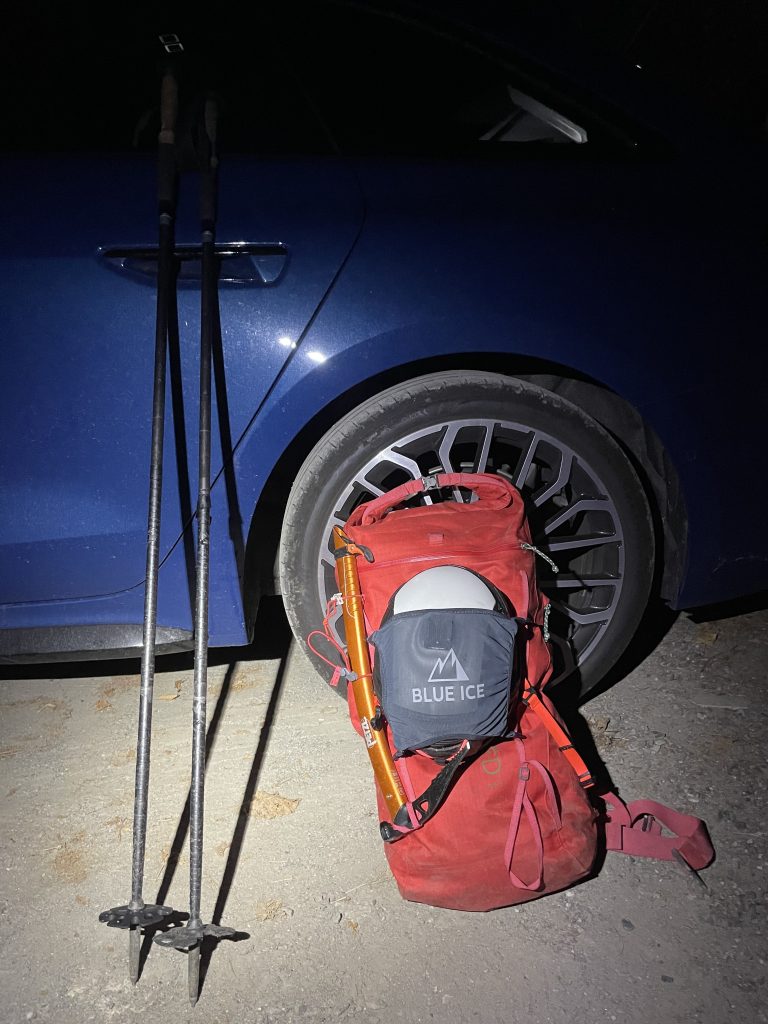
My bright red bag sits rigid on my shoulders – all 9.4kg of it. I’ve saved up and purchased new gear to give myself a fighting chance, but I still remark at the total weight. Small things help; I will wear trail shoes to the Tête Rousse Hut and then switch to B2 boots; this will reduce fatigue later in the climb. My hip-belt is broken but rigged with a tension knot on a carabiner, aside from this all my gear is dialled. I’m carrying exactly 2100 calories and 2000ml of water. No room for miscalculation on these margins.
I travel through the forest overlooking Torrent de la Griaz. I’m moving well and quickly catch a few bobbing headlamps ahead. In a way the newfound company is reassuring but in other ways I’m unsettled. I briefly join forces with a Slovak and a Spainard, but conversation doesn’t materialise. I notice my pace quicken as we ascend further through the forest and here, I realise the danger of my own ego. I want to beat these men to the summit, but then I catch myself. This is not a race, and these are not competitors. This is a personal challenge, so I separate with these kindred souls soon after we reach Cabane des Arandellys. Now, I’m thrust back into the solitude and darkness toward Mont Lachat.
Section 2: Mont Lachat (2023m) to Tête Rousse Hut (3167m) | 01:00 – 3:30
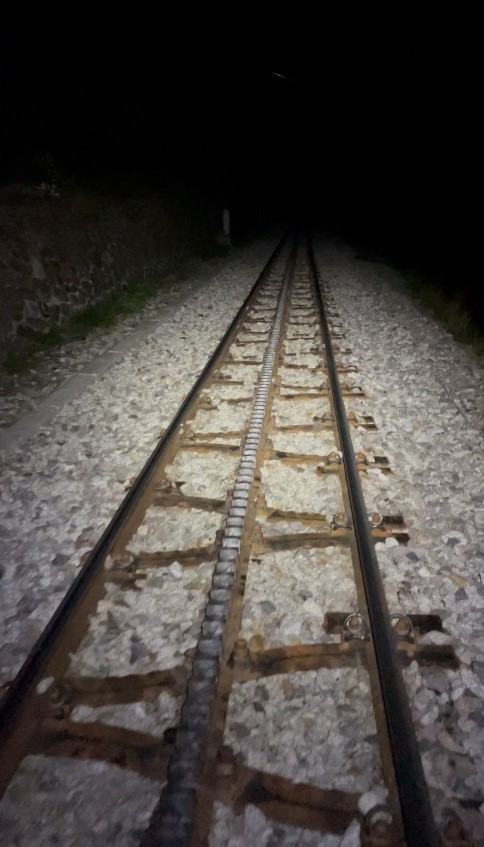
Yellow reflective barriers now appear, and I am directed onto a cliff edge with a railing. I clamber up a steel ladder and am thrust into brand new kind of terrain: the building site of the Nig d’Aigle Station. Signage, red tape and hi-vis jackets are designed to promote caution. And it is hard to process the artificiality of this scene – it is also hard to ignore its symbolism: there are no safety barriers in the alpine. It is a hostile place, and death is a real possibility. I rest for a few minutes and continue my journey.
I can’t appreciate the round stone desert given the darkness. At night it mimics a lunar landscape, populated by brightly coloured spacemen carrying sophisticated equipment to maintain life. The moon is an almighty size tonight and the Milky Way prominent against the inky galaxy. The red round stone desert could well be Mars – I reach for a Snickers bar in my back pocket and centre myself on the task in front of me.
It is dark and still as I approach the Tête Rousse hut. I find water running off the glacier, collect some and iodine it. Not the best but it’ll do. It’s getting chilly and I spot the remnants of the Tête Rousse glacier – my boots come on and I fish out my crampons. I spot groups of lights high on the cliffs above, and I return to the mission. The moon is now hidden by the North face of the Goûter and my headtorch tries to penetrate the darkness. I follow a line of boot prints across the glacier as it steepens. Soon I’m at the edge of the Grand Colouir, It’s 4am and I’m on time. I listen for rockfall for 5 minutes. Nothing. I assume everything’s frozen in. I walk carefully across the narrow traverse. The nighttime hides the extreme exposure.
Scrambling up the Goûter face at night is psychedelic. There is total silence. My human experience is distilled to the limits of my headtorch beam. I only worry about what I can see. I spot intermittent yellow and red paint marks on the cliffs which reassure me of my chosen course. I settle into a flow state somewhere near 3300m. My life now has only two rules: three points of contact on the rock and constant vertical motion. My breathing moves in rhythm with my body. My bag grows lighter on my back, and the 800 metres of vertical relief passes rapidly. I lose sense of time. As I entered the upper sections of the scramble my fear begins to return – I feel safe here clinging to the cliff face.
The sun starts to threaten the stars; I finish up this experience on a metal platform at the old Goûter Hut and speak to an Italian climber who was coming down from the Brouillard route. He told me that snow conditions were excellent up there. I climb onto the Auguille de Gouter snow ridge. It’s 6am. Cloudless. 1000 metres left.
Section 4 Aiguille de Goûter (3,863 m) to Vallot Hut (4,362m)| 06:00 – 08:00
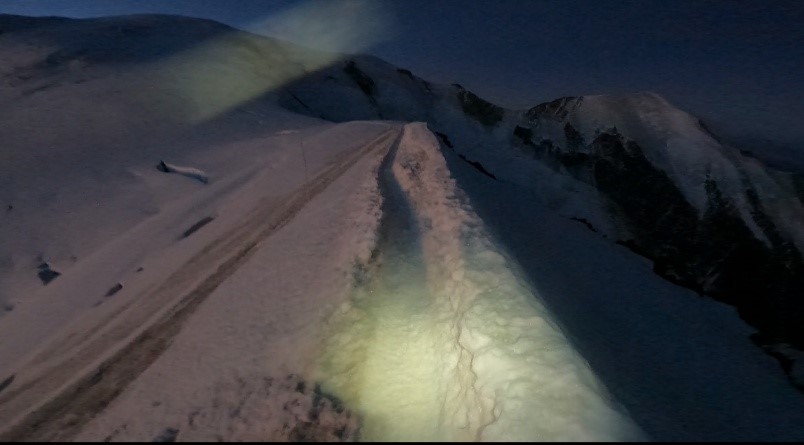
I’m now entering the section of Goûter route with the highest objective danger: the Dôme du Goûter Glacier crossing. Crossing a wet glacier by yourself is always risky. Snow bridges become less structurally sound as the sun hits, so I timed my entry point to this section for the coldest part of the night (4-6am). The freezing level was at 4000m, just low enough. I swallow my fear and move onto the ice mass.
A wide, flat and desolate glacier field opens ahead of me. I make out faint tracks zigging and zagging around several crevasses. I creep upwards along the path. Passing 4200 metres of elevation now, and the altitude bites back. I see three lights high near the Dôme, and I motivate myself to chase them down. After 20 minutes, the lights disappear, and I’m thrust back into isolation. I am moving alone on this glacier for over an hour. Abject terror arises each time I pass a crevasse, to which I give a wide berth. It feels surreal, the moon, the stars, the mountain and me.
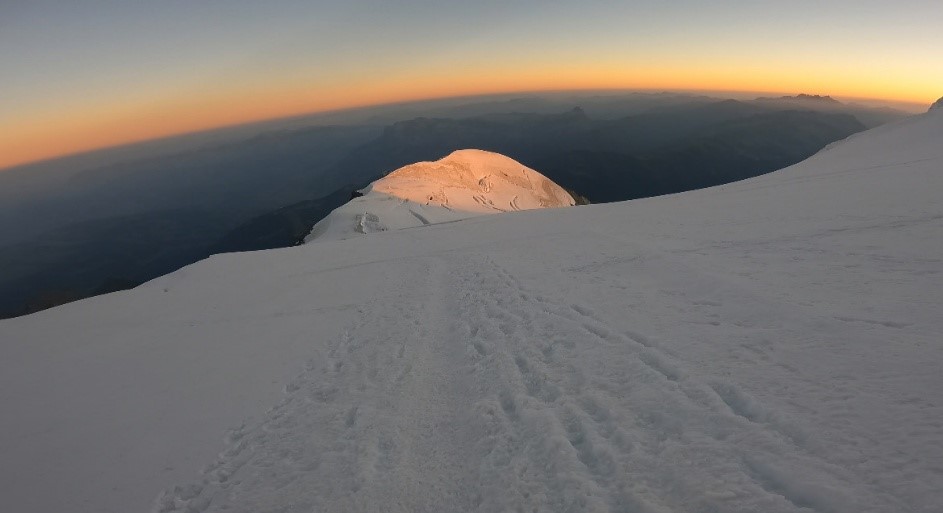
I amble cautiously upward towards the Dome du Goûter. The sun is shining on the Refuge du Goûter as I look back. I think of it as an alien spaceship in an alien place. The refuge seems right at home. As I ascend over the Dome du Goûter, the sun greets me for the first time. I’ve been pushing hard now for almost 8 hours, ascending 3600 metres over 13.5km. The average gradient has been 25%. I’m down to my last litre of water and I’ve been awake for over 24 hours. It’s a serious situation by all accounts. I can feel fatigue cloud my brain, luring it into rest. I try to keep my focus because the most difficult section is yet to come.
The Bosses Ridge splits the blue sky in front of me as I arrive at the Vallot Hut. The Glacier du Bionnannasy falls away on my right, and the Grand Mullets falls away to my left. I spot Aiguille du Midi for the first time far to the North-east. I spent yesterday acclimating at the Midi, which was the extent of my acclimatisation plan. It’s quaint museum, café and exhibits feel so foreign now, as I look out across the Massif.
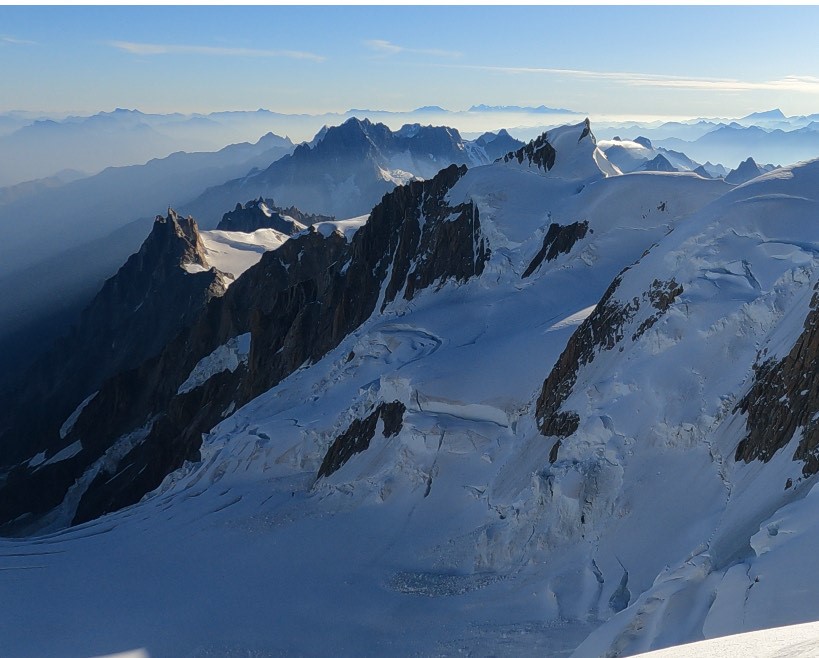
I take a breather at the Vallot Hut and cache some gear. Poles, Shoes, Hardshell – they won’t come any further. The weight loss buffers the fatigue, and I start to feel agile. 400 vertical metres left to climb, I think this might go, but I hold back any aspirations of summiting.
Section 5: Vallot Hut (4,362m) to the Mont Blanc Summit (4807m) | 08:00 – 09.15
My ice axe and crampons plant me to the warming snow of the Bosses Ridge. Precision is required; the adrenaline blocks the fatigue as I settle back into my climbing rhythm. The air is noticeably thinner over 4400m, and my lungs strain to get their feed. Grande Bosse (4513m) up first, but my heart sinks as I spot a group of eight climbers in front of me. I realise now that the biggest danger is being knocked off by others. When I reach the tail end of this group of Italians, I make a mad dash of about 70 metres up to their right. This puts an almighty strain on my chest, but I am in the clear. It takes me over five minutes to fully catch my breath. I hope this episode doesn’t repeat itself higher on the narrow ridge.
This effort was more than worthwhile but knocks it out of me, and I need to overcome the lassitude as I ascend the Petite Bosse (4537m). I know my window of opportunity is short for this reason. The ridge is stunningly beautiful, and the exposure is immense, but it is difficult to feel any emotion now. My entire focus is on my next step. I barely dare to glance up.
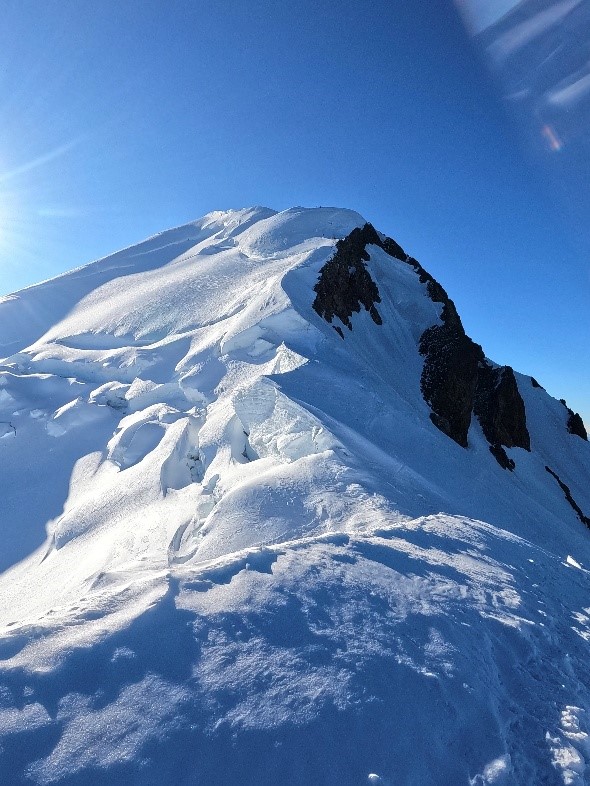
Now I drop down from the Petite Bosses ridge into a wider saddle. I see my next obstacle: a 50-degree ice/snow slope which rejoins the main ridge. The route follows the left-hand edge of an enormous serac. Below this serac to the right, the Bionnassay Glacier rests at 2600 metres. Between them is thin air. You can see this in the centre of the picture, to the left of the base of the highest rock band. I stop momentarily to assess the difficulties, and to catch my breath.
“No despair, no happiness, no anxiety. I have not lost the mastery of my feelings; there are actually no more feelings. I consist only of will” – Reinhold Messner
Like a stray dog in search of his next meal I power on. I will myself onto the edge of the serac. My joints move robotically, drugged by my own aspirations and the lack of oxygen at 4650 metres.
I tip-toe gingerly up the icy slope as my crampons impale the crust. I make 50 paces before resting on my axe. 50 more. Rest. And so on. Until I am standing atop of the serac on a narrow ridge. I shuffle forward at my familiar place, mostly numb to the exposure now. 50 more paces and I enter onto a much wider slope. The summit seems closer now, but I can’t be sure. I glance up anxiously now as I move, hoping for respite or reprieve. Nothing comes as I grit my teeth. My breathing narrows and my lungs constrict. This situation has generated a new state of being, nestled between masochism and meditation.
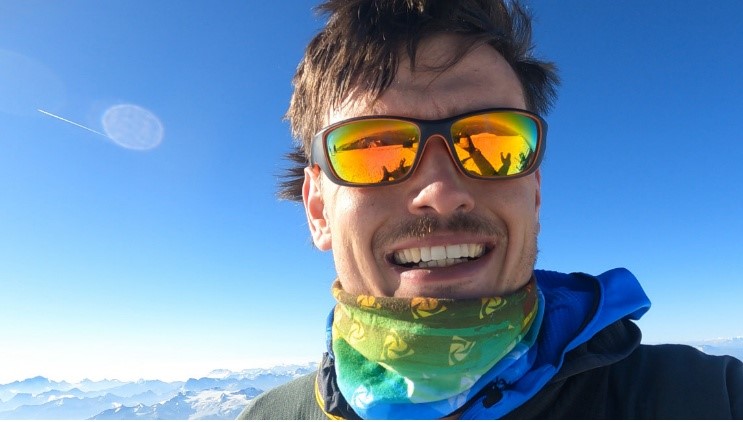
My mind is totally empty. For many months I lived with the self-inflicted burden of attempting this climb. Doubt, fear and anxiety are first cousins of aspiration. To not aspire, is to not live. The risk is always failure, which can manifest itself in many ways. But today I won’t fail. I now stand 50 metres below the summit cap. I slowly realise that I will satisfy my ambition; I will self-actualise. I move slowly up the final stage of the summit ridge, soaking in every step.
The view from the summit at 4807 metres is impossible. It extends for hundreds of miles in every direction. There is no wind. The sun glints off my ice axe as it catches the morning rays. My lungs burn and strain in the oxygen depleted air. I have arrived at my destination.
It is 9.15am on the morning of Monday 19th August 2025. In ten hours, I have climbed 4000 metres over 16km, alone. I started in Les Houches on the valley floor at 11.15pm last night and now I stand on the summit of Mont Blanc, the highest mountain in Western Europe. I take a seat on the summit cap and fall on my back. I feel free as I stare at the blue sky above me. All I can bring myself to do is sit down at this very spot and smile. The dragon smiles back, he knows I caught him this time.