Skip to content
Irish Mountaineering Club IMC, Cumann Sléibhteoireachta na hÉireann
  • Facebook
  • Instagram
Join Now
Book the Hut
Members Login
  • About
    • Introduction
    • Contact Us
    • Documents
      • Constitution
      • Privacy Policy
    • Expeditions
    • Kindred Clubs, Handy Hostels
    • Library
    • People
  • Join
    • Introduction
    • New Membership
  • Blog
    • Article
    • Obituary
    • Review
    • Route Info
    • Training
    • Trip Report: International
    • Trip Report: Ireland
    • Other: Bottom of Home Page
  • Events
    • Introduction
    • Calendar
  • Hut
  • Publications
    • Introduction
    • Books
    • Newsletters
      • 2010-now
      • 2000-2009
      • 1990-1999
      • 1980-1989
      • 1970-1979
      • 1960-1969
      • 1950-1959
    • IMC Archive
    • Videos
  • Training
    • Overview
    • Introduction to Trad climbing Programme
Irish Mountaineering Club IMC, Cumann Sléibhteoireachta na hÉireann
  • Log In
  • Join the IMC
  • About
    • Introduction
    • Kindred Clubs, Handy Hostels
    • Library
  • Blog
    • Article
    • Obituary
    • Review
    • Training
    • Important Information
  • Events
    • Introduction
    • Calendar
  • Hut
  • Publications
    • Books
    • Newsletters
      • Newsletters 2010-2018
      • Newsletters 2000-2009
      • Newsletters 1990-1999
      • Newsletters 1980-1989
      • Newsletters 1970-1979
      • Newsletters 1960-1969
      • Newsletters 1950-1959
    • IMC Archive
    • Videos
  • Training
    • Overview
    • Introduction to Trad Climbing Programme 2026
Join Now
Book the Hut
Log in
  • Steep and Meaningful at El Chorro

    Steep and Meaningful at El Chorro

    Spanish radio is great. I don’t understand a word but when the news comes on, it always sounds like they are announcing a revolution in some distant land. It lets me imagine great people performing heroic acts. How would I fair in such a thing? The reality is, maybe not so well.

    As a climber, it’s easy to fancy yourself as a rebellious, independent and adventurous soul capable of handling many diverse situations. Truthfully though climbers are good at one thing, going up steep bits. Aside from being a skill that became superfluous with the invention of the step ladder and absurd after the arrival of pulley systems, in general we are not even that good at it. Think of the most difficult climb you ever climbed, now think how easy it would have been if you had let yourself drill a few holes and pull on a few bolts. No, as climbers we pride ourselves on upward progress by the most awkward manner we can accomplish, with ropes to protect us if we fall and as much lightweight gear as we can carry strapped to our waist. Not very useful in the midst of a revolution. No the heroes of the revolution are the heroes of now, firemen, nurses, paramedics. People who, when the revolution comes will be doing the exact same thing they are doing today (though presumably they will be a mite busier). The climbers will be, well, probably climbing, far too self obsessed with their latest project to notice. They will be busily trying to scale an insignificant piece of rock in a manner consistent with the local ethics. Ethics are another peculiar thing, the apparent freedom of climbing comes with many, many rules as to what makes an acceptable ascent. All of which make climbing that piece of rock more difficult than it need be.

    David climbing corner
    The author clipping every bolt on a perfect corner crack at El Torcal.

    A recent trip to El Chorro (you can envision a revolution happening in El Chorro “La gran historia está en el chorro” or the less enigmatic “the big story is at the spurt”) had me contemplating such things. Mostly how little the Spanish worry about these self-imposed rules. Climbing in El Chorro, like most of Spain, is almost all bolted. Clip sticks and pulling on draws abound. Climbers redpoint or top rope to their hearts content, with no fear of judgement or self-loathing at having missed an on-sight attempt. Now don’t get me wrong, this isn’t a plot to start bolting our own precious crags. I started as a trad climber and have no desire to stray fromthat righteous path. However, the down side of that is, my Irish-catholic upbringing provides a strong sense of shame while sitting on bolts at sunny crags. The Spanish-catholic seems to be much less encumbered, climbing-wise at least. El Chorro epitomises this.

    The climbing is centred around an impressively steep and narrow gorge, which is the highlight of a small national park. In the early part of the 20th century, a walkway called the Caminito del Rey was built. It is high above the gorge and allowed workers access for the construction of a hydroelectric plant in the area. The walkway fell into disrepair and after several deaths at the turn of the 21st century was renovated (it’s worth noting that nobody died during its construction). At least it was called a renovation, but actually they built a completely new walkway on top of the old one. The Caminito provided a boom for tourism in the area with punters flocking to pay the 10 euro it costs to walk along it. So much so that you have to book months in advance if you are planning on going. It has not been so bounteous for climbers. Before the renovation climbers used the old dilapidated walkway to access the gorge and many lines were established. Now, climbing is strictly banned in the gorge due to the amount of traffic the Caminito gets. However, intent on ignoring that ludicrous decree, some ardent enthusiast has built a Tyrolean traverse to span the bottom of the gorge. A via feratta can then be followed to access the Africa area and the classic climb of the same name. You climb up close to the Caminito and if you time things well (the Caminito closes at 5) you can stroll out along the the kings little footpath and hop over the locked gate at the end. Needless to say, this is against the park rules.

    Another highlight of the park is the Escalera Árabe or Arabian Steps, an historic attraction built circa 1500, presumable by some Arabs. These provide a nice hike for those of a mind and also a significant climbing area. There are no problems climbing here, but you are supposed to walk in from the main road below along the forestry road (20-30 mins depending on where you want to climb). It being Spain and the forestry road being a road, this is largely ignored making the Escalera Árabe a roadside crag.

    There is a seemingly endless supply of quality climbing at El Chorro with probably the best being accessed through the train tunnels that run alongside the gorge. Of course walking through the tunnels is forbidden and comes with a hefty fine if you are caught. However, (you may begin to observe a trend here) on our visit we didn’t come across anyone who had actually been fined or knew of anyone who had been. This really epitomizes the Spanish way, they have as many rules as the rest of us, but to their credit, are much better at ignoring them.

    Via Ferrata
    Sile Daly grappling with the fixed ropes on the approach to Africa in the gorge.

    This lackadaisical relationship with the rules makes you wonder if this is why bolting is so prevalent in the region. No doubt when bolts first started to appear, traditionalists besmirched them as they do in this part of the world. But that would not have stopped anyone. “Spanish crags are suited to bolting” I hear you cry, and yes that’s true, particularly at the higher grades. That said, it is not difficult to find lines that would go on trad gear. It is harder to find people (myself included) willing to ignore the bolts running along side them. Yes, the Spanish bolt a lot of their climbing, but simultaneously they are not worried about leaving them out at times. This is particularly true on longer routes. On multi-pitch climbs it’s not unusual to find yourself run out, wishing you had brought a few wires, or your entire rack! Spanish climbers have their own rules and dutifully ignore them when inconvenient.

    One of El Chorro’s most famous climbs, Zeppelin, is a prime example of this. Síle and myself had it at the top of our list of things to do on a recent trip to El Chorro. However, our guide book and the internet only provided dismay, as the approach was through the railway tunnels and strictly forbidden. The German proprietor of the local climbing shop was genuinely aghast at the thoughts of anyone contemplating such a trip. But salvation was at hand, as speaking to local Spanish climbers, any concerns were dispelled by their nonchalant attitude and a wave of their unbothered hand. I suspect it may be a translation problem, where “estrictamente prohibido” should actually be “just don’t get caught, nudge, nudge, wink, wink”.

    The locals gave information on the best way to enter the tunnels, what to do if a train comes rattling past, and where to climb down to the start of the route. All very normal to the Spanish and very liberating for myself as we made our way to the base of the climb one morning. By the time we reached it so many rules had been cast aside I felt every bit the revolutionary I had imagined. This fever reached such a degree, that even my staunch traditionalist morals were momentarily cast aside.

    The crux pitch passes through a massive roof where I couldn’t quite reach the finishing holds. A couple of good efforts were made but as it is a long route, I claimed expediency was more important than virtue (Síle may claim I said “F#*k this for a game of soldiers”). Then, putting my Irish-catholic-traditionalist conscience aside, I stepped up in a sling. A more virtuous version of myself would have missed out on the splendid pitches above one of which was on trad gear (the existence of which probably has more to do with the price of bolts than any Spanish climbing scruples).

    The result of breaking all these rules, those climbers impose on themselves and those of the Spanish rail system, was one of the best days climbing I ever had. Don’t get me wrong, rules are important, they make you feel iconoclastic when you ignore them. Sadly however, this is only true if you are well used to following them.

    David belay zeppelin
    The author happy to be have made it (by any means) to the belay above the impressive roof on Zeppelin.
  • First Impressions of Costa Blanca

    First Impressions of Costa Blanca

    First Impressions of Costa Blanca – Sun, Sea & Climbing

    Costa Blanca – Sun, Sea & Climbing

    Having joined the IMC trip to Nice last November, we were keen for some more continental sports climbing in the sun but unable to make the dates of Ian’s trip to Costa Blanca.  Undaunted, within a couple of weeks of returning from Nice, we had booked passage to Alicante flying out the Thursday before Easter and returning the following Friday.

    Being our first visit to the area, we decided to stay at The Orange House in Finestrat.  It is well located, pretty much 30 minutes drive to crags in all directions, and whilst situated in a nice, quiet country area, it is only 5 minutes away from a large retail park with Lidl, Carrefour & more.  As well as that all your fellow guests are climbers, so at breakfast, sitting in the sun by the pool, you can chat away and get their insight into crags & climbs.

    If you’re going to Costa Blanca, you’ll need a hire car to get around.  We used Lara Cars and have no complaints, we were met off the flight and taken straight to the car a few minutes away in the short term car park, 5 minutes for paper work & payment and we were on the road.  Navigating Spanish roads is easy enough, I had a freebie satnav (Navmii) on the phone which we used together with a bit of cop on which got us where we wanted no problem.

    I’d got the Rockfax book well in advance and figured out where I wanted to go, which areas would give us best value for our abilities (at the moment I climb VS tops, which according to Rockfax is equivalent to grade 4/4+, but in reality we found grade 5/5+ to be more equivalent to VS and I even dipped my toe in a couple of 6a’s).

    Good Friday – Sierra de Toix – Far Oeste

    For our first day we opted for simple, easy access single pitch routes of which there are plenty at Sierra de Toix (pronounced Toysh), especially at the Far Oeste crag.  The first few we got to were occupied by families top roping their kids but further along, from Gracias Uwa 4+ onwards were some nice little climbs with stings in their tails, the best being Grand Grill* 5+.

    Sierra de Toix – Far Oeste – Ausgeschissn(4+)

    Encouraged by this we went back to the now emptier main section to do some easy multi-pitch revision, the 2 pitch Bernd* 4.

    Saturday – Sierra de Toix – Este (Left)

    Back to Toix for some multi-pitching.  An educational visit. The Este(Left) crag is more remote & exposed, in comparison to yesterday, we were the only ones there. On impulse I opt for 4 pitch Espolón Arta 4 to get a feel for things.

    Sierra de Toix – Este (left) – Espolon Arta (4) [Pitch 1]

    We haven’t done much multi-pitching, so I fancied something easy that would get us into the rhythm and see how fast & efficiently we moved.  I took the first & third pitches which (not entirely by chance) were the best.  After the first pitches these climbs tend to become a bit scrappy and there are a profusion of bolts leading to a little route confusion.  Due to the more slabby nature of these upper pitches, in places mud & gravel had been washed over the rock which made for an awkward traverse at one point.  We got to the top by a line that was probably right allowing for foreshortening in the topo photo.

    Sierra de Toix – Este (left) – Espolon Arta (4) [Pitch 3]

    There was then a bit of discussion about the way down.  Supposedly a straight line abseil down the line of Horst would bring us to within a few metres of where we started, but from the ab point I felt we were too far over – and the line of Horst was not obvious at all; we could easily end up bashing through thorn bushes and not being able to locate subsequent ab chains.  We ended up abseiling down the line we had climbed.  In retrospect, it would have been better to climb Horst first so that we then knew where it was and where the chains were.

    Back at the bottom we met a friendly self-belaying German who told us he only climbed the first pitches in this crag as it was so scrappy above. So we did the first pitch of Horst* 4+ (a dropped belay presenting a first chance to use an Italian hitch in anger) followed by Spatz* 5, the latter notable for it’s razor sharp holds and for snagging our rope after ab’ing off.

    Easter Sunday – Olta – Sierra de Toix – Placa

    On Sunday we decided to head to Olta which takes a winding road up to a forestry car park & campsite.  Unfortunately, many of the locals had obviously forgone a morning of munching chocolate eggs and got there before us.  The car park was jammed and the road approaching it nearing gridlock.  Having lost time we decided to head back to Sierra de Toix, as it was the nearest crag, and try a different area.

    We wanted more multi-pitching, the popular routes on Oeste were taken but the Placa area was empty. We started on the 3 pitch Lara** 4+ although pretty much ran pitch 1 & 2 together.

    Sierra de Toix – Toix Placa – Lara (4+)

    I took pitch 3 which was quite exposed and slabby with well spaced bolts leading to some focused contemplation at times.  The chain was taken by a party who had started up Ana after us but we had a good chat at the top and enjoyed the view.  At least with 60m half ropes we could (just) get back down to the bags in one go.  After that we went for the 2 pitch Anto* 5, again I took the final pitch which is where the fun was to be had, a great climb.

    Sierra de Toix – Toix Placa – Abseiling off Anto (5)

     Easter Monday – Guadalest – Esther’s Chimney

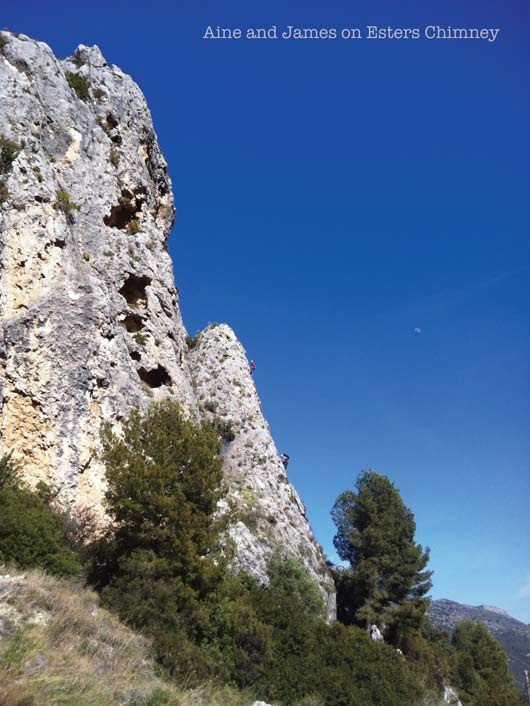
    Guadalest was fairly busy, as you’d expect for an Easter Monday, but the parking for the crag is out of town, down a fairly narrow windy road (I’m glad we had a small hire car).  We wanted to do Esther’s Chimney*** S(4a) having heard about other IMC members visits there.  It’s not a hard climb but has definite novelty value.  It’s not in the Rockfax book but starts around the corner from the Penya Maura area, a topo PDF can be downloaded from the Compass West website.

    Guadalest – Esther’s Chimney S(4a) [Pitch 1]

    The first pitch is now bolted and is a nice climb in itself with a good chain at the top.

    Guadalest – Esther’s Chimney S(4a) [Pitch 2]

    The second pitch is merely a via ferrata style traverse to the foot of the chimney.  The third pitch is where the fun begins, heading up 20m of vertical passageway in the rock.  There’s no bolting here and not much protection but it’s safe enough and has an ab ring at the top.  It’s one of those climbs that’s so enjoyable you find yourself laughing as you make you way up it.

    Guadalest – Esther’s Chimney S(4a) [Pitch 3 – halfway]
    Guadalest – Esther’s Chimney S(4a) [Pitch 3 – stance]

    The fourth pitch is interesting, seemingly committing at first as you step out of a window in the passageway onto the main face again, now some distance above the road.  There is a single bolt to confirm you are headed in the right direction but after that nothing, so you will need a bit of gear to get you to the chain up above.

    From the chain I’m pretty sure you could ab straight down and find the chains at the top of Makarrereta & Inevitable, but not 100% sure.  With two 60m ropes you might even make it down in one, but the chances of the ropes getting snagged on rocks or thorn bushes thereafter are high.  I’d asked Ian before and he said he’d always ab’ed back down the climb, so we went back the way we came.  Tricky swinging back into the window at the top of the chimney but at least you get to go through it again.

    After that we fancied a go at Amber Lights** S(4b) to the right of Esther’s Chimney.   Dorota lead off, taking the line of The Haze 4 to start, again a great climb on it’s own.  But the weather changed, it had clouded over and a cold wind had come up (for those stood around in shorts & T-shirt) so we called it a day and headed for tourism & ice cream in Guadalest town.

    Guadalest – View over castle and Penya l’Alcala (Esther’s Chimney)

    Tuesday – Day Off

    On Tuesday we took a break from climbing and did a spot of tourism including a brief (but not brief enough) visit to Benidorm and further on to the more amenable Altea.

    Wednesday – Echo Valley – Echo 1.5

    Echo Valley is a phenomenal outcrop of crags.  The potential of this area has only been scratched (and in places, subsequently polished).  Echo 1.5 is a popular roadside crag and the lower section was nearly full when we arrived.  The upper section was empty and looked more interesting anyway, so we went up there.  I did Synovial* 5 which certainly got me warmed up, a great climb with, again, some brutally sharp edges for holds.  We took it easy doing the rest of the lower grade climbs and when the party from the lower crag came up, we went down.

    Echo Valley – Echo 1.5(Upper) – Sesamoid (4+)

    I did Phantom* 5+ which has all the work at the start and then took a go at XMAS* 6a which was fine until it became polished slab, so I crossed over onto the upper half of Regalo por Ali** 5 which was much more work than the 5+ I had just done.  A balancy rock over finish with screaming finger tips tensed into the merest of limestone dimples.  It was good but it was time to call it a day.

    I’d wanted to have a look at the El Castellet/Wasp area in Echo valley but it was definitely time for an ice cream. And you have to save something for next time.

    Thursday – Guadalest – Penya l’Alcalà (Right)

    Our final day of climbing and back to Guadalest for single pitches.  Penya l’Alcalà (Right) is a good area on a sunny day as the trees come right up to the crag (hence the confusing topo image in Rockfax).  There’s a series of climbs here that consist of polished bouldering problem starts with easy finishes.  We did a few of these and then dropped further down to Aprendieno a Escalar 4+ an interesting little route up a rib and then stepping across a large chockstone to the main face.

    Guadalest – Penya Maura – Aprendiendo a Escalar (4+)

    Later, sat down at the foot of this eating lunch, a red squirrel appeared, looked up the line and followed the same route we’d just done.  Free solo.  Fumbling with the camera I managed to take a picture of its tail as it leapt onto the chockstone.

    Guadalest – Penya Maura – Aprendiendo a Escalar (Soloing squirrel)

    After lunch we decided to head back to Amber Lights** S(4b) and give it a go.  I started off, again up the line of The Haze 4 traversing left at the end to reach a good chain.  The next pitch looked a bit more challenging closer up, so I got lead again.  It started fine with ample shiny new bolts but then required a bridge into a groove of freshly exposed rock.  It was still a bit loose here and the only hold a wobbling but seemingly sound piece of rock. I started across and up but my second obviously picked up on my uncertainty and revolted.  The bolts at this point had become sparse and as the rock was recently exposed it had a totally different character, much more blocky with far fewer cracks & crevices for fingers.  I decided to move off the line, out to the right and drop some gear in.  Ahead I could see an abseil ring but I was obviously off line and on looser material, favoured only by the birds.  I was barely 15m up the pitch but had reached one of those “it’s probably better to keep going up than down” moments.

    Guadalest – Amber Lights S(4b) (retreat)

    With bloody knuckles I mantled onto the ledge near the ab ring, looked for a fleeting moment at the continuation of the proper line – it looks like a great climb, but not today – I made myself safe and rigged an abseil with shaky fingers whilst my second sunbathed and casually took photos.

    Back down at the bags we decided it would be best to make sure the ice cream shop in Guadalest was still in business.


    NOTES

    Lara Cars (www.laracars.com/rentacar/) – Skoda Fabia 9 days €149 + €61 for a full tank of fuel (which lasted us just about perfectly)

    Navmii Free SatNav (http://navmii.com/#action) – quirky at times but you can download maps and so don’t have to be online to use it.  Also, it helps to predefine the crag parking locations as favourites so you can just hit the button and go.

    The Orange House (http://theorangehouse.co.uk/) – lots of useful info on their website, even if you don’t stay, and some additional topos for newly developed areas.

    The Book (http://www.rockfax.com/climbing-guides/books/costa-blanca-2013/)

    Compass West Topos (http://www.compasswest.co.uk/topos/) – you can find Esther’s Chimney & Amber Lights here:
    Guadalest Lower Amphitheatre

  • Standing on the roof of the Pyrenees on the longest day of the year

    Pico de Aneto – The Idea

    Standing on a crowded tram on a dark December morning, watching the rain beat against the window while watching the resigned faces of my fellow commuters shuffling with their wet umbrellas, I reflected on how most of our lives are taken up by an acceptance of routine and the mundane.

    Time can anaesthetize us to that routine until it seems normal. But then a moment of clarity flashes and the cloak is lifted to reveal the rapid passage of time and ones life.

    It was one such bleak winter morning that the thought of spending the summer in warmer climes began to germinate. The south of Spain is only a two-hour flight from Dublin and so that was going to be the base for my summer adventure.

    It’s a funny thing but familiarity often breeds contempt, and after a month trying to hike in southern Spain, I was missing the variety of the Irish weather.

    A cloud floating through the sky is needed to appreciate the clear blue sky yonder.

    So around the middle of June, I found myself in the valley of Benasque at the foot of the Aneto Maladeta in the Pyrenees.

    BenasqueThis area is a contrast from the south in that instead of a dry arid landscape, there is a rich variety of lush green flora.

    It has the intense greenness of Ireland, but with a warmer climate.

    Benasque is a four drive on the A2/A22 highway from Barcelona and is situated in the west of the Maladeta Massif. This area lies in the Posets-Maladeta nature reserve, which is an area of some 33,000 hectares.

    The Pico de Aneto peak is within the Aneto-Maladeta Massif. This massif contains the largest glaciers of the Pyrenees with around 230 ha of ice.

    Climbing the Pico de Aneto entails crossing two glaciers – the Glaciar de la Maladeta and the Glaciar de Aneto.

    The Summer Solstice, 2014 – A good time to climb of the Pico de Aneto

    It is now the morning of the eve of the Summer solstice and I am sitting at an outdoor eatery enjoying a café americano in the shadow of the Aneto.

    It seems like providence that I am alone at the base of the Aneto and tomorrow is the longest day of the year. Pondering my situation, I make the decision that I want to be standing on the top of the highest mountain in the Pyrenees tomorrow, even if that means soloing it.

    The little village of Benasque has many outdoor shops and in one of them I find a map and small multi-lingual guidebook to the Aneto Maladeta.

    Over another café americano, I study the map and read the one page description of the Aneto. The description is brief but adequate, but it mentions the need for a rope for cracks in the glacier and the final stretch to the summit, the Paso de Mahoma.

    The map shows the that nearest car park to the refugio is at La Besurta, which stands at a height of 1895 m, and is situated at geographical coordinates: N42.67884 E0.64982.

    Please note that geographical coordinates refer to lines of latitude and longitude.

    Now, before I continue, I would like to briefly mention the grid system used on the map.

    This map, like most modern maps in Spain use a grid system called UTM (Universal Transverse Mercator). This is similar to other map grid systems, like the National grid.

    For example, the car park at La Besurta, which is at geographical coordinates: N42.67884 E0.64982, would be represented in UTM as:

    31T 30744E 472782N (accurate to 10 m).

    The first number is the zone, which is then followed by an easting and northing reference.

    UTM coordinates are more useful when navigation with a map and compass, so I shall use them in my descriptions. At the end of this article, I provide a conversion table between the UTM and geographical coordinates that I have used.

    The guidebook mentioned a rope for prevention of fallen through cracks in the ice and the last exposed section. As I’m soloing, a rope will not be an option, so I do some further research and learn that the cracks in the glacier don’t become a problem until September.

    Armed with my map and guidebook, I leave the village of Benasque and drive northwest for about half an hour in the direction of the mountain hut, the Refugio de la Renclusa. I will spend the night there before my summit attempt tomorrow.

    It should be noted that access to the La Besurta car park closes for the summer. I was fortunate in that it wasn’t closing for another week.

    When the car park closes, it is necessary to park at another small car park just before the Hospital de Benasque and then hike for an extra hour.

    From La Besurta car park, it is about a 40-minute hike up the Refugio de la Renclusa, which stands at 2,127 meters. The geographical coordinates of the hut are: N42.67884 E0.64982.

    Refugio de la Renclusa

    The refugio was very clean, comfortable and quiet, with a well-equipped bar.

    That night there were about 30 people staying at the refugio, most with the intention of climbing the Aneto the following day.

    I got speaking to a French couple that had climbed it many times before. The man had climbed it all the way to the top, but his wife never reached the summit, choosing to stop 40 metres shorter, rather than cross the very exposed Paso de Mahoma. The man explained that it was easy to cross, but it was just psychological fear. I detected a slight annoyance from the man at his wife for not crossing it, but she remained adamant that she wouldn’t do it.

    I conversed with a few more people and the subject of the Paso de Mahoma came up again. At that point I resolved to get as far as the Paso de Mahoma and either cross it or turn back, but in any case not to think about it anymore.

    That night one could sense the heightened anticipation in the room, with people listening to the weather forecasts and looking out to the sky.

    The Summer Solstice, 2014 – A good time to climb of the Pico de Aneto

    It is now 4:45 am. I get up; quickly get dressed; and have a communal breakfast.

    The refugio serves breakfast from 5:00 am to 8:00 am.

    By 5:35 am, I am leaving the hut and embarking on my first ascent of the Pico de Aneto.

    This early start is necessary to avoid melting snow and thunderstorms later on the return journey.

    From the hut, you take a fairly obvious path leading in a southerly direction. The path is marked by red dots painted on boulders and small cairns.

    It is not yet dawn and so I need to use a head torch for the first half hour. My excitement at this exploration into the unknown builds, and my pace quickens. I try to manage my pace, so not to tire too soon. I have about eight to nine hours ahead of me.

    The first forty minutes is a traversal of rocks and boulders until I eventually reach the foot of the Glacier de la Maladeta (2,620 m, UTM E30712 N472563).

    Here, I stop and put on my crampons, but I feel secure enough with using the walking poles and leave the ice axe in my backpack.

    I march out into the glacier using the walking poles to steady myself. At this point I feel the ascent has started in earnest. I begin to feel like an explorer of olden times and a real mountaineer.

    There is something exhilarating about embarking on a adventure into the unknown on your own without the security of others for safety.

    Travelling south towards the Portillon Superior, the glacier gets steeper and it becomes necessary to zigzag a switchback course up the mountain to mitigate the steepness.

    I’m still on the first glacier, the Glacier de la Maladeta, but despite its steepness, I don’t feel that I need to have quick access to the ice axe.

    A few times, I consider removing my backpack to fetch the ice axe, but the ground felt a bit too steep to be making any awkward manoeuvres, and I was afraid that if I dropped something, it would roll down the slope and be lost forever.

    The route up is fairy straightforward – just continue south until you approach a rocky section at the ridge of the Pico de Maladeta (2844 m, N42.65475 E0.64415), which leads into the Portillon Superior.

    This is the crossover point to the second glacier, the Glacier de Aneto.

    It is amazing how many climbers miss this point and instead continue on into terrain that becomes much more precarious.

    At the rock section leading into the Portillon Superior, I remove my crampons, climb and then drop back down through the Portillon Superior, to the Glacier de Aneto (2860 m, UTM E30712 N472563).

    The second glacier – the Glacier de Aneto

    I am now on the second glacier, the Glacier de Aneto.

    This glacier, just north of the Aneto summit, is largest block of ice in the Pyrenees, but unfortunately is shrinking rapidly due to warming summer temperatures. In the last 100 years, it has lost more than half of its surface, and in another 40 years it may disappear completely.

    At this point it is necessary to put my crampons back on.

    From here, the Summit of the Pico de Aneto is visible far away in the distance and the glacier rises steeply. Some rocky sections interrupt these snow-white fields, but to save time I keep my crampons on.

    This glacier becomes much steeper as I progress, and so when I reach a relatively safe spot, I exchanged one of my walking poles for the ice axe in my backpack

    I continue walking holding the ice axe in my uphill hand and the walking pole in my downhill hand.

    At this altitude, the air is noticeably thinner, causing my heart to beat faster and my breathing to become quickly. I also find my energy levels feeling a bit depleted, everything just feels that little bit harder.

    I am beginning to feel a bit nervous about the steepness of the glacier at this point. I started noticing these strange whirling snow patterns running down the slope and over a ledge far below. At first these sights puzzled me, but then I discovered that as the walking poles displaced small fragments of snow, the snow ran down the slope, amassing more snow into a snowball. It was quite fascinating to watch, but also quite sobering to realize how even a small object can pick up speed so quickly.

    Eventually, the gradient of the glacier eases off as I come on to the Collado de Coronas (3284 m, N42.63330 E0.65516).

    I am glad that I have reached this point and now I can chill out some. I am still a bit concerned of the return trip – they say most accidents happen when you’re coming down.

    Paso de MahomaAfter about five hours of climbing, I now reach the last obstacle, where the snow ends and the Paso de Mahoma (3361 m, N42.63185 E0.65639) begins.
    The Paso de Mahoma is a narrow crest with very exposed drops at either side, but is an easy scramble. The name translates into English as the “Bridge of Mohammed”, because according to a Muslim legend the entrance to Paradise is as narrow as the blade of a scimitar on which only the righteous pass. I guess I can call myself one of the righteous if I make it across this scimitar.

    Many people fail to cross the Paso de Mahoma because they fear this exposure.

    Even though it was very cold at the top, I decided to remove my gloves, because as a rock climber, I know that you can get a much better grip with bare hands.

    My other trick was not to look down, but instead imagine that this crest was only a meter or two above the ground.

    This worked and I crossed the crest with very little difficulty or fear.

    Pico de Aneto SummitEventually, I reach the Summit.

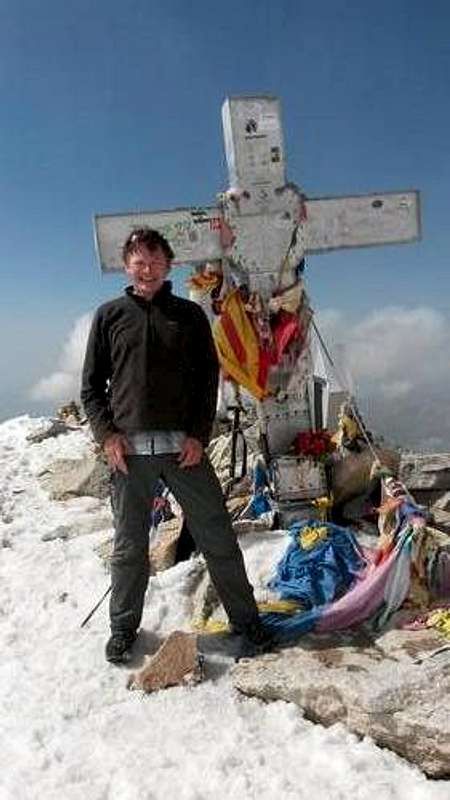
    The summit of the Aneto is marked with a large white cross, with flags and other textiles attached, reminiscent of the prayer flags that one might see in the Himalayas.

    The first person to reach the summit was a man by the name of Platon de Tchihatcheff, a former Russian officer, on the 20 July 1842.

    It is now 10:35 am on the 21st of December 2014, five hours after I left the hut, and I am standing on the roof of the Pyrenees, just 172 years after it was climbed for the first time.

    The views and panorama are spectacular. I wander around the top for about 15 minutes, as other climbers start to arrive, and then I make my descent.

    I had expected the descent to be more difficult, but it is actually easier than the climb and I descend back to the hut in about three hours. The entire return trip has taken about eight hours.

    As I’m not staying in the hut this night so I descend for another forty minutes to the car park.

    The Party – 25 hours without sleep

    I have no place to stay tonight, so I drive for about half an hour until I get a mobile signal again, and then I search for nearby accommodation.

    I had hoped to stay in Benasque that night and celebrate my achievement, but everywhere was fully booked. All that was available was a hotel in the tiny village of Sahun.

    I reasoned that as it is probably in the middle of nowhere, I would get good nights sleep.

    When I arrived at my hotel, it was facing the village square, which was also quite small, but with a large bandstand being erected.

    This didn’t bode to well for the anticipated peaceful nights sleep.

    I went to my room, freshened up and wrote up my journal.

    At 10:00 pm, the band started up and it became clear that I was not going to get any sleep that night.

    So rather than trying to force myself to sleep, I got up and joined inwith the activities outside.

    It was actually a summer solstice fiesta – the first Spanish fiesta that I’ve experience.

    The band, composed of seven members playing guitars and saxophone, played a broad array of music ranging from the Glen Miller band to Lady gaga.

    Summer Solistice Fiesta
    Summer Solistice Fiesta

    This party atmosphere was very unexpected and it was so entertaining that I forgot how tired I was from climbing the mountain.

    The fiesta eventually finished at 5:30 in the morning.

    I had awoken yesterday at 4:45 AM, climbed a mountain, partied until 5:30 am this morning, and then I thought to myself “What a way to celebrate the Summer Solstice”.

  • Costa Blanca 2014

    Costa Blanca 2014

    19 of us met up bleary eyed for the 7am flight from Dublin to Alicante on Sat 8 March. Half the flight was made up of Spanish teenagers, who were probably going home after a school trip to Ireland. There was a big cheer out of them when we touched down in Alicante and looking out at the bright sunshine and 20 degrees we could see why. It was a handy 1 hour transfer up to our accommodation at Finepark mountain lodge, a couple of km outside Finestrat and about 10km away from Benidorm. This was a great find by Ian Christie because the lodge was big enough to accommodate all of us, which made for great social evenings, with all the group together each night. 4 who flew in later had to put up with the hardship of staying in a house by the pool a 100m away.
    The pattern from day 1 was drinks after dinner in the big common room until the wee hours (well 1am most nights) and muchos cerveza and rioja was had at bargain prices. Thankfully there was no dancing on tables but ear plugs were recommended for early nighters.

    P

    On the first afternoon, 10 of us trekked up to have a look at the start of ‘Espolon Central’, the 13 pitch monster climb up Puig Campana (at 1400m the 2nd highest mountain on the Costa Blanca). This climb ranged from 3 (VD) to 4+ (VS) but with the serious exposure applying and route finding being critical I decided it was one to aim for next year. However, Kevin Coakley, Ian Christie, Peter Woods and Barry Watts went off satisfied and ready for their assault a few days later. James Aitken cooked a great meal for us all that first night and by 10pm we had our full complement of 23 (asthose coming by the later Ryanair flight were then in).

    spain2

    The first day we all went to Sierra de Toix (well all bar John Duignan and Hugh Reynolds who being the cute ones with a priority car booking had made a dash for Toix straight from the airport the day before and so went elsewhere). Toix is an impressive sea cliff face about 10km north of Benidorm and with a choice of 222 sport routes (ranging from 3 to 8a+) you could spend your week just here alone! There are great views of the coast and the mountains inland from here. Just a short walk from the car park is Toix far Oest, a nice short rock face (single pitch climbing) which had some 3s, and plenty of 4 and 4+s for us to get used to rock again (after a winter indoors). Most of us amused ourselves on this face for the day, as there were 27 routes to choose from. I was climbing with Brian Lawless, as well as Aine O’Reilly and James Aitken, who shared our car.

    spain4

    The second day we went to the crag beside the picturesque village of Guadalest, which is perched on top of an impressive limestone pinnacle and has an imposing castle watch tower and church. We went to the Penya Alcalà area which had a number of 4 and 4+s for us to warm up on. Peter and Barry were climbing beside us and told us that Ian, Kevin, Niall and Tina Ennis had gone off to do an impressive Trad route called Esther’s Chimney (which climbs up through a vertical tunnel hollowed out in the mountain by erosion).

    spain7

    After lunch we moved over to that crag called ‘Penya Maura’ and we met Ian who was just back down and so able to give us details of the climb which was 3 pitches long and took about 3½ hours to do. We decided to give it a go (the first pitch at least) and because it was now mid afternoon Aine lead off up the left side (with James), following Ian’s earlier route, and in order to save time, I lead off up the right side (with Brian) at the same time. Ian had warned us that he had had difficulty getting good protection in and had found this pitch the most committing. This was certainly the case, there was some ‘psychological’ gear put in (that you didn’t really want to fall on), but we both made it up without incident. It was part HS, part VS, but climbing it ‘on-sight’, unsure of protection and unsure what was coming next definitely made it feel VS all the way. The limestone was very sharp compared to the bolted routes and really made us appreciate what the people who developed this area had to deal with in the early days (I imagine an even stronger aversion against falling than usual and a fair investment in rock shoes).
    E
    By stark contrast the 2nd pitch through the chimney inside the mountain was completely smooth and quite straightforward, but because it was so unusual it made the climb particularly memorable. The final pitch was surprisingly short and not too difficult, but exiting out of a small window in the rock onto an exposed face by an airy delicate move this proved equally memorable. On top of the climb a fantastic view of Guadalest on one side and a turquoise coloured reservoir on the other greeted us.

    spain1

    The third day we went to Vall de Guadar (Echo Valley) which per the Rockfax guide “is one of the more impressive mountainous limestone regions in the Costa Blanca. Compared to many of the other crags in the Costa Blanca it is relatively unspoilt and quiet which makes it a great venue for those who are after a bit of solitude far from the madding crowds.” There are 8 climbing areas and we climbed in the Echo 1.5 area (which offered a number of humane grades as well as harder stuff). We warmed up on a number of short single pitch 4s and 4+s, though accidentally did a 5 to start with, and then moved to longer 25m climbs on the upper face. The first of these ‘Romero’s birthday’, graded 4, I found more committing and difficult than the short 5 I did earlier (so certainly one that I would swap the grades around on). Meanwhile Aine and James found an extended climb all the way from the lower crag up onto the upper crag and up to the top on an oddly named route calle ‘Sesamoid’. The imposing face of ‘Aran de Batistot’ and fine views back to the coast made Echo Valley another very scenic place to climb. Meanwhile, today being the last of the very good weather days Kevin, Ian, Peter and Barry had gotten up at 6.30am and gone to Puig Campana to tackle the epic 13 pitch classic ‘Espolon Central’ climb up the east face of it.

    spain6

    That evening we discovered that Eric, Geraldine, Przemek and Karolina, had done the very airy and imposing grade 5 (HVS) Magical Mystery Tour route on Sierra de Toix.
    Three solid days climbing done at this stage we were keen to give the fingers a break from pure climbing and so we hatched plans to have a climbing ‘rest day’ and instead go for the Castellets ridge walk. Per the Rockfax guide “sandwiched between the rock climbing meccas of the Sella valley and the majestic Puig Campana is a serrated ridge of marathon proportions – Castellets. The ridge is composed of a multitude of summits linked by dizzying, and at times difficult knife-edge aretes. There is the magnificent traverse of the first section of the ridge, the El Realet Ridge”. Unfortunately, after escaping for 4 days someone in Met Eireann discovered where we were and sent some Irish weather over our way and so the forecast for Wednesday was suddenly for high winds and rain showers. Knife edge aretes not being the best place to be in high winds and rain we quickly changed plans on Wed morning. As the wind and rain was sweeping in from the north east, we scoured the guide for SW facing crags and found that a low down crag across the road from Echo Valley was just right and so back we went to Echo Valley on day 4. In the end the showers didn’t amount to much and being Spain the rock dried out immediately after so we got a number of good climbs in.

    spain5

    Needing a break from climbing all the time we took the opportunity to set up a top rope from an overhang in order to practice self ascending a rope using harness and foot prussiks (and this was meant to be a rest day!) Ian and a few others were climbing up at the main face of Echo Valley. We had hatched a plan earlier that if the weather held we might walk from Echo Valley back over the mountains, around Puig Campana to Finestrat (a walk of about 10km which Ian had done last year and highly recommended). Luckily the weather held and so Ian, Aine, James and myself, set off from the top of Echo Valley over the mountains to complete this walk late in the afternoon. So much for a ‘rest day’, but I have to say, the views were fantastic (far exceeding my expectations) and ‘Ballymun by the Sea’ (Benidorm) actually looked pretty good from up there (like some futuristic space city). The inland countryside and mountain views are stunning. The view of the knife edged Castellets ridge in the twilight, with mountain ranges behind it continuing to the horizon was particularly good. We even had a full moon rise up over Puig Campana to make it a magical walk back in the last of the daylight.

    S

    On the fifth day, the forecast was for more serious rain, so we decided to use high tech methods to decide where to go i.e. we stuck our heads out the lodge door to see which way the wind was blowing and which way looked least grey. We gambled on a dash back to the coast and Sierra de Toix (as it jutted out of the coast and might escape some of the rain). This turned out to be a good gamble because we spent a full day

    spain3

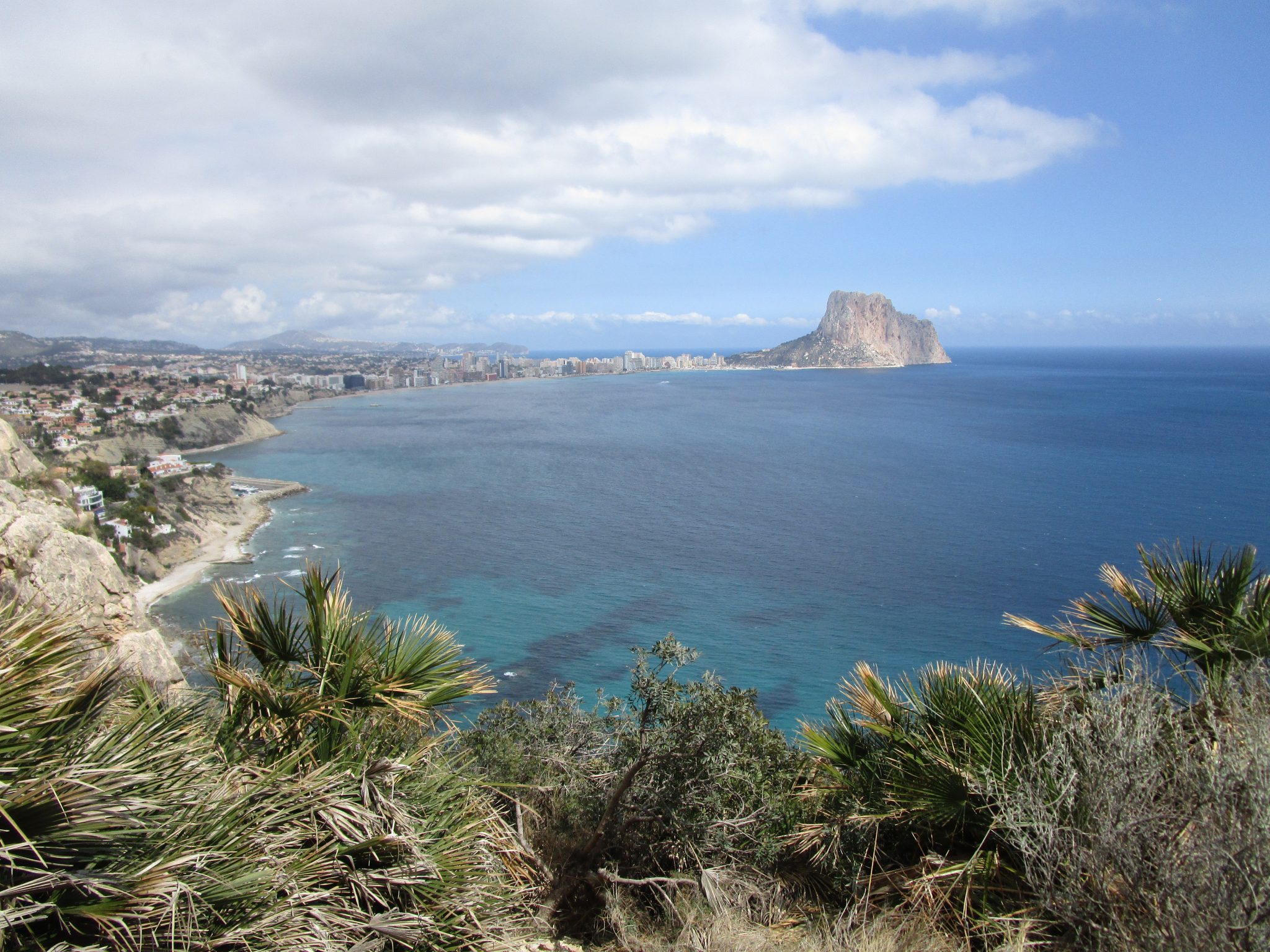
    On our final day, we travelled to Olta (which sits just inland from the massive 300m tower of the Peñon d’Ifach which looms over Calpe). We picked Olta because there were lots of routes to choose from at our grade and because we got to finish off in style with stunning views of the Penon d’Ifach (probably the most famous landmark on the coast). We got in several climbs and finished on a brilliant climb up onto a pinnacle, which gave fine views of the Penon and the coast. That night our hosts at Finepark mountain lodge laid on a huge bbq and we all feasted, told tales, and drank under the stars. Out came the guitar, and Karl, the new voice of Finestrat, gave it socks and led the way in belting out the songs.

    costablanca2

    We climbed for 6 days in a row and had barely scratched the surface of what the Costa Blanca has to offer. We climbed in 4 different locations and in 1 / 2 areas in each. However, to put it in context, the Rockfax guide lists 50 different locations, many with over a dozen different areas in each, a total of 3,500 sport routes, and 21 featured Trad routes (there are many Trad routes, like Esther’s Chimney, which aren’t in the guide, as it focuses on sports routes). We didn’t even make it to the most extensive climbing location in the Costa Blanca, Sella which has 317 routes, albeit, mostly in the higher grades. All the places we climbed were within a 40 minute drive from our accommodation (Echo Valley was only 20 minutes away). Within a 1 to 1½ hour radius from Finestrat dozens of locations are in range and many only have a short walk in to them. The choice of climbing areas and climbs are huge. I reckon you could go to the Costa Blanca every year for over a dozen years and keep climbing new areas every year. Thanks to Ian for a great trip. I can’t wait to get back . . .

    Holiday info: Fly to Alicante (c.€150) Aer Lingus or Ryanair
    Car Hire: (c€50), if you add full ‘crash and bash’ insurance and petrol (c.€200 for the week)
    Finepark Lodge was €17 pp per night (€119 for the week)
    We used the Rockfax Costa Blanca climbing guide.
    Also, lots of info online on Rockfax [Spain, Costa Blanca]
    Also see – Costa Blanca Climbing

  • Calpe Rock

    (by Gerry Moss, February 2009)
    Sun rock in Spain.


    The sun was shining and the wild flowers in bloom in Calpe last week. But there was more than just flowers blossoming. I was accompanied on the trip by Padraic and young Paddy, two of last year’s new recruits to the club, and it was heartening to see how their skills, attitude and technique blossomed as the week progressed. Indeed, in the latter half of the week I had the distinct feeling that I was working my way steadily towards the back of the bunch. It’s a feeling I am becoming more and more familiar with these days, and that’s as it should be.

    We had set our sights on the multi-pitch routes in the area, partly because the two lads wanted to gain experience of setting up belay anchors etc., but mostly because these routes are much more satisfying and enjoyable. We arrived on the Sunday night in heavy rain, but it had cleared by the following morning, though there was cloud on the mountains. Breakfast on Monday morning was unavoidably delayed as we waited for the local supermarket to open, but as this meant we were able to enjoy the one-off luxury of dining in full sunshine on the balcony, there were no complaints.

    We got the climbing off to a gentle start with some of the many four pitch routes on Toix, a sunny and ever reliable crag just above sea level, – a sort of local, and larger, version of Barnbawn. The lads took to it like ducks to water. Back at the apartment that evening we spent some time practising setting up belays on the balcony railings with the boys demonstrating their ability to do one-handed clove hitches in all kinds of situations.

    From the balcony of our apartment we could look straight across at The Peñon, Calpe’s own mini-mountain, and a magnet for all visiting climbers, providing climbs of up to eight pitches in length. With the weather set fair, we went for it on the second day. I had previously climbed a route on the south face with Liam, so this time we opted for a seven pitch route on the north face. Although it wasn’t planned, Paddy got the crux pitch and cruised up it, no bother. A sign of things to come.

    The following day there was a light covering of cloud, with even a few drops of rain, so we opted for the seacliffs and Roland’s Magical Mystery Tour, a rising traverse through some dramatic and imposing cliff scenery. The approach to the foot of the cliffs is via a sensational free abseil (another first for the lads), down alongside the remains of an old, rusty, rickety ladder, used by local fishermen in days of yore. Although I had done this route previously, I must admit I was a little anxious, as the only easy exit was the route we were tackling (a five pitch HVS with a grade 5 crux) and a serious proposition if the rains came on. I opted to lead the crux sections, just to be sure, but, as it turned out, I could have left it to either of the lads as the weather remained fine and, more to the point, they both cruised up the rock.

    On Thursday, a glorious day, we headed for one of my favourite places on the Costa, the beautiful Echo Valley, home to some very pleasant multi-pitch trad routes. With excellent rock, plenty of opportunities to practise gear placements and some route finding skill required as well, it provides a good test for any up and coming climber. Here Padraic shone, with some solid leads. A very pleasant day, in a very peaceful setting.

    Buoyed up by all of this, we decided to up the ante a little and on Friday we tackled the Mascarat Gorge, a seven pitch HVS route with a 5+ crux. By this stage I was really surplus to requirements as the two tyros ran the show, with Paddy polishing off the 5+, while Padraic wrapped things up with a 60m traverse that caused some minor palpitations as one of our ropes was only 50m long. To add spice to the occasion, Paddy had to second this pitch in a dramatic thunderstorm, with the lightning flashing just overhead. However, it was a typical Costa storm in a teacup and by the time we had completed the hour long trek back to the car we had dried out and were in sunshine again.

    Another visit to Toix and a trip to Marin on the final day wrapped up a great week’s climbing, made all the more enjoyable by reports from home of snow, sleet and sub-zero temperatures. The two lads lapped it all up while I was treated right royally – fortified by numerous cups of tea, courtesy of Padraic, and never having to carry more than a light rucksack, thanks to Paddy’s broad shoulders – throughout what proved to be a very enjoyable trip.

    I should mention that we were joined on Thursday night by Barry and Alan, over for a long weekend. I was very impressed when I saw Barry approaching, bent almost double under a huge rucksack. This guy was obviously up for some serious climbing. It was something of a letdown to discover that 90% of his load consisted of porridge. When asked about what gear he had brought along, we were greeted with blank stares. This man has his priorities right, that’s for sure. Though his climbing partner may have a different view of things. As for Alan: beer was to him what porridge was to Barry, I suspect he even uses it to clean his teeth. No problems with liquidity there then, recession or no recession.

    Whether or which, they had a very successful trip, with a route on the south face of The Peñon on Friday, and a long classic on Puig Campana on Saturday.

    What with these four lads ready and eager to tackle long routes, and John’s successful and well supported trip to the West, it was, all in all, a good week for the club, and one that augurs well for future.

    Looking back on it, there was just one small disappointment – despite numerous threats and promises, Paddy never appeared in his flowery shorts. Ah well, there’s always next time.


    Some photos

1 2
Next Page

Postal Address

Irish Mountaineering Club
Glendasan
Glendalough
Co. Wicklow
A98 EY91
Ireland

Follow us on Social Media

  • Facebook
  • Instagram

IMC Website

  • Contact Us
  • Introduction
  • Hut