Skip to content
Irish Mountaineering Club IMC, Cumann Sléibhteoireachta na hÉireann
  • Facebook
  • Instagram
Join Now
Book the Hut
Members Login
  • About
    • Introduction
    • Contact Us
    • Documents
      • Constitution
      • Privacy Policy
    • Expeditions
    • Kindred Clubs, Handy Hostels
    • Library
    • People
  • Join
    • Introduction
    • New Membership
  • Blog
    • Article
    • Obituary
    • Review
    • Route Info
    • Training
    • Trip Report: International
    • Trip Report: Ireland
    • Other: Bottom of Home Page
  • Events
    • Introduction
    • Calendar
  • Hut
  • Publications
    • Introduction
    • Books
    • Newsletters
      • 2010-now
      • 2000-2009
      • 1990-1999
      • 1980-1989
      • 1970-1979
      • 1960-1969
      • 1950-1959
    • IMC Archive
    • Videos
  • Training
    • Overview
    • Introduction to Trad climbing Programme
Irish Mountaineering Club IMC, Cumann Sléibhteoireachta na hÉireann
  • Log In
  • Join the IMC
  • About
    • Introduction
    • Kindred Clubs, Handy Hostels
    • Library
  • Blog
    • Article
    • Obituary
    • Review
    • Training
    • Important Information
  • Events
    • Introduction
    • Calendar
  • Hut
  • Publications
    • Books
    • Newsletters
      • Newsletters 2010-2018
      • Newsletters 2000-2009
      • Newsletters 1990-1999
      • Newsletters 1980-1989
      • Newsletters 1970-1979
      • Newsletters 1960-1969
      • Newsletters 1950-1959
    • IMC Archive
    • Videos
  • Training
    • Overview
    • Introduction to Trad Climbing Programme 2026
Join Now
Book the Hut
Log in
  • Winter Climbing in Scotland

    Winter Climbing in Scotland

    In between soloing Great Gully Ridge and a one-day round trip to inspect the slushy snow on Howling Ridge, Dave Keogh managed to squeeze in a quick visit to Scotland, cramming in an impressive array of climbs.
    He doesn’t even enjoy climbing apparently and only does it to annoy Ken. But what a fine job he’s doing. Over to Dave…


    Scotland Winter Jan 9-13

    So after 2 canned trips during the Christmas period due to pish weather I made a last minute trip to Scotland.  Colder weather was forecast and things looked promising.

    €8 flights to Glasgow ➡️ Bus to Fort William ➡️ Bus to the north face car park ➡️ 2hr walk with provisions for 5 nights & 4 days ➡️ CIC hut.

    Situated at 680m and just below Ben Nevis’s north face it provides an ideal base for a few days.

    I had 4 quality days, 2 of which I spent with a climber I met through the UKC website after an 11th hour shout out for a partner.

    Day 1
    Climbers on Good Friday

    •Tower Scoop (III** ice climb)
    •Good Friday Climb (III*** ice climb) – Down Gully no. 3 (I**)
    •Gully Buttress No. 3 (III,3*** ice & mixed) – Down Gully no. 3 (I**)

    Day 2 (with my UKC blind date)
    Lost The Place (V,5*** mixed) – Pitch 1

    •Lost The Place (V,5*** mixed) 3 pitches 40,25,40m located high on Coire na Ciste. A really good route with a memorable top chimney pitch.

    Day 3 (2nd date)
    Cutlass
    Cutlass (VI,7** mixed)
    Horrible slab pitch to start Cutlass
    P2 Cutlass
    Cutlass – Pitch 2
    Coming up P2 Cutlass
    P3 Cutlass
    Cutlass – Pitch 3
    Setting out P3 Cutlass
    Setting out P3 Cutlass
    SW Ridge Douglas Boulder
    Cutlass-2016-01-12 14.49.32
    Finishing up Cutlass

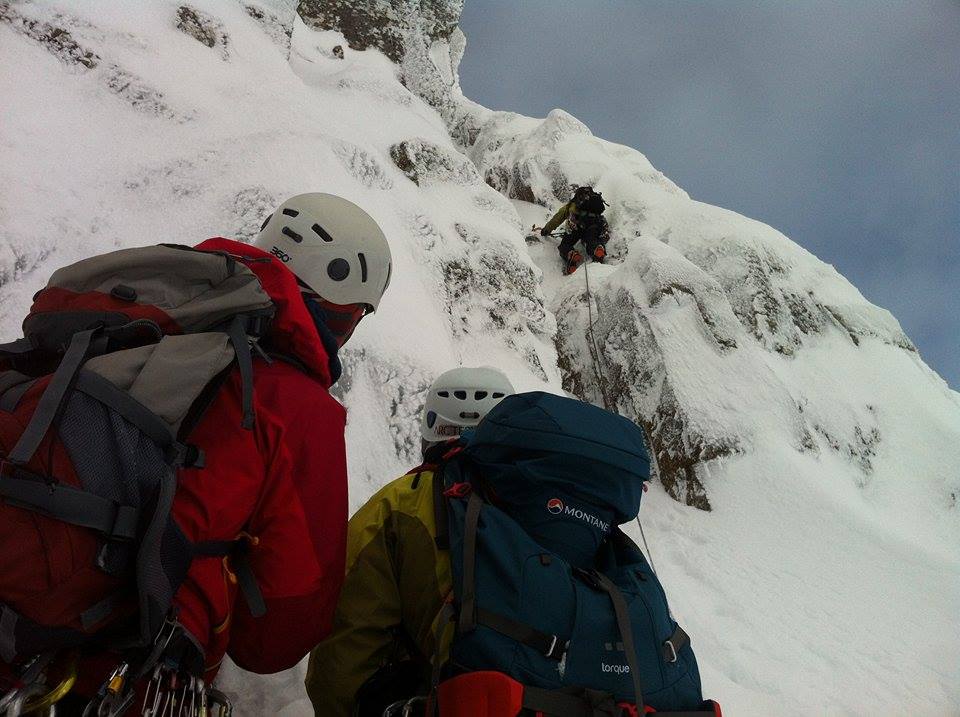
    •Cutlass (VI,7** mixed). A lot of snow and a couple of other factors had us setting our sights low on the mountain. An excellent route which went in 5 pitches to the top of the Douglas Boulder. The climbing on pitch 2&3 (corner/chimney) is so good.

    Day 4 (dumped)
    1934 Route (II/III**)
    Looking up at Tower Ridge ice pitch
    TR Ice pitch
    Tower Ridge ice pitch
    TR little tower
    Tower Ridge – Little Tower
    Tower Ridge – Eastern Traverse
    Tower Ridge – Fallen Block
    A tight squeeze, but fun

    2016-01-13 13.21.11

    TR top
    Tower Ridge – Nearing the top
    Parties behind negotiating Tower Gap

    2016-01-13 13.29.20

    2016-01-13 13.31.57

    TR finish to summit
    Tower Ridge – Finish to summit

    2016-01-13 13.38.06

    2016-01-13 14.13.22

    •1934 route (II/III**) up onto Tower Ridge
    •Tower Ridge (IV,4****). Snow has yet to really consolidate so it was well banked out. Being first on the route this meant a lot of clearing ledges and cracks for axes. A real shoulder workout.
    •CMD Arête (I**)

    Tower Ridge was a day to remember. One of my best. Cold (minus 6 on top), no wind and blue skies made things perfect.

    A good start to winter!

    2016-01-13 14.04.11
    On the summit of Ben Nevis

    Just a week later and Dave returns, to mixed conditions, this time with Cearbhall…


    Scotland Winter: Thaw & Storms Jan 20-31

    Myself and Cearbhall Daly had an interesting 8 days or so Winter Climbing in Scotland. It was a real mixed bag of thawing conditions, wild weather and some excellent climbing. We got to see a few new venues and even had a first attempt at some dry tooling down in the cave at Dunkeld. All the climbing was mixed as the ice routes haven’t formed at this point. Below is a list of the routes and areas we got to.

    • Cairngorms
      • The Seam IV,5**
      • Savage Slit V,6***
      • Hidden Chimney Direct IV,5*
    • Ben Nevis
      • No. 2 Gully Buttress III***
      • Wendigo IV,4**
      • Thompsons Route IV,4***
      • No. 3 Gully Buttress III***
      • Jackknife V,6
      • SW Ridge Doulas Boulder IV,5***

    I stayed on a for a couple of days after Cearbhall left and climbed with a friend of a friend at Stob Coire nan Lochan and yesterday we did Scabbard Chimney V,6***, Twisting Gully III,4*** and Dorsal’s Arête II/III***

    I learned a fair bit more about Scottish weather and climbing conditions which play a big part in dictating your route choice.

    Wednesday 20th Jan – The Seam
    Coire an t’Sneachda
    IMG_4554
    Climbers on Coire an t’Sneachda
    The Seam
    Looking across to Fiacaill Ridge and climbers on The Seam, probably David Keogh [Photo: Alistair Hurst]
    Midway point on The Seam
    Midway point on The Seam
    Nearing the top of The Seam
    Nearing the top of The Seam
    Thursday 21st Jan – Savage Slit

    IMG_4575

    IMG_4576

    IMG_4579

    Friday 22st Jan – Hidden Chimney Direct
    Thawing conditions on Hidden Chimney Direct
    Top out after Hidden Chimney Direct
    Wednesday 27th Jan – The Wendigo
    Wendigo
    Toping out on Wendigo
    CMD Arete from the top of Wendigo on a rare calm day
    CMD Arete from the top of Wendigo on a rare calm day
    Sunday 31st Jan – Scabbard Chimney
    Parties climbing at Stob Coire Nan Lochan
    Scabbard Chimney
    Pitch 2 Scabbard Chimney
    Pitch 3 Scabbard Chimney

    IMG_4567
    Where next….?

  • Scotland Winter 2014

    Scotland Winter 2014

    The adventure begins

    A wet 4.30 am start marked the beginning of our trip to Scotland in Feb. This is always my favourite trip of the year. From the first year I went out, the place captivated me. The wildness of the landscape and weather thrill me. The unpredictability of every trip keeps me motivated throughout autumn and winter. When I’m out running through the rain and mud in Wicklow, when the spirit flags, casting my mind north keeps me moving. What will the weather be like? What climbs will be “in”. If a particular climb is “in“, what will condition be like? Will I get some more of my tick list done?
    scotland20141
    Weather-watching and perusing the local blogs fill a lot of spare time. I knew this year would be tough going. Scotland had been on the receiving end, like us, of storm after storm since December. Unlike here though it was dumping huge amounts of snow and I knew this would curtail our activities to some extent.
    Niall, Karl, Ken and I made the long trip north towards Fort William. I had climbed with Niall last year in Scotland and we had some cracking days out. We have similar goals and seem to generally have the same aims when we’re out there. Karl had done an introductory course to Winter Mountaineering last year and had really enjoyed himself. He had signed up to do an advanced course this year and seemed really keen. Ken had never done any winter climbing but we had convinced him it was something he needed to do. We were to meet my friend from Newcastle, Alastair who I meet the first year out there and we had met up each year since. He’s the quietest Geordie you’ll ever meet but very solid when it counts and finally, sharing digs with us up there, club adventurer, Ambrose.
    Disembarking from ferry it was obvious there was plenty of snow on the hills. Looking north the mountains on Arran were blanketed. I love the drive. Once past Glasgow you soon hit Loch Lomond and from there on its one stunning vista after another. We crossed Rannoch Moor. The amount of snow was truly staggering for Scotland. Few of the usual features could be picked out.
    On many slopes we could see the trace of avalanches. When we got to the top of Glencoe we stopped to take a look at Buachaille Etive Mor.
    10799480_877474865616488_971006403_n
    I have passed it many times and never seen it in such condition. Two of the plumb gully lines on it were full, Crowberry and Ravens but with unconsolidated snow. No use to anyone. A picture of someone climbing in Crowberry is what started me winter climbing. I only now feel ready to tackle  it but it’s rarely in the right condition. Ravens is a pipe dream! There is always next year. We continued on to Fort William and got set up in our digs for the week.
    My usual itinerary up here is to hire a guide for a couple of days and then get out myself for the remainder of the trip. Not having anyone to teach me the requisite skills I have found this to be an ideal way to learn the basics of winter climbing. It’s a good system. You’ll second routes that will be initially way outside your ability to safely lead but at the same time give you the self confidence to tackle climbs at an easier grade. I think it’s a good idea to work your way up through the grade so you won’t end up getting sand-bagged on mid grade climbs. More so than rock, during the winter the golden rule of winter climbing is, don’t fall.

    Day 1: Stob Coire nan Lochain

    We like to get a tune up day in before meeting our guides, so Niall, Ken, Alastair and myself and set our sights on Stob Coire nan Lochan. The forecast was reasonable and we felt the avalanche hazard, although Considerable (see link below) was manageable. The walk into the coire is short by Scottish standards but brutal to the uninitiated. Ken moaned about his knee a lot. The snow level started at about 400m which actually made it a bit easier at the start but the last 100m into coire was tough going.

    scotland20142

    Niall had been keen to do Twisting Gully (III,4) a Cold Climbs classic (required reading for any would be winter climbing) as he had led the crux on SC Gully (III) the year before and I think it was just an itch that needed scratching. We knew that gullies would be out on this trip, in Lochaber anyway, so I had set my eye on Raeburn’s Ordinary Route (IV,4) as a backup plan. I love doing climbs that have been put up by some of the greats and Harold Raeburn is right up there. This would be my first IV lead and the game face was on. Ali and I swam up to the base of route. There were prodigious amounts of snow it took ages to get to the base. Eventually we got a descent nut in after 10 minutes digging, not ideal for a belay but I had spotted some rope tat 5m away and knew I could clip that and expected to get more gear in as I moved up the initial chimney. This was my first mistake.
    10807825_877474912283150_1548832133_n
    The first pitch is close to 60m and over the length of it I got 3 pieces of gear in. The route was buried in fresh powder so axe placements weren’t as secure as you’d like and by the time I had worked my way up to the second belay my head was well and truly fried. It physically wasn’t very hard but it was mentally the hardest bit of climbing I’ve ever done. I arrived at the second belay sitting au cheval on ridge, knowing I was just out of rope and starting to freak. I couldn’t see a thing to set up a belay with. Just as I was about to start trying to bury my axe I looked out to left and saw a newish peg in a crack. I dug the snow out of crack further down and place a descent nut. I had my belay. The sense of relief was unbelievable. I brought Alastair up. And he followed through. Niall arrived up quickly behind him. He had led the first pitch well, finding more gear than me. The second pitch bypasses a big tower. You traverse around it and then up a shallow gully behind it. After that you make a bold step out to the left over the cliff face on soft snow. The wire Alastair used to protect this is still there. He bet it in. I don’t blame him. Niall appreciated the courtesy. The last belay was solid. I led the last pitch and although it was easier it was quiet precarious. I was also getting into the swing of things and found plenty of protection using a bit of cop on, sadly in short supply on first pitch. Alistair and I topped out. It was dry but the wind was biting. I wasn’t sure how Ken was doing. It was his first winter route so Niall would have to lead it all.
    After an extended wait, Niall topped out and shortly afterwards Ken. The steward’s enquiry commenced. How long was I on first pitch? I don’t know but it was a while. How long were we on top waiting? A while. What we do know is Ken had an attack of the vapours. What caused them? No one knows but I suspect it’s because he’s a great big fanny. It was a great day out. I was buzzing. I had the piss ripped out of me on the way down to car. I didn’t care. A great start to the week.
    Karl had a good first day. He had the good luck to get paired off with a guide on a 1 to 1 basis, it’s normally 2 to 1 so on his first day he managed to get The Curtain (IV,5) on Carn Dearg and Left Hand Chimney (IV,4) on the Douglas Boulder done, with his guide Matt Stygall. Ambrose was off  on the North Buttress (IV,4) on Buachaille Etive Mor with Alan Hughes finishing up a course. We went straight to the pub to have a drink and see who could bullshit the most. I won. I’ve lots of practice.

    scotland20143

    Day 2: The Curtain/Curtain Rail – Ben Nevis

    The second and third day out were to be guided days. The forecast on the first of these wasn’t brilliant, we decided to head up the Allt a Mhuilleann to the CIC hut under the North face of Ben Nevis, and take a look at our options when we got up there. There wasn’t a huge amount on. No  one had been high on the mountains for weeks. Most of the big classics were out.
    It’s a stunning walk in, even in foul weather. I remember how intimidated I felt the first time I walked in under Carn Dearg and up towards the CIC hut. Now it just gives me a rush. So many great climbers have climbed here, set new routes here and still today the boundaries are being pushed.
    Mike Pescod and Guy Stevens our guides for next few days pointed out bits and pieces. Because of the unusual weather over the last 6 weeks climbs were in that hadn’t been done in years. The Shroud (VI,6), an icefall in Castle Corrie had touched down for the first time in years. No one could get near it though because of the avalanche hazard on the hill above. We took turns out in front to try breaking the wind for the others behind. Eventually we got to CIC Hut and geared up. The Curtain was in good condition and there was another climb beside it the Curtain Rail (IV,4) beside it that would allow us climb together and then switch. Although given a harder technical grade I found The Curtain the easier of the two climbs. The ice on The Curtain gave first time placements all the way up while the crux move on the Curtain Rail had slightly cruddy ice. It made for a nice thoughtful sequence. I believe Ken suffered a brain fart here but I only have second hand information so it’ll stay on the hill. For the moment. My descent down No. 5 Gully would have won me a prize at the Winter Olympics. It certainly gave the lads a laugh.
    10807965_877474922283149_2030742782_n

    Day 3: Observatory Ridge – Ben Nevis

    The following day Alastair and I climbed Observatory Ridge (V,4) with Mike. This was the last of the 4 great ridges on Ben Nevis for us. The Ridge was covered in snow and mist. It made the digging out of belays really difficult, and in some cases, further up the ridge impossible. We had to move together over steep but easy ground with massive exposure on either side. Every axe and foot step had to be 100%. It felt really out there at times. As we were doing this the mist lifted for a while and we could see all around. It is really massive. We could see climbers across on Tower Ridge and we could hear Ken (really loud) and Niall across on the NE Buttress. Unfortunately the clag closed back in but not before we got a chance to check out the cornices. They were massive. We were able to skirt these by moving out left, but even now 3 weeks later I don’t believe any of the classic gullies have been done. We topped out to find Niall and Ken were already on their way down. After a most enjoyable bum-slide down the Red Burn, losing about 400m in 10 minutes we met up with lads at the car park. Karl had also done the NE Buttress with Matt. He had an exciting day. Starting up to the First Platform by a rarely in condition, Newbiggings 80 Minute Route Right Hand Variation (V,6) and then, while doing one of the crux moves on NE Buttress, the Mantrap, he was left holding just the handle of his axe as it had become detached from shaft. Exciting stuff! While we were all on Ben Nevis Ambrose was out on a blind date on Stob Ban in the Mamores. He had done the east ridge of the North Buttress (II/III) and had a cracking day.
    10819074_877474955616479_1796178505_n

    Day 4: (Aidan/Alastair) George – Liathach, Torridon

    The following day we were back out by ourselves again. Niall and Ken were keen to do Tower Ridge while Alastair and I opted for a road trip. I have for a few years been looking to go to the NW of Scotland. Conditions are fickle here because of its proximity to the sea. This year though the best conditions seemed to be up there. The avalanche forecast was good so Alistair and I set off at 6.30 for Liathach up in Torridon. It was a fantastic day out. Once north of Invergarry it really does become wild and remote. It took us nearly 3 hours to get up there but it passed quickly. We had set our eye on a climb called George. It’s graded as a III,4 but with some recent rockfall local climbers have upped it to III,5. We arrived at the car park on a lovely clear morning. All the walk-ins are meaty up there and the guidebook had it down as a 2.5 hours in to coire. We made good time and got to the foot of climb. I took the first easy pitch and ran the rope out to its full length. To the start of the more technical sections. Alastair set off and came to the first step which he surmounted with the minimum of fuss. He disappeared out of sight. I was left there occasionally paying out the rope taking in the views which were magnificent. Eventually the rope came tight and I got moving. Over the first step the rope continued on for 15m and then disappeared into a hole/cave(?). I followed the rope. Ali, had set up belay in the cave. It was really tight. He looked uncomfortable. ‘Are you sure this is the right way?’ ‘Yes 100%’. I could see light behind him.
    The guidebook describes it as fun and that it shouldn’t be bypassed. There was no way I could follow him in and swing leads, he’d have to continue on himself. With hindsight this was a real stroke of luck. To continue Ali had to dig away the snow and move towards the light. The cave is formed by an enormous chockstone. To lead on you have to climb up into a letterbox above it turn through 180 degrees and reverse out over a sheer drop. There is very little clearance so turning around is a struggle. Reversing out over sheer droop is a bigger struggle and trying to get your arm/axe out and into something solid is ….?. The belay was a massive thread so 100% but Ali did ask to be kept on a tight rope. A few times. When I eventually followed thru I couldn’t believe it. It was a really ballsy lead. I led through to the top and out on the ridge near the summit of Spidean a’Choire Leith.
    10808055_877474882283153_1157184030_n
    At this stage it was later than I had expected and the weather was crapping out on us. I had planned to traverse Liathach over the Am Fasarinen Pinnacles, get two routes done but there was no point. We needed to get to the top of Spidean to find our way off the mountain.
    It’s a fabulous top (only 275 Munros to go now) but we were only getting fleeting glimpses in the worsening weather. We descended to a col lower down the mountain and found our way off the mountain by using the tried and tested method of following the footprints. We eventually picked up the track lower down the mountain and reached the van for 7.30. It was a proper Scottish day out and the pair of us were buzzing, even faced with the long drive back to For t William. We already have plans to get back up there for a few days next year. It was a brilliant day out. We arrived back at Fort William just in time for beer and kebabs. A per fect end to my birthday.
    While we were off fannying around on Liathach, Niall and Ken were doing the famous Tower Ridge
    (IV,3) Ken takes up the story . . .

    Day 4: (Niall/Ken) Tower Ridge – Ben Nevis

    It was Wednesday, my fourth day out and my third morning in a row to be walking into the CIC hut. We had arrived on the Saturday. I had an ‘easy introduction’ day on Sunday; a quick spin into Stob Coire na Lochain; a restful belay and a record breaking ascent, with Aidan, Alastair and Niall leading the way. Monday and Tuesday we climbed with guides. The pace was a bit easier this morning than that set on the earlier mornings. We were up earlier than the other days and were making good progress. The sky was blue and the air still.
    Our walk-in was going to be 40 minutes longer this morning, as we hadn’t access to the higher car park , used exclusively by the guides. As we approached the hut we could see some parties setting out and behind us we could see a string of climbers approaching.
    Happy that we had set off early enough we passed the hut and headed up and left of the Douglas boulder. On the steeper ground we put on our crampons and got the axes out.
    This was my first trip to Scotland, my fourth day in crampons and I was comfortable uphill, downhill though I was still being cautious.
    We were heading for Tower Ridge. It was Niall’s route really, I was along for the experience and happy to second. If other days were anything to go by we were expecting lots of snow on the route. Protection might be hard to find and perhaps some critical features might be buried. We  were both looking forward to testing ourselves in the conditions.
    Niall lead off up a wide snowy gully, finding gear on the left wall, he disappeared around an elbow and I was quickly called up to the belay; a piece of in situ cord on a spike. The next pitch was the first bit of real climbing, rock snow and ice, a short chimney lead to a broad snowy ridge where Niall set up a stomper belay. As I completed the pitch, a guide and his client appeared to our left, ascending a snow slope. Niall hit the green for go button. The race was on to keep ahead and not have people getting in our way, especially a guide and his client.
    10814216_877474998949808_1591964313_n
    As I pondered the view, Niall was off. Niall and Aidan had done a number of trips together and this was my first trip with them. They climbed with guides on a couple of days each trip and they obviously had absorbed a lot of knowhow and had made it their business to learn the skills and the environment. I wasn’t out of my depth, but certainly I had no winter climbing experience and deferred to the two lads when it came to planning the day’s climb. Part of the plan was obviously not to stop! The previous few days I had become accustomed to eating and drinking on the hoof,  being fed hot drink while I belayed. My efficiency had to improve, with the guides it is possible to switch off; today there was no switching off. It was going to be a long day and we were not on for having anyone make our day longer.
    We completed a couple of pitches along a shallow ridge; following instructions I moved out ahead and belayed Niall along a pitch, he arrived and corrected my stomper belay technique.
    The Guide and client arrived, Niall was gone. He was along the ridge digging out a belay at the base of the smaller tower. When I arrived we were belayed on a couple of nuts and a piton. It was a wide part of the ridge, plenty of room for everyone. Niall traversed right along the base of the tower and dug out a spike about ten meters out, another ten meters he disappeared around a corner and I could tell by the rope he was now moving up. The Guide and client arrived. There seemed to me to be an alternative route straight up the tower, but on the left, but most route  descriptions warns against this route. Niall called me across, the guide following. My first winter lead was offered; I was up the gully like the proverbial rat. I know from other climbing experience that I climb differently as a second; I seem to get less absorbed in the climbing and tend to follow the rope. It’s a habit I’m trying to break. I exited the gully onto a long snow slope, I ran it out the length of the rope, but couldn’t get to the obvious end of the slope. Now to build a belay; a stomper or dig one out at the base of a small boulder to my right? Well my last stomper did not meet approval so perhaps I should stick with what I know. I dug, and dug and dug some more. Finally I had a route dug out for a long sling, which of course was not on my harness but below on Niall’s harness. I dug some more and found two nut placements.
    The guide appeared to my left. I watched as he did a little stomper dance, drove his axe in and within seconds was calling his client up. I eventually called Niall up. He was now second; I reasoned that he was at least safe and alive; he was still second! I’ll have to work on that efficiency!!
    Another pitch or two and somehow Niall was ahead again and digging out good belays for the guide and client. Finding good belay spots is a bit of a black art I think and it comes with experience I hope. The competition was beginning to dull as the two leaders got chatting; they switched leads  for a couple more pitches, one belaying slightly above the other on each pitch. It is good to cooperate with other climbers, but it was obvious we were all trying to stay ahead of the posse behind us. The blue sky had disappeared and there were no views from the ridge. The wind was rising. I arrived at the foot of The Great Tower. The guide was ahead on the eastern traverse, his client belaying. I looked up at the near vertical face of The Great Tower and wondered if I could climb it. The guide was on what seemed to me to be a snowy path, well beaten out by previous climbers over the last few days. The narrow path seamlessly blended into the surrounding mist that rolled down the steep slope below. Niall moved quickly along the traverse, it swung left then right with a step over a small ridge and over a buried block then the route turned sharply up to an open slope. As I turned the corner and climbed the slope Niall called, he was way out to my left, almost below me, standing in Tower Gap. I crossed the slope to the top of The Gap. The snow and ice were soft and mushy and not at all as good as what we had previously climbed. As I approached, on my right was the sense of yawning space. I couldn’t see it but felt it was there, Down to my left in The Gap Niall was belaying and gave some instructions about the climb down. The ice wasn’t solid. It was undercut and below where you would like a good right foot there was only scratchy rock. It was the first time in the week I felt I had to reset myself and consider that I might have to be prepared to take a swing, right down the narrow walls of Glovers Chimney. I kicked some of the slush away, got a good left foot and traversed across, not very stylishly, but it was winter in Scotland!!
    The Gap was definitely the most technical part of the climb, the most exposed and the least secure. There were a few delicate moves to follow to get out and onto the ridge above. I had the comfort of the rope; I was quickly getting to like this seconding. Niall had no such comfort and did well to step delicately up the fragile snow and ice.
    10818734_877474972283144_1238625784_n
    Another run out, a climb right over a short wall and bulges and we were up. Niall was barely visible in the blowing snow. The weather had got a lot worse. We gathered the gear and prepared for the descent. We had prepared a couple of bearings and distances to guide us from the top back to the well trodden descent path. The plateau of Ben Nevis is not the place to be lost in a white out. If there was evidence of other climbers about it was quickly blown away by the high wind. There were no footprints to follow. I walked on our bearing, Niall close to my shoulder making sure I didn’t stumble over an edge in error. A sharp turn right after 150 meters brought us onto the correct bearing to descend towards the Red Burn.
    As we descended we were sure we were on the right path, the texture of the snow was solid underfoot compared to left and right of our route although visibility was nil. I had never experienced a complete white out before where there seemed to be no up or down and it was good practice to navigate through it.
    We gradually emerged and quickly descended; helped by an exhilarating 500 meter bum slide. It was almost dark by the time we got to the car park. A day out in the mountains would not be complete without some injury and my right leg obliged. I hobbled down the last bit of path, Niall didn’t seem in such a hurry now, happy with his successful lead he waited at each bend to make sure I was still mobile. We both reached the jeep, sat stiffly into the comfortable seats and relaxed.
    A full on, great Scottish winter day out. Now back to Aidan . . .

    Day 5: Stob Bán

    The following day’s weather was horrendous so we all had a rest day to recharge the batteries and even though the day after that’s forecast was poor we had made up our minds to go out anyway We thought we’d head up and take a look at Stob Ban and see if we’d get the route Ambrose had  done earlier in the week done. We battled our way up the track on the way in for an hour or so in the strengthening wind and deepening snow and finally decided unanimously to turn around.
    The avalanche hazard was rising all the time, still it filled part of the day and after going back to Fort William we went out for the afternoon and spent the day climbing indoors.

    Day 6: North Buttress, Buachaill Etive Mór – Glencoe

    With high winds and a sketchy avalanche forecast we decide to head over to Glencoe to try North Buttress (IV,4) on Buachaill Etive Mor. The weather was to deteriorate during the day so we left early. I was climbing with Ken and Niall because Alastair had injured his hand at the climbing wall the day before. Ambrose and Karl were joining us. We got in to the base of the buttress and started to ascend towards the foot of the climb. The snow wasn’t frozen so even getting to the bottom of climb was hard work. When I went to put my crampons on one of them decided to come apart in my hand. It took me 15 minutes to fix it and by the time I got moving again my hands were frozen and I was in foul humour. I caught up with the two lads who were waiting for me and flaking out the rope. Niall was ready to run the rope out, up to the first belay just to get things moving as there were two lads in front of us. Niall brought me and Ken up to belay, not before Ken tried to remove one of my fingers with his new axes. By the time we got up to it, the rope was in a right mess. Niall was going to lead the first proper pitch so it needed to be pulled back thru. While I was doing this Ken had spotted a helicopter. Instead of paying attention he was staring vacantly at the helicopter (RAF practicing I’d guess). I believe he has some previous here so I should of let it pass but I lost it and told Ken to ignore the big helicopter. I was quite frank. Meanwhile we waited for the two lads in front to finish. They were painfully slow, but I’ll cast no stones after my performance earlier in the week. Niall led off up first pitch. It wasn’t in the best condition, freezing level was above the mountain top and it was covered in unconsolidated snow. Sub-optimal I believe is the expression.
    By the time Niall reached the second belay he had caught the two boys up. The next pitch was the crux. The lads were down to a crawl. I was cold and flowery. The toys came out of the pram. I told Ken I’d had enough. I untied and down-climbed to the base of route. I stopped to see how the lads were getting on. Even after getting to the base of the hill and looking up, the team in front were still on the second pitch. I crouched down behind a boulder to watch. The eventually finished and Ken set off. It was his first winter lead and he nailed it. He was up it in no time. I’d seen enough. They had caught the two lads again. I went back to the carpark and met Ambrose and Karl who’d bailed earlier, and got a lift back with them. Niall and Ken arrived later on. They had abbed off after the second pitch because the team in front were so slow. We’d had a good day out despite the poor weather. One important thing I took from the day was the forecast. Although very high winds (70-80mph) had been forecast, they didn’t materialise until much later. Nine times out of ten the forecast is on the money and should never be ignored, but in Scotland to a degree you should always head out and stick your nose in. Otherwise you’d get nothing done.
    That was the end to our unofficial IMC meet in Scotland. There was the usual bout of drinking and bullshitting and the long drive home but I think everyone enjoyed it. The rat had been sated for the time being.
    10833841_877474848949823_1318034174_n

    Next Year

    I’m already looking at ideas for next year. I definitely want to get up and do some more routes in the NW. Niall still has his eye on Point Five. Ken is going to get his knee fixed so he can join us again next year without having to do all his weird stretching, and I think the bug has well and truly bitten Karl. He just needs a pair of axes that don’t come apart on him. Ambrose seemed to have a good two weeks and picked up lots of new skills as he works toward his Winter ML.

    Useful Links

    Mountain Weather
    Avalanche Forecast
    CFort William: Accommodation
    Courses, Private Guiding
    UKC Logbook: What’s been climbed in past 5 days
    SMC Guidebooks: A good selection covering the whole of Scotland.

    Ken looking a bit rough at the end of the week!
    Ken looking a bit rough at the end of the week!
  • Scottish Winter Climbing

    (by Allister Gerrard, from IMC Newsletter Spring 2012)
    I have been going to Scotland for a number of years, winter mountaineering and climbing. It takes a bit of forward planning and organising to get there, finding suitable accommodation and of course deciding on the areas and routes to walk and climb in the Scottish highlands in winter. Here are a few of the lower-grade, easier, Scottish winter climbs I have had experience of doing, and recommend.

    Number Four Gully, Ben Nevis

    Grade I , 100m

    No. 4 Gully is a great gully for starting off as a first winter route. It is quite straightforward, and gives the opportunity to practice belays using bucket seats, and other winter skills.

    It is also a good descent route to the CIC hut in good visibility. The top of the gully has a metal marker post with the number 4 drilled into it (Grid ref. NN 15821 71733), though this marker may be removed in the future. Due to the cornice it may require using a snow bollard abseil but usually there is a section of cornice dug out below.

    Avalanches have occurred in this gully, so check conditions first. I climbed it in 2004.

    North Gully, Ben Nevis

    Grade II **, 110m

    A narrow gully, close to the entrance to No. 4 Gully. An excellent outing, with a mix of steep snow slope and some ice lower down. Takes approximately five pitches. Belays can be found on rock walls along the route, also snow belays. We exited to the far right, a steep finish with a small gap in a cornice previously made. Exiting out left is a grade III finish, which I found was difficult to find good gear placement as the rock was crumbling. Beware avalanche danger on the final slopes.

    I did this with Aileen Moloney and Pádraic Gibbons on 21st March 2009, and again with Aileen in March 2011.


    Pádraic Gibbons on North Gully

    Number Two Gully Buttress, Ben Nevis

    Grade III **, 120m

    A mixed route, with steep snow and an ice wall of approximately twenty metres. Anchors can be found along the way and vary from using a snow stake, buried ice axes, nut, friend and peg. When climbing the ice wall, we belayed from the buttress to the far right, which was great because we didn’t get covered in snow and ice from the leader. There was a long run-out of the rope at the end up the snow slope to the plateau. No. 2 Gully next door looked heavily corniced at the time (26th February 2007). We had good weather for it, no wind, and a clear day. It took about ten hours for the round trip from the North Face car park, including about four hours for the climb. Descent was via the Red Burn.


    No.2 Gully Buttress


    Allister on No. 2 Gully Buttress

    Number Two Gully, Ben Nevis

    Grade II ***, 120m

    Early in winter it can be grade III. A fine gully, wide and gradual at the lower slopes, it narrows and then opens higher up to reveal a large open snow expanse, with large cornices above. We exited out left on steep snow and ice to avoid the cornice.

    I did this with Aileen Moloney on 29th March 2011.


    No. 2 Gully


    Aileen on No. 2 Gully

    Other Ben Nevis Classic Scottish Winter climbs

    • Point Five Gully (V)
    • Tower Ridge (IV)
    • Raeburn’s Easy Route (II)
    • Ledge Route (II)

    Broad Gully, Stob Coire nan Lochan, Glencoe

    Grade I *, 150m

    The climb is straightforward and doesn’t usually have any cornice difficulties. The route can be hazardous in avalanche conditions and is best avoided after heavy snowfall and/or heavy winds. From the top, walk easily up to the summit of Stob Coire nan Lochan and head SW to the summit of Bidean nam Bian along a fairly narrow ridge. Descend to the corrie by either shoulder (NW is easiest); from the corrie follow a path back to the start. The gully is also used for descent and can be even quicker when glissading!

    I did this one in 2004.

    Forked Gully Left Hand, Stob Coire Nan Lochan, Glencoe

    Grade I/II

    The route starts just to the immediate right of Dorsal Arête. Like a typical IMC party in the winter of 2005, we arrived up near the base of the climb in dribs and drabs. Moira and I for some reason decided to head off right of the start on a solo climb of our own; I blame Moira, I was following her. After a nice bit of solo climbing, we found ourselves on steep snow and ice. Twenty metres above, our party were settling into a nice belay spot. We had to back-climb across and down to them, which was a slightly hairy moment for us. All back together, we climbed in two groups up the steep snow gully which is Forked Gully. It is a great gully in condition with a bit of chopping for Denis to cut into the cornice at the top. A great day out with splendid views from the top.

    It was an IMC meet, with Eileen Murphy, Denis Beakey, Moira Creedon, Sé.O Hanlon and Allister Gerrard, on 6th March 2005.


    Forked Gully


    Eileen and Allister at the top of Forked Gully

    Dorsal Arête, Stob Coire nan Lochan, Glencoe

    Grade II ***, 120m

    Starting from Broad Gully, we climbed up onto the ridge by whatever obvious route we could find from the bottom of the arête. Up to the arête itself is straightforward enough. The arête itself is more defined and very narrow but can be avoided on the left by traversing along under the side of the arête. Just below the end of the arête, Pádraic and myself broke off left and Pádraic led an alternative finish up a rock pitch in a narrow gully; probably a grade III/IV finish. A great climb but short.

    Done with Pádraic Gibbons on 16th March 2009.


    Allister on Dorsal Arête

    Ordinary Route, Stob Coire nan Lochan, Glencoe

    Grade IV **, 150m

    The climb starts on mixed ground, mostly rock, then a groove, and moving right a tough move up onto a ledge overlooking NC Gully. Follow the edge to a tower and a series of awkward walls. Half way up, due to time and weather constraints, we abseiled off into NC Gully.

    This was on 2nd March 2007.

    Other Glencoe Scottish winter classic climbs

    • Twisting Gully (III) **
    • SC Gully (III) ***
    • Aonach Eagach Ridge, 4km, II/III ***
    • NC Gully (II) **

    The Runnel, Coire an t-Sneachda, Cairngorms

    Grade II *, 135m

    A fantastic winter climb. A straightforward well-defined gully with some rock belays, left and right, until you reach a narrow ice chimney which is the crux of the climb. I managed to get one or two ice screws in here before leading on to the upper slopes, with a little soft snow at the top before topping out for fantastic views at the top.

    Climbed with Pádraic Gibbons on 17th March 2009.


    Pádraic on The Runnel


    Allister on The Runnel

    Golden Oldie, West Face Aonach Mor

    Grade II, 500m

    A mixed Scottish winter snow and rock climb. Our approach was to take the gondola from the Aonach Mor ski centre (see their website). During the winter they run a climbers’ gondola at 8am before they open for skiers at 9am. As the route is quite long (500m) I would advise taking the 8am one if possible.

    From the top of the gondola follow a track to the west. After 15 minutes this track ends, but a small path can be seen descending into the valley below. Follow this then continue up the valley for about an hour and a half until you can see a number of rocky ridges descending from the summit plateau. These ridges are not obvious until you are almost below them. Pinnacle Ridge is the furthest left ridge and has a small gendarme near the top. Golden Oldie takes the ridge to the right. Harder climbs (grade II/III and III) take the ridges further right. We found it tricky enough to find with poor enough visibility; we were lucky to have someone point it out to save time, as the whole west face is without huge features. Gear up at NN 1877 7301 which is below the buttress. If time is short then slopes to the left can be ascended for a hundred metres or so to the platform.

    From here the route follows the crest of the ridge directly. The way is now obvious almost to the summit plateau. We found the route relatively straightforward, except for a step I had to make on the final knife-edge before reaching easier ground. A delicate traverse on the right-hand side can be taken. Continue up easier ground to the summit, which we had to navigate to in whiteout conditions. Navigation was required to lead out across the summit plateau to our descent route.

    Climbed with Pádraic Gibbons, 15th March 2009.


    Allister on Golden Oldie


    Golden Oldie

    The Web, Aonach Mor

    Grade II/ III

    A nice chimney 100m in length. Situated approximately 30-35m south of Easy Gully. The grade varies depending on condition. We found good hard névé, with some ice patches and occasionally small patches of verglas-covered rock. Mostly straight up and we had one short traverse to the left across a small rock slab required at about half-way. At the snow slope above the chimney we traversed out to the left and up to find a suitable exit, using snow stake and axes as anchors (using a T-bar and we switched axes), with one peg in a rock slab half-way up the snow slope.

    I climbed this on 1st March 2007.

    Right Twin, Aonach Mor

    Grade II **, 120m

    Narrow gully and well defined, with steep sections at the bottom and at mid-height. Exit left at the top is the norm I think; however, I exited straight up and found it a little struggling pulling up over the top in snow, with soft deep snow underfoot, often the case on steep exits in gullies I find. With time not on our side I found on the second half of the route it was difficult to find any anchors.

    Climbed with Pádraic Gibbons and Tony Barry on 18th March 2009.

    Icicle Gully, Aonach Mor

    Grade IV, 130m

    A wider gully at the start, narrowing. Continue up a wider right-hand line to where it narrows (we went left for some more challenging ice), climb the icicle to a snow bay, at which point Pádraic proceeded to unleash half the mountain of snow and ice down on top of me. We followed up a steep snow slope before stepping out left on mixed ground. Out left is a direct finish graded V, and we went left. The final climb provided us with a serious mini soft snow field before pulling up with difficulty over the cornice, with soft snow again underfoot and topping out ‘wasted’, with cold hands, into glistening sun. Scottish winter bliss.

    Climbed with Pádraic Gibbons, 20th March 2009.


    En route to Icicle Gully


    Pádraic leading on Icicle Gully

    Other Scottish winter classic climbs on Aonach Mor

    • Left Twin (III) ***
    • Forgotten Twin (II) *

    Getting there

    A number of ferries operate from Belfast to Stranraer. Alternatively, people could fly to Glasgow (Ryanair to Ayr; Aer Lingus to Glasgow airport or even Inverness or Edinburgh) or another airport and hire a car or get the bus, all of which I have done myself at one time or another.

    What to do

    Ben Nevis is close by Fort William and Glencoe. For example, Stob Coire nan Lochan in Glencoe (about 30km from Fort William) is within easy enough reach by car.

    The Cairngorms are also manageable as a day trip, from Fort William (95 km approximately).

    Aonach Mor nearby also offers easy access to the snow line via gondola for skiing, winter mountaineering, and some great Scottish winter climbs.

    There are many guidebooks and lots of walking options, as well as a multitude of climbing routes and grades in these areas. A good guidebook is Scottish Winter Climbs (Scottish Mountaineering Club Guide), by Andy Nisbet, Rab Anderson, Simon Richardson.

    For an easier indoor day there is also the Ice Factor at Kinlochleven (see their website).

    Accommodation

    Camping or even snow-holing may be an option!

    I have stayed in various accommodation; however, a place I have repeatedly returned to, depending on availability is Alan Kimber’s Self Catering (see the website), a minute’s walking distance into the heart of Fort William town. Alan of course himself having put up some of the harder routes in Scotland and with vast experience, is always willing to give you key update information of routes and conditions.

    Scotland Weather

    Some useful sites to plan your Scottish winter climbs, around the weather.

    • Met Office mountain area forecast: www.metoffice.gov.uk/loutdoor/mountainsafety/
    • Mountain weather information service: www.mwis.org.uk
    • Sport Scotland Avalanche Information Service: www.sais.gov.uk/
    • Exacta Weather: www.exactaweather.com

    Other useful websites for Scottish climbing routes and conditions

    • Scotland winter climbs and information: www.scotclimb.org.uk/bennevis.shtml
    • Nevis Range: Aonach Mor Gondola: www.nevisrange.co.uk
    • Check conditions: www.ukclimbing.com/forums
    • 50 of the best Scottish winter climbing routes: scottishwinterroutes.com
    • West coast mountain guides blog: blog.westcoast-mountainguides.co.uk
    • Scottish winter blog: www.scottishwinter.com

    General

    Navigation skills and competent map reading are essential, particularly coming off the Ben Nevis summit plateau. Leave adequate time to descend. Early starts for longer routes are essential, especially for places like Ben Nevis, if you have limited experience. In low cloud, it can be difficult to even find the right route and can take time.

    Typical rack

    For a grade-I route a walking axe will suffice; after that two axes will most likely be needed. Be selective; the more you have the more to carry and slow you down. A deadman can be useful in snow gullies where there is no rock or ice available, although admittedly I have never used one and used axes only in snow gullies for anchors when there is no rock or ice. Some of the routes above are okay with a single rope. A half-set of nuts, one or two hexes, two friends/cams, two or three ice screws depending on the route, a few assorted pitons, extenders and quickdraws (extensions for these can be useful to avoid excess drag), a few long slings, twelve-point crampons, for example Grivel G12. All these are personal decisions.

  • Tower Ridge, Ben Nevis

    (by Kevin Byrne, from IMC Newsletter Summer 2003)
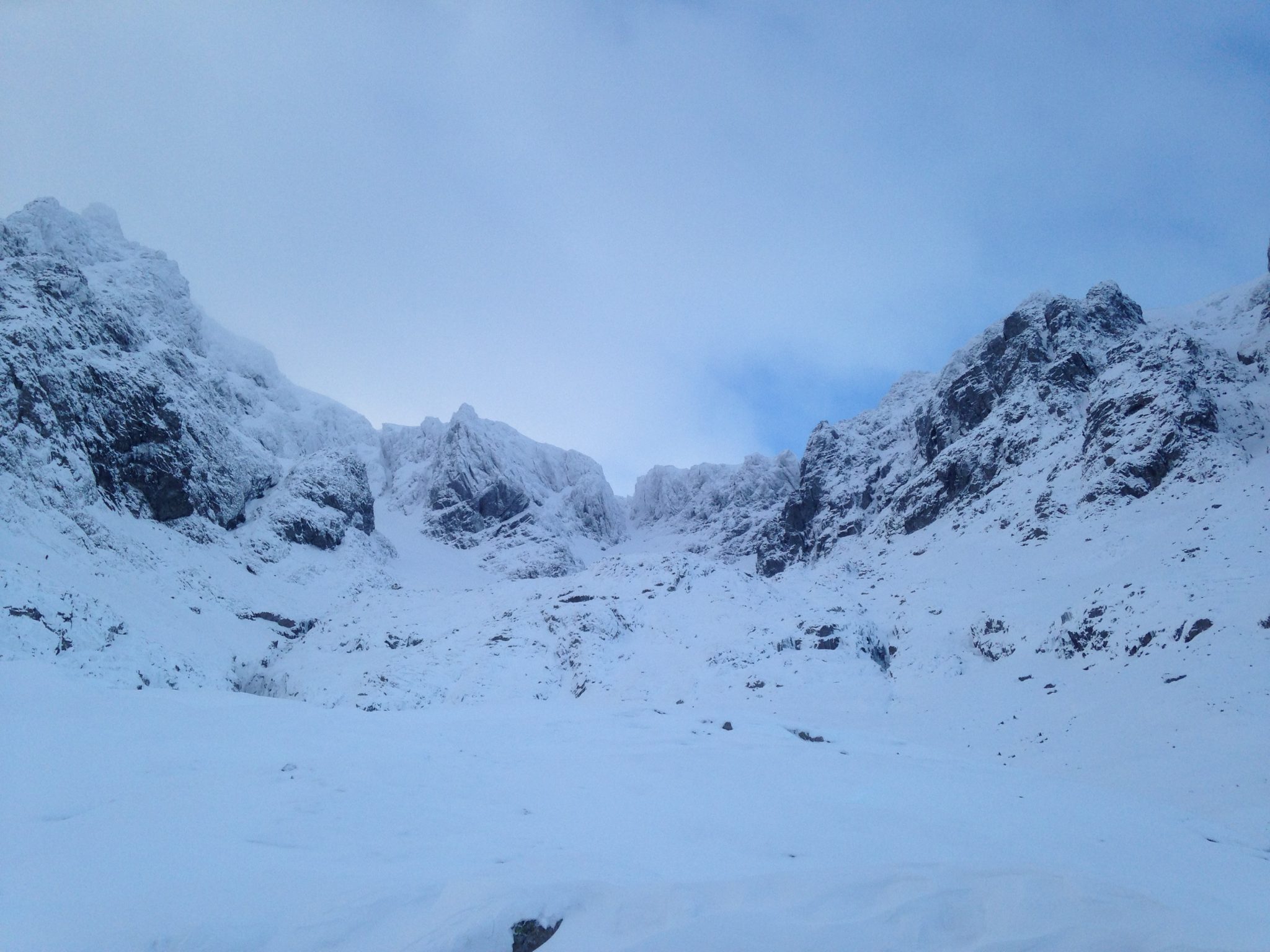
    An account of a winter ascent of Tower Ridge (600m Grade III, 3) on Ben Nevis on 14th March 2003. Climbers: Eileen Murphy, Kieran Kelly and Kevin Byrne.


    It was just before 3 o’clock in the afternoon. Kieran standing to one side untying his rope, Eileen on the final steepening leading to the summit plateau, the sun shining, the wind a mere whisper, thin mist forming and dispersing around the impressive ice-encrusted cliffs of North-East Buttress, Observatory Ridge and the Orion Face. It was the stuff of dreams. Then, as if to celebrate the moment, a perfectly-formed Brocken Spectre appeared without warning on the thin clouds that were briefly hugging the upper rocks of the ridge. I stared, distracted in wonder at the sheer beauty of what was before me. Too late I fumbled for the camera. The ghostly image and its halo-like shadow faded as quickly as they had formed, not to reappear. Recalling something read years ago about coming to the great cathedrals of the mountains not to conquer but to worship, this was indeed a moment to treasure.

    Tower Ridge in Winter. A route of great tradition and history, it still possesses an aura of mystery and had been on my mental tick-list since my first experience of Scottish winter climbing in the early 1970’s. No longer considered technically difficult, it is by no means easy pickings. My visits over the years had never even been rewarded with conditions decent enough to tempt us up to ‘have a look’.

    Many have struggled hard on this route and felt only a sense of relief on crossing the fabled Tower Gap knowing that all the difficulties were at last behind them and success was finally assured. Others, like the IMC party of precisely 12 months, to the day, previously, have had the misfortune of finding the ridge in one of its less benign moods – the wind, cold and blizzard of what Hamish McInnes famously called “Full Conditions”. On that occasion, the consequences of a particularly violent storm were benightment at the Tower Gap followed by an arduous and lengthy rescue.

    For us, as departure day the 13th of March approached (hmmm, 13th lucky for some), the weather was already shaping up well. Sunny, settled and likely to last – thanks to your local friendly continental High-Pressure system. Continental systems are more reliable and generous than their dodgy cousins, the Atlantic Highs, which we all know can play tricks on unsuspecting mountaineers leaving them floundering in cloud when sun was promised. By a stroke of good luck (thanks, Eileen) we had put the trip back a week to Paddy’s weekend. Going earlier, we now knew, would have resulted in another of those monotonously depressing, wet, dismal trips for which Scotland in winter has become infamous. Frequent sad tales of washed-out climbing plans have prompted many of today’s young things to seek their pleasure on the frozen waterfalls of remote alpine valleys rather than in the manly challenges of Scottish winters!

    Intent on giving ourselves every chance of success, we treated our attempt as an alpine route. Indeed it has many of the same qualities – remoteness, a serious feel, the certainty of a long day (guidebook time is 6–10 hours for the climb) and no guarantee of success right till the end. We first found the new car-park at Torlundy on the eastern (Aviemore) end of the golf club and we reconnoitred the initial hour or so of the walk towards the Allt a’ Mhuilinn. Though determined to make a dawn start, none of us actually knew what time dawn was at!

    Next day, Friday, we were at the carpark at 6.15am having driven the 35 miles or so from Laggan Bridge – roughly half-way between Ben Nevis and the Cairngorms. We had chosen that location to give ourselves climbing options east to the Cairngorms and west to the Ben! The carpark was already alive with early starters like us and those who had stayed overnight and who were just waking to a cold frosty morning. Temperatures were down to minus 8 or so.

    It was daylight as we set out at 6.40. The walk-in with full packs quickly got the blood flowing and gradually hats, gloves and top layers were put away. Less than two hours later we were at the CIC Hut. Not bad going. We stopped for a break and were quickly forced to add back the layers as mist obscured the highest ridges and a truly bitter wind raced down and whistled menacingly in the wind vanes of the Hut. Maybe the day would not turn out as well as we hoped! A tentative suggestion from Eileen that a tea break was in order was quickly scoffed at as we resumed the trudge to the foot of the Douglas Boulder. Boulder? Well, if you count things that are 600 ft high with routes that can take a full day to complete.

    Rounding the Douglas Boulder into Coire Leis and the foot of Observatory Gully, we continued to follow intermittent footprints before cutting off right across avalanche debris to begin the climb proper. We had in fact passed the normal start but had no intention of deliberately losing height in the interest of purity! At 9.30am we were ready to rope up but before doing so we did finally allow ourselves the luxury of a cuppa. Being unlikely to stop for lunch on the ridge itself, it was wise to get food on board now. The sandwiches were a challenge. Too much for me at this early hour, my eyes were instead drawn to the magnificent line of Point Five Gully, easily the most famous of the classic Scottish ice climbs. With modern tools, it may no longer be the challenge it once was, but it’s undoubtedly still a physical and mental test. One for next year maybe!

    The lower parts of the ridge are straightforward. Well defined, the line is never too steep or exposed. Here the guidebook urges moving together in the interests of speed. We were delighted to find there was no one ahead of us. Footprints were all several days old. For the moment too, it seemed there was no one behind. As a party of three, one of our concerns was to move quickly and not be overtaken by ropes of two, thereby leaving us at the back of a queue for the Eastern Traverse or the Tower Gap.

    The higher we climbed the more the wind died away and soon the sun was working its magic on the snow-covered ridges and gullies to sharpen the perspective all round. Tempting as it was to stop and admire the scenery, we continued to push on, passing one or two spots where pitching it was the safer option. For those few short stretches, the two behind moved together to ensure that little time was lost. On Tower Ridge, as in the Alps, safety lies in speed as much as anything.

    We were enjoying ourselves in the perfect conditions we’d found. Even the snow had a crispness born of the heavy frost the night before. Then all too soon, it seemed, the prow of the Great Tower appeared and we knew we were already approaching the crux pitches of the climb. These come one after the other and offer a startling variety of climbing in a short distance. First is the Eastern Traverse. In good conditions it presents no major obstacle but the yawning drop towards Tower Gully demands care and attention. Next up is negotiating the jammed boulder followed in the same pitch by a steep and demanding wall leading (in one long or two short pitches) to the summit of the Great Tower. From here a narrow crest leads out to the Tower Gap which again is not technically difficult but the exposure on both sides and especially the prospect of a drop into Glover’s Chimney provides memorable atmospheric qualities.

    A 20/30 minute wait at the Gap was forced on us by a party of two finishing up Glover’s Chimney. For his belay, the leader had chosen to occupy the blocks used to traverse the Gap – though in reality he didn’t have much choice. Even this relatively short hold-up resulted in a queue forming. Despite the delay, we were fully relaxed knowing that we were next, that it was early and that we could fully enjoy the magnificent mountain scenery all about as we waited.

    Finally we were across the Gap and moving again on the easy slopes leading to the summit, which by now was bathed in sunshine under a clear blue sky. What more could anyone ask from a day in the hills? An hour later, as the sun began to set, we dragged ourselves reluctantly away from the ruins of the summit observatory and began the descent of No 4 Gully and the three-hour walk out. A final piece of good fortune ensued when we met a friend of Kieran’s at the upper carpark and got a lift down the last section. Ah, bliss.

    The images of the day were still burning brightly in our minds as we finally settled down to a well-deserved night’s sleep.


    See also Kieran Kelly’s report

  • Travel Log – Scotland

    (by Kieran Kelly, from IMC Newsletter Summer 2003)
    Ascents of Tower Ridge and other Scottish winter climbs.


    13/03/2003

    I tend not to sleep too soundly when there is an early start (5am). Two hours check-in before meant we had to be at the airport for 6.15. A strand of advice; do not carry your rope in your hand luggage, put it with the rest of the offending objects like the ice axe, scissors, tooth pick, sewing needle etc. Fifteen kg max in the main pack, 7 in hand luggage (Ryanair), anything over this will cost €6 per kg.

    From Prestwick head for Glasgow (29 miles) from there the A82 to Fort William. This was not the most direct route to the accommodation, but we were planning an early start the next morning and needed to check out the start of the planned route. Apart from this we needed to stock up on supplies and a visit to Scotland is never complete without a visit to Nevisport to check out the gear and the weather forecast. The weather for the weekend was to be very good and so it proved.

    Back on the A82 as far as Torlundy, turn right then over the humpback bridge then right again for 750M and we arrived at the car park. A chat with a few other people gave an idea of the conditions on the Ben. In order to stretch the legs we walked along the route for a couple of km. The final part of the journey brought us to the Laggen Bridge Bunkhouse, one hour from Fort William.

    The Bunkhouse, a timber-framed structure, offers good accommodation at reasonable cost (£10 per night). The bedrooms were clean and for a once-off payment of £2 you get a sheet bag and a quilt. They did squeak a little, especially the one above me. Jack and Jill shared it; they must have been on a very tight budget. The kitchen/dining room was well equipped with plenty of utensils. A big pot-bellied stove stood proud in the dining area; the sting in the tail was it required a woodcutter to keep its appetite satisfied.

    14/03/2003 – Tower Ridge

    Another early morning start, rise at 4.30 am. Eileen’s porridge provided central heating to get the day off to a good start. We arrived at the Torlundy car park at 6.15. We were surprised to find some people camping and other sleeping in the back of a van; others were arriving back having spent the night on the hills. At 8.30 we arrived at the CIC hut and from there made our way to the start of the route.

    After some nourishment we geared up ready for the off. The guide book recommended moving alpine-style at a steady pace on the lower section. This proved to be sound advice; before long we were at the base of the lower tower. A few belays got us over the lower tower; from there we advanced on to the Great Tower. The biggest distraction was the scenery. It was fantastic in every direction; clear blue skies meant you could see for miles. Having negotiated the Eastern Traverse we ascended to the top of the Great Tower; from there we caught sight of Tower Gap.

    Tower Gap could be renamed Gridlock Gap. This is where time can be lost on this route; it cost us 20/30 minutes. Two climbers had come up the gully and had pole position, with more coming up behind. As soon as the group moved, Kevin descended into the gap and from there ascended up the slope on the far side and set up a belay. One more belay and we were there; it had taken 5 hours from start to finish. Elated at our achievement we had a photo-call followed by lunch at the summit.

    Our ascent was down No. 4 Gully, which was very steep initially; it is at times like this that a second ice axe would be useful. A short time later we reached the CIC Hut and then retraced our steps down the valley to the forest road where we came across a Tollymore bus. The driver (Brendan Whelan) greeted us. I had known Brendan for some years; he was working in the area as a freelance ML instructor. He offered to drive us to the car park. Kevin refused as he said it would be cheating. We agreed for about two seconds then made a dash for the van.

    15/03/2003 – Creag Meagaidh

    Two hours walk through the valley brings into view a spectacular sight that gets better with every step. Ice helped to shape Creag Meagaidh (“Crag of the Boggy Place”) and it’s still a big part of its attraction. When snow fills the big gullies and the mountain buttresses glaze with cascades of steep ice, the winter climbs are amongst the best in the country.

    Having reached Lochan a’ Choire we split up. I decided to head on up the valley to Uinneog Coire Ardair (The Window); from there a short ascent up a snow slope gained the ridge. A short walk brought me to the summit of Creag Meagaidh (1128m); from there the ridge walk offered panoramic views of the valley.

    Nearby Kevin and Eileen had decided on Raeburn’s Gulley, a 360m grade 1*** route. This ice gully is long, continuously steep and the pinnacle buttress face provides exciting scenery.

    16/03/2003 – Cairngorms

    The walk into “Coire An tSneachda” was an easy walk both in terms of time (40 min.) and the terrain. The plan today was “The Runnel”, a grade 2** ice gully (135m) on the fluted buttress. It is described as the central and best-defined of the three gullies, which rises from the top of the snow bay. It is straightforward climbing leading to a fine ice chimney near the top, which is the crux of the route.


    Eileen and Kieran on the first pitch of The Runnel

    17/03/2002

    Day two at the Cairngorms; time would be tight. We had to check into Preswick at 8pm and with four hours drive we had to be on the road by 4pm. Eileen and Kevin had a date back at Coire An tSneachda with “Aladdin’s Mirror Direct”. A popular ice problem, Aladdin’s Mirror Direct (Grade 4) varies in length and steepness according to build-up.

    Overall the trip was a great success; four days of continuous sunshine, good accommodation, not to mention the outdoor hot tub. The trip was well organised at a reasonable cost. Last but not least was the good company and teamwork that went towards achieving our objective Tower Ridge.

    Cost Per Person:

    Airline €76
    Car Hire £88
    Accommodation £42
    Food £37


    See also Kevin Byrne’s report

1 2
Next Page

Postal Address

Irish Mountaineering Club
Glendasan
Glendalough
Co. Wicklow
A98 EY91
Ireland

Follow us on Social Media

  • Facebook
  • Instagram

IMC Website

  • Contact Us
  • Introduction
  • Hut