
Last year, Kevin Coakley and I had travelled to the Bregaglia in Switzerland, with a view to climbing the infamous Piz Badile. Weather and conditions worked against us, so this year we decided to try again. We were joined by experienced IMC members, Vincent ‘Doc’ Astier, and Barry Watts.
-
Bregaglia Rocks (or the strange case of the missing helmet)
-
A day on the Nordkante
(by Conor Warner, August 2008)
An ascent of the north ridge of the Piz Badile.
It was Monday 7th July, it was lashing, and we just had to get out of the camp site and away out of the valley. It had been raining more or less continuously since we were rained off the north-east ridge (or central spur) of the Spazzacaldera early on the Sunday morning. James and Barry had already spent the previous week in the Bernese Oberland where they climbed a number of wonderful snowy peaks, while I had just arrived on the Friday into Zürich. On the Saturday, which was a cracking day, the three of us, Barry, James and myself, climbed the south ridge on Piz Balzet (III / IV) (a relatively short but excellent route on prefect granite), descended the east ridge (after having a bit of banter on the top with a few wandering Milanese), followed by a short trek down marmot-infested slopes back down the Albigna Hut where we stayed over the night very comfortably.

Photo 1: South Ridge on Piz BalzetThe next morning Barry and I attempted the route on Spazzacaldera, as mentioned above, before retreating back down to the Vicosprano via the compact cable car and zooming down across the border to euro land to Chiavenna for a mountain of Italian food in a side-street restaurant.
Barry and I had set our sights on completing two other routes before the trip was over namely the Meuli Route on the Punta da l’Albigna and the North Ridge of the Piz Badile.
The weather forecast however looked ominous. Tuesday looked like being the best day with the weather set to deteriorate on Wednesday and the remainder of the week lapsing into thunderstorms with downpours. So, having discussed plans with the mountain guides at the MCI meet and having contacted the guardian of the Sasc Faru hut, we decided to pull out all the stops and head straight for an attempt on the North Ridge of the Piz Badile. James dropped us off at Laret (1,252m) which is reached by a private steep winding toll road above Bondo. From there we trudged our way up through larch forest and dense undergrowth via a winding path, crossing several rivers en route, in literally a continuous downpour to the Sasc Faru hut (1904m).

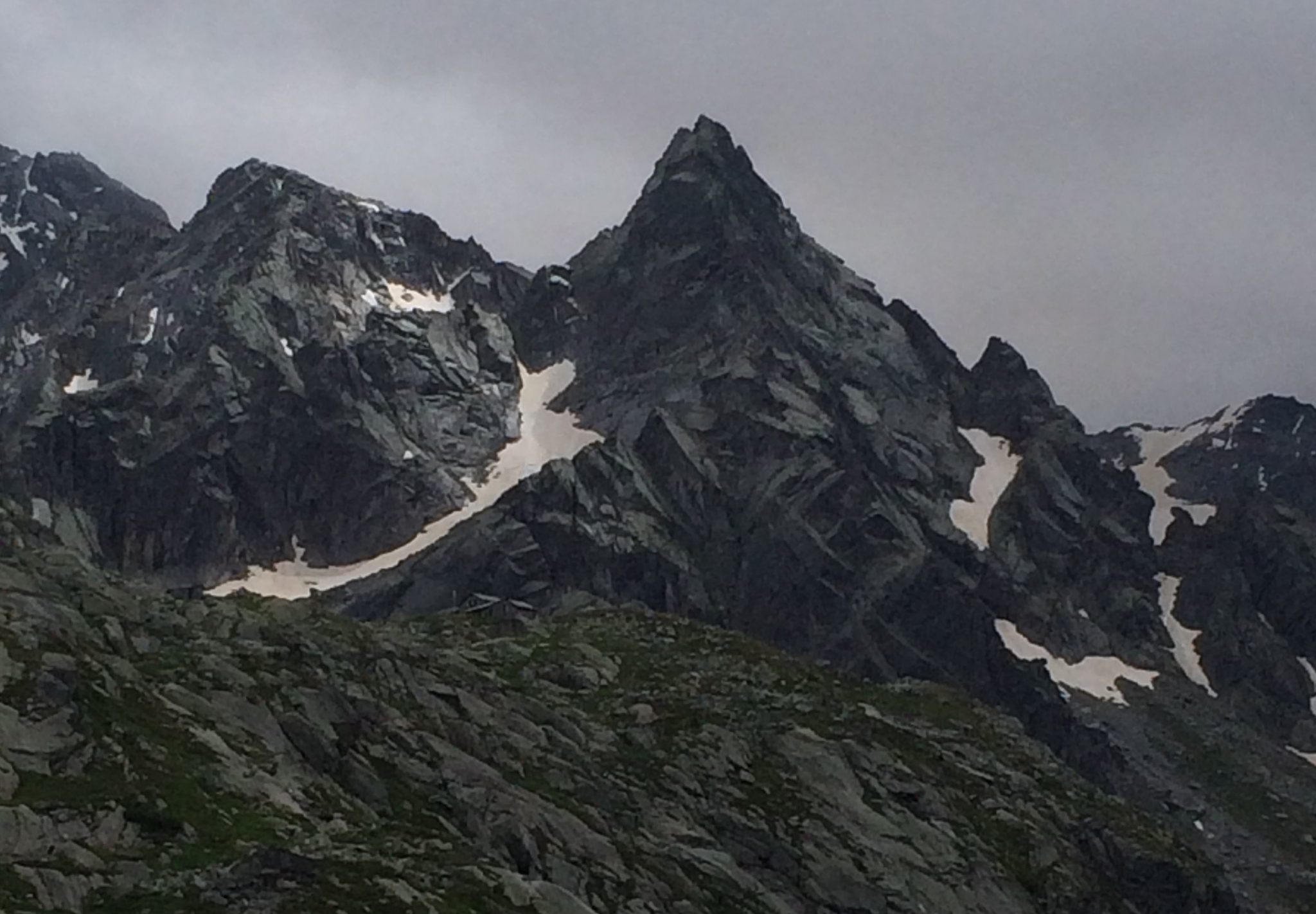
Photo 2: Tuesday morning, a view of the north ridge from the Sasc Faru HutThe guardian, Heidi, was very welcoming (considering we were the only two booked for that night) and amused when she saw the state of us, soaked to the bone, drowneded cats, Paddies on tour. She advised us that the weather forecast had changed and that the weather was set to improve from Tuesday morning onwards and that both Wednesday and Thursday looked like being settled, warm and sunny, and basically that we should hold off going for the route until the Wednesday when a number of other teams were also going to give it go. Local wisdom. That evening we discussed the route in depth with Heidi (she had climbed the north ridge twice), read up the various guide book (in German) that were available in the hut, with particular attention to the descent route (read the pictures), had a few beers and hit the sack.
On Tuesday morning we dried out our gear, chilled out until noon and read up on the route a little more. We then decided to walk up to 2,400m just below the route proper to give it a good reckie and to stash our gear so as save us the effort of lugging up a heavy load the following morning. (note: between 2,300m and 2,400m there were plenty of good bivy sites and running water from springs). The reckie proved invaluable, helping us to visualise and plan the route; the initial snow field and slabs up to the col at 2,589m, the start of the ridge, the Risch slab and its overhang, the daunting ridge above, the crux section, another steep looking ridge section, another large slab (which we nicknamed the Shimmering Slab), and above that the route seemed to continue endlessly to a ever-narrowing ridge. The rock looked dull grey, smooth and compact and the ridge as a whole looked somewhat like the prow of an upturned US navy aircraft carrier.

Photo 3: Tuesday afternoon, a view of the north ridge on the way to 2,400mPiz Badile was first climbed in July 1867 by William Coolidge with guides F. and H. Dévouassoud by the south face, while the north ridge, also known locally as the Nordkante, wasn’t climbed until 4th August 1923 by Alfred Zürcher with the guide Walter Risch. From 2,400m we could vaguely view on the east face the line of one of the most famous routes in the Alps, the Cassin Route, which was infamously climbed in July 1937 by Riccardo Cassin, V. Ratti, G. Esposito, Mario Molteni and Giuseppe Valsecchi. Heidi had informed us the evening before that Cassin still lived locally.
When we got back down to the hut other groups had already arrived and there was a buzz about the place. We relaxed for the rest of the evening, had dinner and hit the sack early enough planning to be up and at ‘em around 3:30am so as to get out by 4:00am.
We left the hut at 4:10am in darkness and with the aid of head torches arrived in good time at our stash point, just below the final snow fields. We donned our harness, arranged our gear and with ice axes made our way to the col (2,589m) at the start of the route on the north ridge, where we roped up, put on our climbing shoes, put away our axes and set off moving together. By 6:20am, under clear blue morning skies, the five groups who were attempting the route were established on the ridge, consisting of two Austrians, two Italians, three Swiss, two Czechs and ourselves, two Irish.
I led up the first section, moving together over relatively straightforward terrain of perfect granite (II/III/-IV), starting on the left side of the ridge before moving up on to the crest and on from there, with some exposure, to the base of the Risch slab (about 170m up from the col). The Austrians were just preparing to pitch the slab. Barry took over the lead. He started up on the left side, continued to under the overhang at the top and worked out right to exit the slab (IV+). During the next four or five superb pitches of (IV/+IV) of slab and dièdre climbing on the ridge proper, there was considerable traffic and delay with the position of 2nd, 3rd and 4th on the ridge continually changing between us, the Swiss and the Italians, while the Austrians stormed ahead. The interaction between the groups was in general good humoured, with the odd bit of f-in and blinding at the Italians over some ungentlemanly climbing behavior (simply just not cricket!). During these pitches, which were amazingly exposed and weaved from one side of the crest to the other, from bright sunshine to shade, the temperature plummeted as a wind gusted from the east. These proved to be the toughest pitches of the route due to a combination of the sustained climbing, the cold and the jostling for position.
We arrived at a stance that appeared to have two options, to traverse left below the ridge or go right across the ridge passing through a tight dièdre (which the guide book advised was the correct way). I got jammed in the dièdre with my big west-of-Ireland shoulders but managed to barge my way up to the next belay point, with Barry awaiting, grinning, pointing to the crux pitch. The crux pitch (-V) took the form of a short steep wall involving some easy bouldering moves, with lots of in-situ bolts and unlike the section of the ridge before, not in an overly exposed position.

Photo 4: Glorious climbing on the North RidgeWith the crux completed, the ridge eased for two pitches (III/-IV), with some short dièdres with some loose stone, that led to the base of the ‘Shimmering Slab’. This slab (IV) was climbed via numerous cracks; reminiscent of ‘Skull Slab’ at Aill na Crónáin back home in the Burren. From the top of this slab the route continued to another dièdre that traversed up across to the right side of the ridge and disappeared around a corner. The next belay stance was in an outrageously exposed position, a small sentry post situated on an overhanging ledge covered in snow with the full extent of the vertical north west face visible directly below. Barry led from there (-IV) on around to the right, singing a wee tune, leaving me with my thoughts. Each belay turnover took only moments with very little said, just the odd “ya horse!” and “you’re on”, “climb when ready”, “climbing” and “best of luck ya ol’ mucker”.
The climbing grade eased after the next pitch (-IV) and I took over the lead at this point giving Barry a very well-earned break. The next few pitches rose up over easy slabs (III) from one side of the ridge to the other, then mostly on the right-hand side avoiding small gendarmes with the occasional short back-climb until a small col was reached just before a posed block. We could see the top. From this col the route followed down to the left along a small narrow, snow-covered, gangway avoiding the last prominent gendarme before reaching a short tunnel between huge boulders that otherwise blocked the ridge. From the tunnel and after some easy terrain we had gained the summit at 3,305m.

Photo 5: Evening abseiling down the south face.The North Ridge of Piz Badile was climbed. With over 10 hours since the col at 2,589m, 22-plus pitches of continuous glorious climbing on superb granite, we had now to turn our attentions to getting down the south face to the Gianetti Hut.
The pair of Italians had just started descending from the peak when we had arrived. We could hear the Swiss team further below while the Czech team had turned back several hours before, opting to abseil back down the North Ridge. The Austrians, we imagined, were sipping coffee in the hut by that stage.
We changed into our big boots, had a quick snack, gathered ourselves and started the descent from immediately below the summit trig point via a short chimney (into Italy) to the top of the descent route that is defined on the east side of by a steep couloir and on the west side by the south ridge. The guide book suggested that we should descend the top section of the couloir. On closer inspection of the snow- and rubble-filled couloir, we decided to set up an abseil and descend down the slabs to the right of couloir. We could see the Italians immediately below us in some confusion, slipping in the couloir and untangling their ropes. I backed up an existing abseil point with some 8mm tat that I’d brought along and we started to arrange our two 50m ropes for the descent. One of the Italians came bolting back up to our newly set up abseil point and threaded their ropes through before we had a chance to get started (as I said early, simply just not cricket!). After an inconvenient delay we then abseiled down to another ledge and lo and behold there was an abseil point and some streaks of orange paint to indicate the descent route. Sorted! For the next few abseils the Italians were slowing us up big time and they kept asking which way now and then they’d rush off down ahead of us. At the end of our second 50m abseil we noticed that the pair of Italians were preparing to abseil down the right hand side of the ridge via a new looking bolt and chain abseil point. Like a haunting memory we remembered Heidi, back at the hut, warning us not to abseil down via this chain saying “you must stay on the left side of the ridge until the cross!” and that there was another abseil point further along the ledge. And there was. We convinced the Italians to follow us, away from their deaths, and we reconvened our descent down the south face.
Four 50m abseils down from the top of the couloir (from just below the summit trig) brought us to a ledge and narrow track that led down parallel to the ridge to another abseil point. This abseil led down to another ledge at the bottom of the couloir where another abseil point awaited. The Italians kept slowing us up and, despite our best efforts, we couldn’t get past them. Awkward individuals. We then convinced them to abseil down our ropes to speed things up as their ropes kept getting tangled and they seemed to be all up in a heap. I set up the abseil down and then one, then the other Italian and then Barry followed. This abseil ended at the path way to the cross which Heidi, like the oracle, had warned us was difficult to find. The path went down a bit, right a bit, up a bit (not down which is where some apparently go wrong), across a bit, left a bit and steeply down a bit to a ledge at the top of sheer gully which was marked by a metal cross erected by the Italian Climbing Federation. This cross doubled as the abseil point, or so all the tat suggested. Another nearly 50m-long free-hanging abseil, this time down the right-hand side of the ridge led to the final abseil point. By this stage it was getting late and the Gianetti hut, which had been visible for a lot of the descent, was lost in the darkness. The final abseil led down onto a snow field (c 2,900m) with a trail of foot prints leading to the moraine. We packed away our ropes, donned our head torches, and set off down to the hut in the dark. The Nordkante was climbed and the south face descended! Job done! Myself and Wattsie roared out an ol’ Clare shout, shocking the Italians a bit and fumbled our way down guided by the outside hut light that the guardian had put on when he spotted our head torches.

Photo 6: Panorama of the south side of Punta Torelli, Punta Santa Anna, Piz Badile, Punta Sertori and Piz Cengalo (in the early morning sun at the Gianetti)We got to the hut (2,534m) sometime around 10:30pm. Relief. The guardian brought us a full dinner and beer, which were both very welcome. Soon after we hit the sack. The next morning I got up earlyish, hands and feet paining a bit, planning to get ready for our return journey back to the Sasc Faru hut via Passo Porcellizzo and Passo della Trubinasca. Another potentially long day which, to tell the truth, I wasn’t looking forward to. But, the Italians, who at this stage were singing our praises for having apparently “rescued” them from the south face, made us an offer we couldn’t refuse. They had arranged for one of their wives to meet us at the village of Bagni del Masino at the head of the valley and to drive us to Chiavenna. Score. So after 2½ to 3 hours of downhill walking through the absolutely beautiful sun-baked Valle Porcellizzo, with waterfalls and springs, a cheese-making factory, and past enormous boulders and lizards and surrounded by magnificent peaks, we reached Bagni del Masino (1,172m). We paid a quick visit to the village’s famous thermal springs before being whizzed away back to Chiavenna in a Fiat Punto. Four smelly mountaineers, all their gear and one Italian lady zooming through the Yosemite of the Alps, passing by Europe’s biggest boulder, simply comical.

Photo 7: Barry, Conor (me), Mathew and Mario (the Italians) at Bagni del MasinoPhotos 1,2,3 & 6 by C. Warner, Photos 4,5 & 7 by the Italians (and the Italian’s wife)
Gear
(shared between the two of us):
- 10 medium sized nuts
- 6 medium sized rock-centrics
- 2 friends (size 2 and 3)
- 2 50m ropes
- 7 slings
- 12 crabs
- 11 extenders
- 2 belay bugs and abseilers
- Tat and Prussik loops
- Head torches, helmets, harnesses
- Ice axes and crampons (for the return trip back over the passes to Sasc Faru)
- And the usual stuff, but not too much, had to keep the weight down.
Route Description Summary
- Bondo (823m) via toll road to Laret (1,252m) to Sasc Faru hut (1,904m) to summit of Piz Badile (3,305m) and down to Gianetti hut (2,534) and finally down to Bagni del Masino (1,172m).
- 652m ascent of a walk-in from Laret to Sasc Faru hut, less than 2 hours (or 1,081m from Bondo 3½ hours)
- 1,401m of an ascent with 716m on the North Ridge (2 hours to 2,589m). Guide book time for the ridge is 5 to 7 hours, but easy to be delayed with traffic to 10 hours)
- 771m of a descent with 405m on the South Face. (Guide book time of 2 to 2½ hours, but easy to be delayed with traffic (of the Italian type) to 4 ½ hours)
- 1,362m descent of a walk-out to Bagni del Masino, less than 3 hours
Grade Summary
- North Ridge circa 22 pitches of (III/IV) with one pitch of (V-) with an overall grade of (D-) with fixed belay points for much of the middle section and some bolts and pegs.
- South Face (in ascent) is PD (II/III) with fixed rings for the majority of the abseil points.
-
An ascent of the North East Ridge of the Spazzacaldera
(by Pauline Delahunty, from the IMC Newsletter Autumn 2001)
A personal account.
I rarely think about what I say. In fact half the time I bypass my brain completely. My mouth takes off on its own, spewing verbal vomit over everyone, leaving me to deal with the fallout. Mostly, that fallout consists of bruised egos, some shocked moral standards or a dented reputation, and more often than not, these injuries belong to me. I’ve learned to live with the flaw and sometimes even laugh at the scenarios it creates. This was not one of those more humorous times. On this occasion my mouth got me into trouble. Big trouble. Trouble of the life threatening kind.
Sitting around a camp site in the Swiss Alps with fifty other Irish climbers is an exciting place to be. Routes are planned, equipment checked, adjusted, repaired and rechecked. Rucksacks are packed and repacked, each item ruthlessly judged for its weight versus necessity. Weather, snow and even avalanche conditions are discussed in earnest. Health issues are of the utmost importance as people become very aware that their body is a their most vital piece of gear. Most notably, are the compelling stories of death-defying feats and epics of high altitude adventure which are recounted and exchanged.
It’s a wonderful feeling to be part of the MCI meet. However, being relatively new at the mountaineering lark and being acutely aware of my own mortality, I tend not to stick my neck out. I have a secret desire to live for ever and so far so good. Then my big mouth decides to stir things up. In the midst of the bustle and chat I heard a confident earnest voice say "I’d like to do the Fiamma". I nearly laughed when I realised the statement came from me.
The Fiamma is a skinny flake of rock that sticks straight up out of a 2,500 metre mountain called Spazzacaldera. There is just enough room on the summit for one person to straddle the rock and if that’s not heart stopping enough the top is an independent boulder which sits on the flake and has been known to wobble.
A reply came in the form of a Northern Ireland accent "Aye. I’d like to do the North East Ridge of that. Let’s do it tomorrow so." The accent belonged to one Coryn Armstrong who had previously informed me that he leads E1, ergo way out of my league. "Great" says I, not being able to admit that when I said "I’d really like to do the Fiamma" what I meant was "I’d really like to do the Fiamma if I was a competent climber with a fit and co-ordinated body and a spare life in my back pocket". I didn’t mean that I’d actually consider doing the climb, much less the North Ridge and forget about liking it.
Caught in the headlights of my own ego, I could not back out now. Coryn very matter-of-factly continued "so I guess we’ll leave around 10.30 in the morning. You will of course need your climbing shoes, harness, some extenders, I’ll bring the lead climbing gear and I have an 8.5mm half rope. That’s a bit thin but it’s light which is obviously an advantage. It won’t take a hard fall of course, but its strong enough to take a slide, so it will be fine."
"Great" I croaked feeling a little bit nauseous trying to digest the bit about the rope not being strong enough to take a fall.
We started the climb the following morning at 12 noon a little later than planned. At the base of the first pitch we changed from our runners into our rock shoes. As we sorted out the rope we discussed the climbing route, well Coryn discussed the climbing route, I nodded a lot. "How do you feel about alpine-style climbing on the easier gradients?" asked Coryn.
"Great" I replied. Why was I saying "Great" when I meant "No Fucking Way"? Still preoccupied with figuring out a way of getting out of this without losing face, I started the scramble. It was a grassy slope and not very steep, I knew I could handle it. I was cool. The gradient became a little bit steeper and the knot in my stomach tightened. Coryn was way ahead and out of sight, I shouted at him that it might be an idea to stick in an oul’ piece of protection (like before we plummeted to our deaths some 800 meters below). I tried to sound casual but I’m not sure Coryn bought it.
The real climbing started shortly after that. Coryn shot off clipping in to fixed bolts as we ascended. Following behind, I unclipped the gear, getting a frequent bout of disco leg. Elvis would have been proud. My mother would have killed me (had I not been making such a good job of that myself).
"Don’t look down", I thought. I rigidly adhered to this rule all day, knowing that the moves are easy enough, it’s exposure and the views that are the thrill for most climbers on this route. If I didn’t look down, I reckoned I had a serious advantage over those other climbers, so I stuck to this policy.
We climbed on, stopping occasionally on wider ledges for a chat. Coryn, despite his young age, had an impressive and prolific climbing career. As a result, he has more than a few high altitude adventure near-miss adventure stories. My favourite was of his friend Eddie who didn’t have a bog about the wonderful world of mountaineering (I identified). Eddie forgot his water bottle on one of his first Alpine endeavours. Not a bright move. Eddie and his buddies were climbing the ‘Barres des Ecrins’ a 4,000+ metre peak of considerable adversity. The final three hours of the route are a rocky ridge with sheer drops on either side. Given the height and the difficulty of the climb, most people understandably travel light. Eddie however, on reaching the summit, and amidst some slagging from his mates over his water-bottle error, reached into his back pack and casually extracted a stove and pots and began to melt snow. Class.
I was surprised at how quickly we ascended. The summit was rapidly getting closer and it looked like we would finish the route in fine time. As this glimmer of hope was emerging, disaster struck. I was happily(?) climbing a chimney of rock. There were two huge grooves running almost parallel, so with one hand and one foot in each I was shimmying up feeling about as secure as I could at 1,500 metres. The cracks gradually began to diverge. I stuck with them hoping they would reunite but they didn’t. It got to a point where I was spread-eagled, hugging the now very wide central column, koala fashion.
"Eh Coryn," I tried to sound normal with one cheek pressed firmly against the rock face and my heart about to leap out of my chest "I’m about to make a dodgy move. You got the rope secure up there?" I received a completely incoherent reply from an out-of-sight Coryn. He was too far away for me to hear him. I thought I would repeat my warning seing as how my life depended on it. "Okay, I’m going to move now" I shouted not moving an as much as an eyelash but beginning to slide down all the same. I got another muffled response. I wondered how much slack there was on the rope before it would tighten and hold, then I wondered if it would hold. I decided not to leave gravity win without a fight so I dubiously removed a shaking right hand and slowly transferred it into the left crack Feeling around for a good hold I was rewarded with a generous place to wedge four fingers, a gift from God. I then found I was able to pull my right foot over and get two feet in the left-hand groove. Hey presto, I was safe (well I wasn’t falling at any rate). It wasn’t until afterwards, in the sanctuary of the local pub that Coryn told me he was actually shouting "Don’t fall for a minute, you’re not on belay". Great.
We hit the base of the final and most difficult pitch, up to this point it the climbing had been grade 4, this was now a grade 5. The weather looked like it was closing in. I prayed it would rain but didn’t. Instead dark clouds hovered ominously, the odd measure of thunder rumbled around inside them, but no rain.

The Fiamma, Spazzacaldera, BregagliaCoryn led, I watched him from the base of the climb. Towards the top he began to feel around looking for a hand-hold. I could tell from the way he rejected and then reconsidered the holds that there was nothing ideal at that point; it was a question of palming the rock and pushing up with your feet. It took him just ten minutes to get to up. He didn’t spend long on the summit, the odd low roll of thunder warned us not to delay.
Now it was my turn. My stomach was in knots. My breath was shaking. "I can do this", I thought trying to convince myself. Coryn coached me up describing the route as I ascended. I did okay until I received the instruction, "At this point there really isn’t anything to hold on to and there’s not much for your feet either. You just have to smear across and up to your left for a bit". The word ‘smear’ is enough to put fear in to the heart of any woman. At 2,500 meters ‘smearing’ just doesn’t sound like a very good idea. I looked at the smooth rock and contemplated the move. I looked down at Coryn; "It’s okay" he assured me, "I have you". "Yeah, I thought, on an 8.5mm half rope". I went for it, completed the move and found myself in an equally difficult dilemma.
"This is the final difficult move" he said. "That’s what he said about the last one" I thought. "You reach up and around with your right hand and palm the rock on your left and stand up on the ledge on your right." "Ledge on my right" I thought, "what ledge on my right" and then I saw that he meant the quarter-inch sloping blip in the rock face. It was a ‘ledge’ in about the same way a unicycle is a mode of transport but I could see the summit and the thought of straddling it and feeling secure was the incentive I needed. I made the move. I sat at the top, trying to believe I was actually there. I raised both fists in the air and took a deep breath. For the first time that day I dared look down. On one side I could see our camp site way way below, on the other side a massive dam and gorgeous big mountains all around. The view was stunning from my vantage point – on top.