Skip to content
Irish Mountaineering Club IMC, Cumann Sléibhteoireachta na hÉireann
  • Facebook
  • Instagram
Join Now
Book the Hut
Members Login
  • About
    • Introduction
    • Contact Us
    • Documents
      • Constitution
      • Privacy Policy
    • Expeditions
    • Kindred Clubs, Handy Hostels
    • Library
    • People
  • Join
    • Introduction
    • New Membership
  • Blog
    • Article
    • Obituary
    • Review
    • Route Info
    • Training
    • Trip Report: International
    • Trip Report: Ireland
    • Other: Bottom of Home Page
  • Events
    • Introduction
    • Calendar
  • Hut
  • Publications
    • Introduction
    • Books
    • Newsletters
      • 2010-now
      • 2000-2009
      • 1990-1999
      • 1980-1989
      • 1970-1979
      • 1960-1969
      • 1950-1959
    • IMC Archive
    • Videos
  • Training
    • Overview
    • Introduction to Trad climbing Programme
Irish Mountaineering Club IMC, Cumann Sléibhteoireachta na hÉireann
  • Log In
  • Join the IMC
  • About
    • Introduction
    • Kindred Clubs, Handy Hostels
    • Library
  • Blog
    • Article
    • Obituary
    • Review
    • Training
    • Important Information
  • Events
    • Introduction
    • Calendar
  • Hut
  • Publications
    • Books
    • Newsletters
      • Newsletters 2010-2018
      • Newsletters 2000-2009
      • Newsletters 1990-1999
      • Newsletters 1980-1989
      • Newsletters 1970-1979
      • Newsletters 1960-1969
      • Newsletters 1950-1959
    • IMC Archive
    • Videos
  • Training
    • Overview
    • Introduction to Trad Climbing Programme 2026
Join Now
Book the Hut
Log in
  • Trip Report | Mont Blanc in a Day

    Trip Report | Mont Blanc in a Day

    by Ronan Garvey


    Section 1: Les Houches (1050m) to Mont Lachat (2500m) | 23:15 -01:00
    It’s 11pm on a warm August night in the Chamonix Valley. Saint Jean Baptiste stares out at me from his church. The influence of a West of Ireland childhood never too far away as I say a short prayer. I’ve kept this climb a secret, telling only a small group of friends about my intentions. The risk of solo climbing is obvious – but is this greater than the risk of neglecting your ambition?
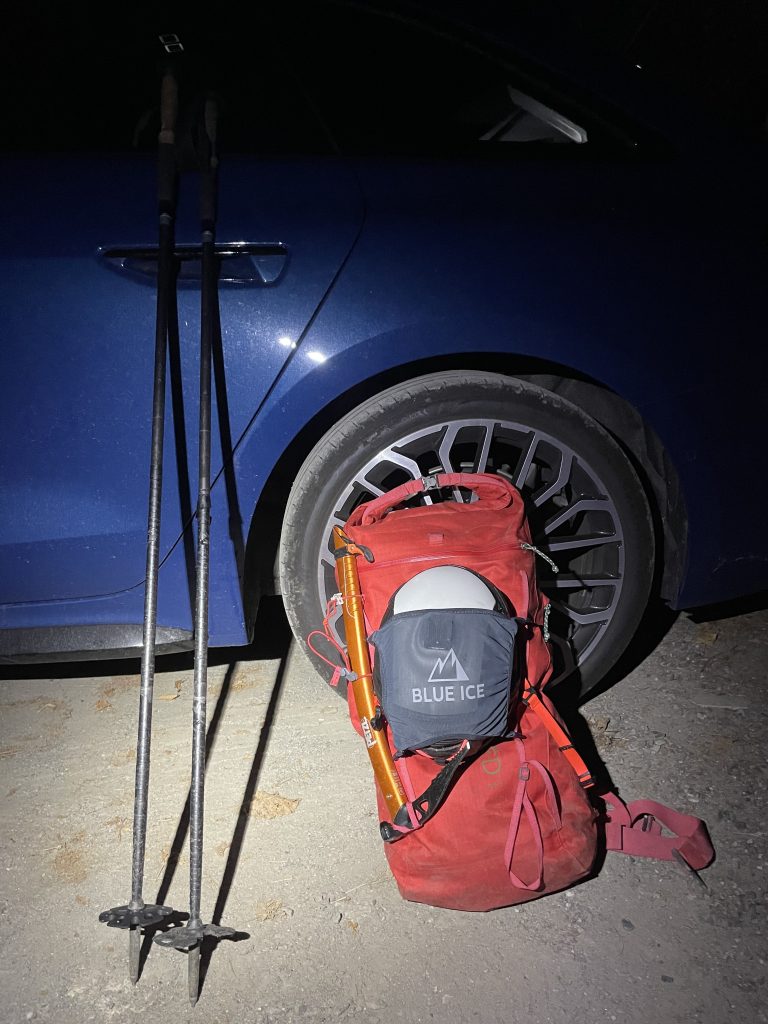
    I know I have trained my body well, but mental fortitude is ephemeral. I’ve been watching and studying this mountain for weeks now. And the closer I get to its base the more intimidated I feel by its presence. The storms, the darkness, the crevasses. I’ve played out the script of this climb many times in my mind. Will the protagonist succeed, or will he succumb?

    My bright red bag sits rigid on my shoulders – all 9.4kg of it. I’ve saved up and purchased new gear to give myself a fighting chance, but I still remark at the total weight. Small things help; I will wear trail shoes to the Tête Rousse Hut and then switch to B2 boots; this will reduce fatigue later in the climb. My hip-belt is broken but rigged with a tension knot on a carabiner, aside from this all my gear is dialled. I’m carrying exactly 2100 calories and 2000ml of water. No room for miscalculation on these margins.

    I travel through the forest overlooking Torrent de la Griaz. I’m moving well and quickly catch a few bobbing headlamps ahead. In a way the newfound company is reassuring but in other ways I’m unsettled. I briefly join forces with a Slovak and a Spainard, but conversation doesn’t materialise. I notice my pace quicken as we ascend further through the forest and here, I realise the danger of my own ego. I want to beat these men to the summit, but then I catch myself. This is not a race, and these are not competitors. This is a personal challenge, so I separate with these kindred souls soon after we reach Cabane des Arandellys. Now, I’m thrust back into the solitude and darkness toward Mont Lachat.


    Section 2: Mont Lachat (2023m) to Tête Rousse Hut (3167m) | 01:00 – 3:30

    Yellow reflective barriers now appear, and I am directed onto a cliff edge with a railing. I clamber up a steel ladder and am thrust into brand new kind of terrain: the building site of the Nig d’Aigle Station. Signage, red tape and hi-vis jackets are designed to promote caution. And it is hard to process the artificiality of this scene – it is also hard to ignore its symbolism: there are no safety barriers in the alpine. It is a hostile place, and death is a real possibility. I rest for a few minutes and continue my journey.
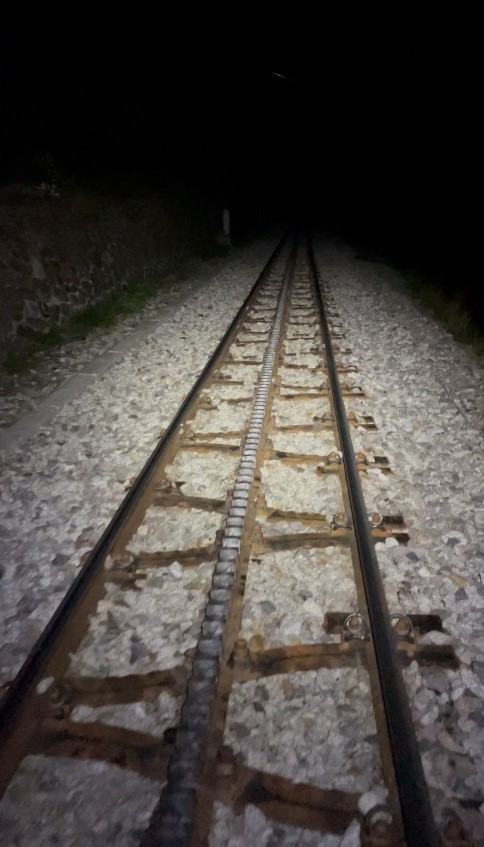
    I can’t appreciate the round stone desert given the darkness. At night it mimics a lunar landscape, populated by brightly coloured spacemen carrying sophisticated equipment to maintain life. The moon is an almighty size tonight and the Milky Way prominent against the inky galaxy. The red round stone desert could well be Mars – I reach for a Snickers bar in my back pocket and centre myself on the task in front of me.

    It is dark and still as I approach the Tête Rousse hut. I find water running off the glacier, collect some and iodine it. Not the best but it’ll do. It’s getting chilly and I spot the remnants of the Tête Rousse glacier – my boots come on and I fish out my crampons. I spot groups of lights high on the cliffs above, and I return to the mission. The moon is now hidden by the North face of the Goûter and my headtorch tries to penetrate the darkness. I follow a line of boot prints across the glacier as it steepens. Soon I’m at the edge of the Grand Colouir, It’s 4am and I’m on time. I listen for rockfall for 5 minutes. Nothing. I assume everything’s frozen in. I walk carefully across the narrow traverse. The nighttime hides the extreme exposure.

    Scrambling up the Goûter face at night is psychedelic. There is total silence. My human experience is distilled to the limits of my headtorch beam. I only worry about what I can see. I spot intermittent yellow and red paint marks on the cliffs which reassure me of my chosen course. I settle into a flow state somewhere near 3300m. My life now has only two rules: three points of contact on the rock and constant vertical motion. My breathing moves in rhythm with my body. My bag grows lighter on my back, and the 800 metres of vertical relief passes rapidly. I lose sense of time. As I entered the upper sections of the scramble my fear begins to return – I feel safe here clinging to the cliff face.

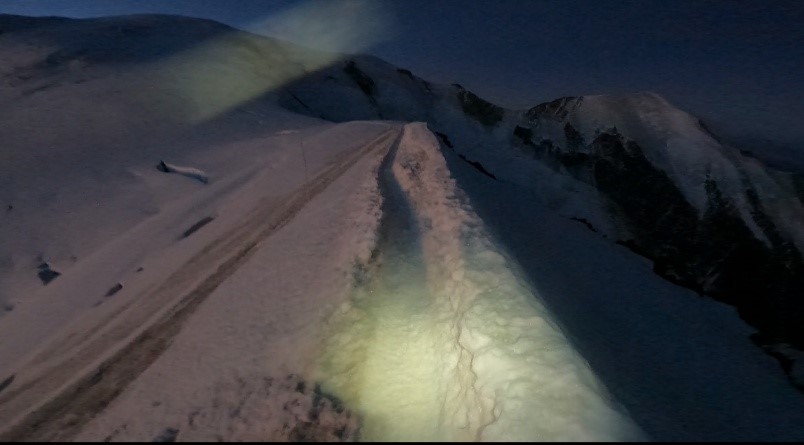
    The sun starts to threaten the stars; I finish up this experience on a metal platform at the old Goûter Hut and speak to an Italian climber who was coming down from the Brouillard route. He told me that snow conditions were excellent up there. I climb onto the Auguille de Gouter snow ridge. It’s 6am. Cloudless. 1000 metres left.

    Section 4 Aiguille de Goûter (3,863 m) to Vallot Hut (4,362m)| 06:00 – 08:00

    I’m now entering the section of Goûter route with the highest objective danger: the Dôme du Goûter Glacier crossing. Crossing a wet glacier by yourself is always risky. Snow bridges become less structurally sound as the sun hits, so I timed my entry point to this section for the coldest part of the night (4-6am). The freezing level was at 4000m, just low enough. I swallow my fear and move onto the ice mass.

    A wide, flat and desolate glacier field opens ahead of me. I make out faint tracks zigging and zagging around several crevasses. I creep upwards along the path. Passing 4200 metres of elevation now, and the altitude bites back. I see three lights high near the Dôme, and I motivate myself to chase them down. After 20 minutes, the lights disappear, and I’m thrust back into isolation. I am moving alone on this glacier for over an hour. Abject terror arises each time I pass a crevasse, to which I give a wide berth. It feels surreal, the moon, the stars, the mountain and me.
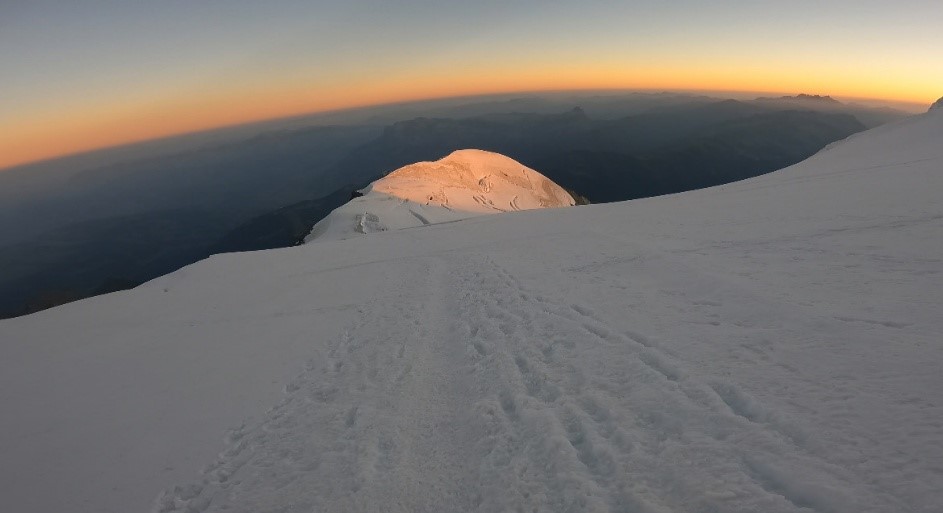
    I amble cautiously upward towards the Dome du Goûter. The sun is shining on the Refuge du Goûter as I look back. I think of it as an alien spaceship in an alien place. The refuge seems right at home. As I ascend over the Dome du Goûter, the sun greets me for the first time. I’ve been pushing hard now for almost 8 hours, ascending 3600 metres over 13.5km. The average gradient has been 25%. I’m down to my last litre of water and I’ve been awake for over 24 hours. It’s a serious situation by all accounts. I can feel fatigue cloud my brain, luring it into rest. I try to keep my focus because the most difficult section is yet to come.

    The Bosses Ridge splits the blue sky in front of me as I arrive at the Vallot Hut. The Glacier du Bionnannasy falls away on my right, and the Grand Mullets falls away to my left. I spot Aiguille du Midi for the first time far to the North-east. I spent yesterday acclimating at the Midi, which was the extent of my acclimatisation plan. It’s quaint museum, café and exhibits feel so foreign now, as I look out across the Massif.
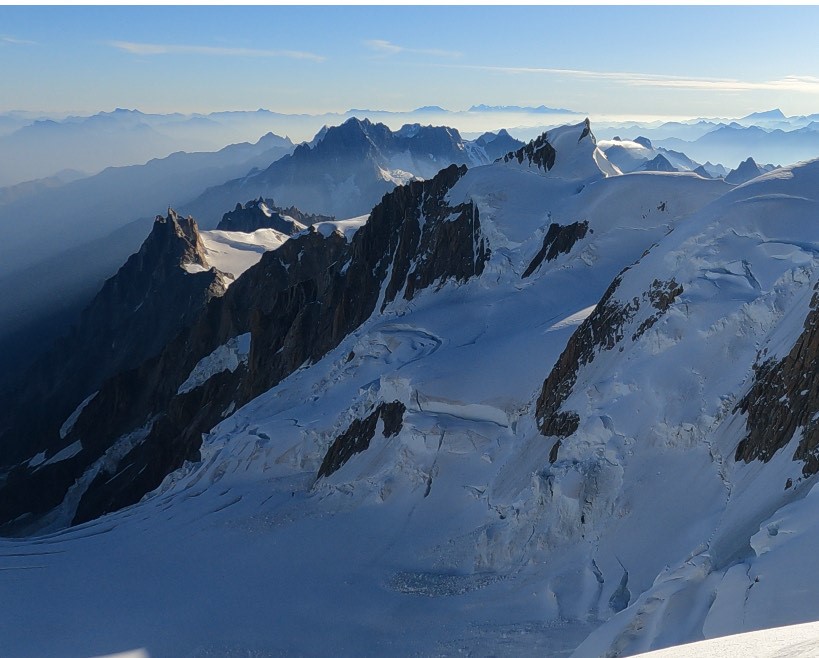
    I take a breather at the Vallot Hut and cache some gear. Poles, Shoes, Hardshell – they won’t come any further. The weight loss buffers the fatigue, and I start to feel agile. 400 vertical metres left to climb, I think this might go, but I hold back any aspirations of summiting.


    Section 5: Vallot Hut  (4,362m) to the Mont Blanc Summit (4807m) | 08:00 – 09.15
    My ice axe and crampons plant me to the warming snow of the Bosses Ridge. Precision is required; the adrenaline blocks the fatigue as I settle back into my climbing rhythm. The air is noticeably thinner over 4400m, and my lungs strain to get their feed. Grande Bosse (4513m) up first, but my heart sinks as I spot a group of eight climbers in front of me. I realise now that the biggest danger is being knocked off by others. When I reach the tail end of this group of Italians, I make a mad dash of about 70 metres up to their right. This puts an almighty strain on my chest, but I am in the clear. It takes me over five minutes to fully catch my breath. I hope this episode doesn’t repeat itself higher on the narrow ridge.

    This effort was more than worthwhile but knocks it out of me, and I need to overcome the lassitude as I ascend the Petite Bosse (4537m). I know my window of opportunity is short for this reason. The ridge is stunningly beautiful, and the exposure is immense, but it is difficult to feel any emotion now. My entire focus is on my next step. I barely dare to glance up.
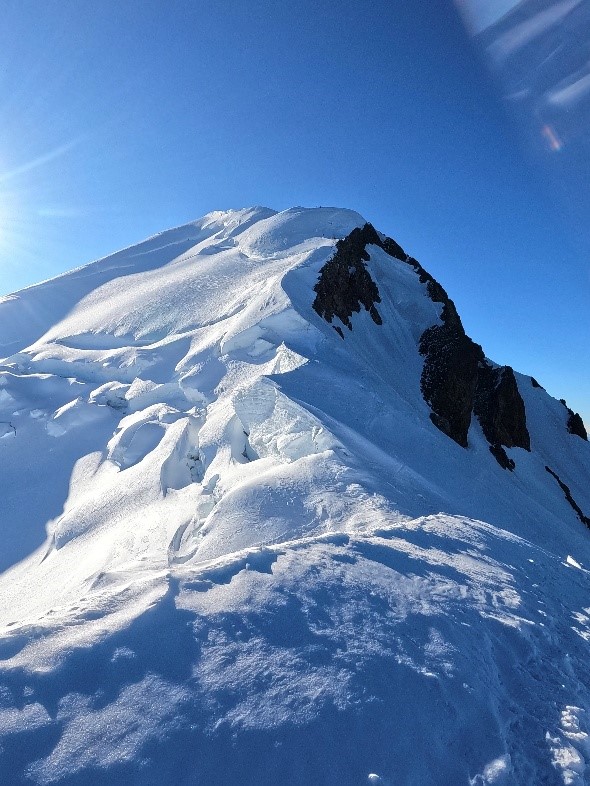
    Now I drop down from the Petite Bosses ridge into a wider saddle. I see my next obstacle: a 50-degree ice/snow slope which rejoins the main ridge. The route follows the left-hand edge of an enormous serac. Below this serac to the right, the Bionnassay Glacier rests at 2600 metres. Between them is thin air. You can see this in the centre of the picture, to the left of the base of the highest rock band. I stop momentarily to assess the difficulties, and to catch my breath.

    “No despair, no happiness, no anxiety. I have not lost the mastery of my feelings; there are actually no more feelings. I consist only of will” – Reinhold Messner

    Like a stray dog in search of his next meal I power on. I will myself onto the edge of the serac. My joints move robotically, drugged by my own aspirations and the lack of oxygen at 4650 metres.

    I tip-toe gingerly up the icy slope as my crampons impale the crust. I make 50 paces before resting on my axe. 50 more. Rest. And so on. Until I am standing atop of the serac on a narrow ridge. I shuffle forward at my familiar place, mostly numb to the exposure now. 50 more paces and I enter onto a much wider slope. The summit seems closer now, but I can’t be sure. I glance up anxiously now as I move, hoping for respite or reprieve. Nothing comes as I grit my teeth. My breathing narrows and my lungs constrict. This situation has generated a new state of being, nestled between masochism and meditation.
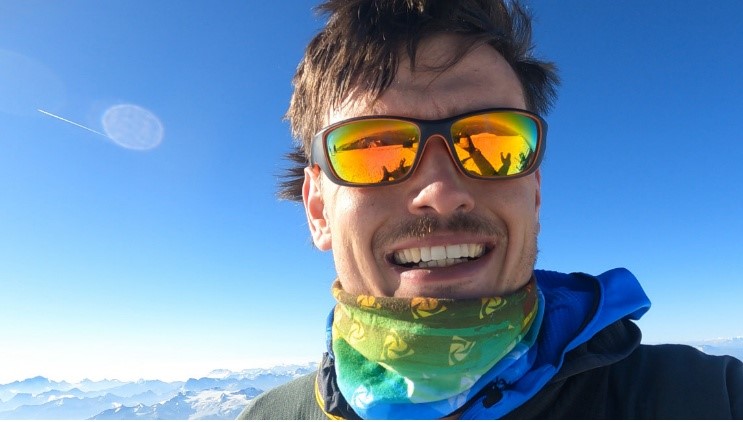
    My mind is totally empty. For many months I lived with the self-inflicted burden of attempting this climb. Doubt, fear and anxiety are first cousins of aspiration. To not aspire, is to not live. The risk is always failure, which can manifest itself in many ways. But today I won’t fail. I now stand 50 metres below the summit cap. I slowly realise that I will satisfy my ambition; I will self-actualise. I move slowly up the final stage of the summit ridge, soaking in every step.

    The view from the summit at 4807 metres is impossible. It extends for hundreds of miles in every direction. There is no wind. The sun glints off my ice axe as it catches the morning rays. My lungs burn and strain in the oxygen depleted air. I have arrived at my destination.

    It is 9.15am on the morning of Monday 19th August 2025. In ten hours, I have climbed 4000 metres over 16km, alone. I started in Les Houches on the valley floor at 11.15pm last night and now I stand on the summit of Mont Blanc, the highest mountain in Western Europe. I take a seat on the summit cap and fall on my back. I feel free as I stare at the blue sky above me. All I can bring myself to do is sit down at this very spot and smile. The dragon smiles back, he knows I caught him this time.

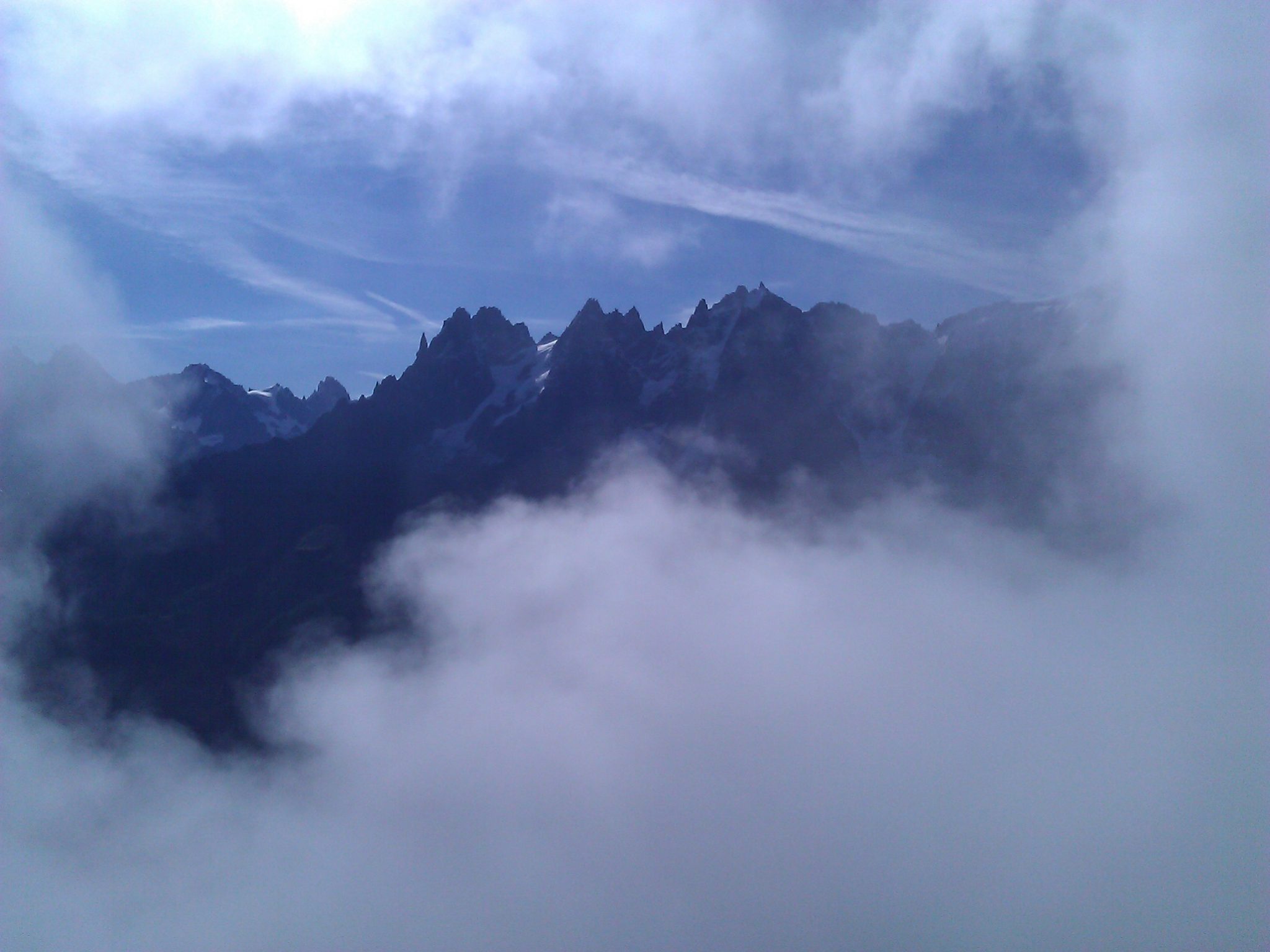
  • The Discreet Charm of Chamonix

    The Discreet Charm of Chamonix

    In late June I spent eight days in Chamonix climbing with Dave Keogh. He had been there for the previous two and a half weeks with Niall and Ken.

    Ace-of-clubs
    Cocher Cochon – Aiguilles Rouge

    I was at a disadvantage with Dave being fully acclimatised having already spent two and a half weeks in Chamonix so we went for a low level start with a route near the Plan-Praz, the halfway station on the Brévant. The 30 minute walk-in to this also suited me fine. The route was bolted and the climbing increased in quality and difficulty the higher we went, finishing with an exhilarating 40m pitch up an airy arête to the summit. it was a perfect introduction to the local rock.

    Cocher Cochon
    Cocher Cochon

    Chamonix from the Brevant
    Chamonix from the Brevant

    2-of-clubsVoie Rébuffat & Cosmiques Arête – Éperon des Cosmiques
    An early start the next day had us at the Midi station before seven am in the queue for the first gondola of the day. For a first day up high we went for the Cosmiques area just adjacent to the Midi. Climbing was straightforward apart from one very awkward roof which Dave managed to do clean. We had decided to climb with our bags rather than abseil, so having finished the route, this allowed us to scramble out over the Cosmiques Arête directly to the Midi. There was lots of rubbernecking on the platform with a chopper rescue in progress as we topped out.

    Dave on the Cosmiques Arete
    Dave on the Cosmiques Arête

    Tourists at the Midi
    Tourists at the Midi

    Helicopter Rescue
    Helicopter Rescue

    3-of-clubsPyramide du Tacul
    Next morning we were back to the Midi queue. Having geared up at the Midi we than had a long downhill walk to the base of the Tacul (makes you wish for a pair of skis). We then circled around a dodgy looking glacier/bergschrund to get to the base of the climb. There was one english party ahead but we passed them on pitch 4 after they took a wrong turn. Dave climbed a nice crack with a rather airy approach while freestyling on pitch 3. The english team and the french behind them both retired under time pressure to get back to the Midi before closing. With the luxury of staying in the Torino Hut we were under little pressure and continued to the top of what was a fantastic sun-baked route. Re-crossing the bergschrund and glacier in the heat of the afternoon happily went without incident and then we had a long pull up the slope to Italy, finally getting to the hut just before six.

    Pyramide de Tacul
    Pyramide du Tacul

    View from the Torino Hut
    View from the Torino Hut

    4-of-clubsDent du Géant
    The giant’s tooth is an iconic peak visible from all parts of the Valleé Blanche. After an early morning walk from the Torino, we had quite a long scramble up rough ground to reach the base of the climb. Facing west it was cold in the early morning, maybe we should have first warmed up on the Rochefort ridge. Also swapping boots for rock shoes was a mistake in retrospect, comfort and warmth were at more of a premium. What is a super route is spoiled by the huge white rope dangling the length of it, and given the bitter cold, it was hard to resist as speed was the order of the day. We finally found some sunshine at the top and could then relax and enjoy the situation.
    After abbing back to our gear we made a cautious descent back to the snowfields, conscious of the route’s recent tragic history. Back on the glacier the morning’s firm crust had now melted into soft mush as we tramped back to the Torino.

    The Dent du Geant from across the Vallee Blanche
    The Dent du Géant from across the Vallée Blanche

    The tooth up close.
    The tooth up close.

    5-of-clubsAiguille d’Entrèves Traverse
    With a long slog back to the Midi ahead, and conscious of time constraints, we decided to have a short day and go for the traverse of the Entrèves. The approach was about an hour from the Torino and we got there just before the Sunday crowds. The route is mainly rocky scrambling and some down-climbing, and while very easy, the situations are fantastic with Italy on one side and the Vallée Blanche on the other. It was a long hike back to the Midi, but having decided not to hire a guide for this incredible challenge, we could now look forward to spending the money saved back in the bright lights of Chamonix. Wandering across the glacier in the midday sun is not textbook alpinism but it was quite busy so presumably it doesn’t eat that many people up.

    The Entrevers
    The Entrevers

    The Entrevers
    Looking back at The Entrevers

    Crevasses in the Vallee Blanche
    Crevasses in the Vallee Blanche

    6-of-clubsL’An d’Emile – Aiguilles Rouge
    After 4 days of big boots, axes and crampons we decided to go lightweight and headed for the Aiguille L’Index, handily located just above the Index chairlift. Although we carried trad gear, the route was completely equipped. Climbing was fantastic throughout, hot rock basking in the sunshine. We made a mistake in leaving a bag at the bottom (as the descent was over the top and down the far side). Dave drew the short straw to go back the long way, but he came back from the road less travelled with quite a collection of swag.

    L'an d'Emile
    L’An d’Emile

    L'an d'Emile
    L’An d’Emile

    7-of-clubsNabot Léon – Aiguille de Blaitiére
    For our next day we went for the Blaitiére which is approached from the Plan station (half way to the Midi). This involved a bit of a slog over glacial rubble and then a short snow slope followed by a scramble up to the ridge. Although still in sight of the Plan the walk-in took the best part of two hours. The climbing here was really good if somewhat hard for the grade. After three superb pitches we were in a quandary as to where the fourth went. After a few false starts Dave eventually climbed something and after taking the fifth we decided to bail as time was out of joint, just getting back to the Plan before closing time.

    Blatiere
    Blatiere

    Dave happy to be back on solid ground.
    Dave happy to be back on solid ground.

    8-of-clubsVoie Gaspard 1’er – Aiguilles Rouge
    After seven days climbing something handy was needed so we headed back to La Flégère gondola & L’Index chairlift to go bolt-clipping. A 45 minute approach across some snowpatches brought us to the foot of this route where we met a scottish pair roping up ahead of us. Climbing was straightforward with some nice jamming on pitch 3. The crux on pitch 6 was easy and overgraded but it was super climbing throughout. There was an option to continue with a traverse of the Aiguille Crochues but we decided to cash in our chips. After topping out, a scramble down the back of the crag brought us back to the chair lift by lunch time.

    The Aiguile Vert, Dru and the Grandes Jorasses from the Index
    The Aiguile Vert, Dru and the Grandes Jorasses from the Index


    Eight consecutive days of sunshine alpine climbing was hard to beat. Obviously the sun always shines here so we decided to return in August and focus on rock routes.

    9-of-clubsLa Fin de Babylone – Aiguilles Rouge
    Originally with three good days forecasted we had hoped to go straight to the Envers hut, but it was booked out the first night so instead we stayed in Chamonix and went for a warm-up on the Brévant where our plan was to do ‘Poème à Lou’. Having taken the gondola to the top station we then scrambled down to the base of the crag where it was rather unnerving to see base jumpers pass by from above. It’s hard to appreciate just how fast they are actually falling until you see them pass you.
    We started up the route and made good progress although it was not quite what we expected from the guidebook. We then came to a delicate traverse under a roof where there should be a fixed rope but none was to be found. Unperturbed Dave continued on and managed to send what was a 6c pitch in fine style. While I was dogging across afterwards, we met a german party on the route next to us. “After the pitch you’ve just done the rest is straightforward” one of them encouraged us. I mentioned that we had expected to find a fixed rope under the roof but she replied that there was never one there…strange! The guide then came up to Dave’s stance and told us that in fact they were on ‘Poème à Lou’, and we were on ‘La Fin de Babylon’ (a grade harder), a route their party had done the week before!. Having done the crux Dave decided to finish out ‘La Fin de Babylone’ for an impressive if somewhat unplanned tick.

    BASE jumper on the Brevant
    BASE jumper on the Brevant

    Golf mats and a little cord to get you started!
    Dave getting ready to tee off

    No sign of a fixed rope!
    No sign of a fixed rope!

    10-of-clubsLe Piège – Aiguille d’Envers
    Having secured lodgings for the next two nights in the Envers hut, we set off on the first train to Montenvers the next morning. This is a rather quaint and scenic cog wheel train that brings you from Chamonix to a little station high above the Mer de Glace and opposite the Dru. The path then drops down to the glacier which is apparently getting lower every year. After about walking 2km on the glacier it was then back on the ladders back up to the Envers path which continued up the valley high above the glacier until we finally reached the hut. After stopping for a brew and sorting our gear it was just a five minute walk to the Tour Verte where we went for ‘Le Piège’. Dave had to work hard on the first two pitches, all that Fair Head jamming practice standing him in good stead. The difficulties eased somewhat above and we had spectacular views over the hut, the glacier and across to the Géant and the Rochefort arête.

    Climbing directly above the Envers Hut
    Climbing directly above the Envers Hut

    The view over the Mer de Glace to the Géant and the Vallée Blanche
    The view over the Mer de Glace to the Géant and the Vallée Blanche

    Jack-of-clubsGuy Anne – Aiguille d’Envers
    The next day we went for the classic “Guy Anne” on the Pointe Des Nantillions referred to as “Little Yosemite”. You can see why as it is a sea of pristine granite in a fantastic situation. It took a while to find the start of the route as we wanted to make sure not to do another ‘Poème a Lou’ on it. After two handy pitches Dave took the lead for two 6a pitches which were sustained and probably more difficult that anything else he’s climbed. The grades at the Envers seemed a lot harder than on the Aiguilles Rouge. After a strenuous battle the pace then relented and we had some handy pitches to the top. There was an option to do a variation with another six easier pitches to the very top of the mountain but we were more than happy to retire to the hut at that stage.

    The Diagonal Crack
    The Diagonal Crack

    Sunset on the Verte/Dru
    Sunset on the Verte/Dru

    Black-JokerEarly Retirement
    The forecast for the next day was deteriorating and while there was some thought of doing some single/double pitch routes under the hut the next morning, the early arrival of the alpine mist made our decision for us, and we beat a retreat to Montenvers and the train home.

    Red-JokerIl pleut comme vache qui pisse
    The next day’s weather was poor to start with and it got worse as the day went on. It was just like an Irish summer’s day. By afternoon it was a downpour so the chances of even climbing the next morning seemed slim, although the option of a rest day was not unwelcome after the efforts of the previous four days.

    Queen-of-clubsNez Rouge – Aiguilles Rouge
    The next morning we needed to give the rock a chance to dry out so we decided to take the morning off and then go up to the Index and do a route in the afternoon. We brought our gear to camp out so we could then make an alpine start the following day for the Aiguille de Pouce. We dumped our gear and provisions at the top of the Index chairlift and went for ‘Nez Rouge’, something handy given the conditions and time. The climb was scrappy and disappointing, more of a scramble. At 5pm the lifts shut down and we had the mountain to ourselves.

    Top of the Nez Rouge
    Top of the Nez Rouge

    Camping above the clouds!
    Camping above the clouds!

    King-of-clubsVoie des Dalles – Aiguille de Pouce
    We were up at four am for a candlelight breakfast on the Index picnic tables. It was a perfectly clear, still and relatively warm night, perfect conditions to camp out. We were on our way by 5am for a rough scramble up over the back of the Glière and then down to the foot of the Pouce where we were geared up and ready to climb at seven. We scrambled the first pitch and then Dave led the second. I then took over starting the third pitch and set off towards a shiny bolt ahead. Ignoring the guidebook warning, I was off route and before long I suddenly passed by a startled looking Dave as gravity had got the better of me. A bit shaken but unstirred I retired from the pointy end of proceedings and Dave was more successful in finding the correct line. It was a lucky escape. The rest of the route went without incident and was followed by a long scramble across the summit arête and then a descent back to the Index.

    Aiguille de Pouce
    Aiguille de Pouce

    Summit Arete
    Summit Arete

    Black-JokerGame Over
    After taking airtime on the Pouce I wasn’t fit for much climbing the next day so we first joined the tourists up at the Midi and then went for a most pleasant hike from the Plan to Montevers, and then a train home to end the week. Our plan to do ‘Poème a Lou’ will have to wait till next year.

    The Mer de Glace from Montenvers
    The Mer de Glace from Montenvers


    Guidebooks: Selected Climbs: Mont Blanc & the Aiguilles Rouges: 60 Rock Routes from F4 to F6a+ – Jean-Louis Laroche & Florence LeLong

    Mont Blanc Massif Envers des Aiguilles – Michel Piola

    Opposite Mont Blanc The Aiguilles Rouge – Michel Piola

  • A Game Of 3 Halves

    A Game Of 3 Halves

    The Gross Furkahorn, The Cresta Segantini
    and The Piz Badile

    PW and I have been keenly climbing in the Alps over the last 3 summers and we have allowed ourselves 10 days, each time, to adjust to altitude and conditions.   Our trips have been loosely based around the Piz Badile, with the aim to complete the climb on this, one of the great ridge climbs in the Alps, with 700 mtrs of clean rock at very amenable grades.

    We first went in mid-July and found that the snowfields proved too much of a challenge (in logistics).   Our next year was at the start of August, and again, the weather conditions did not allow the attempt.   That year, the climb was completed by Cearbhall and Dave Keogh who arrived as we left.   So another year in the Alps beckoned; to climb or fail on the actual route and with this in mind we travelled later in the month and put our plan and preparations in place.

     The Gross Furkahorn

    Peter came up with the suggestion of going to the Uri Alps for a few days, to get some climbing in and to acclimatise.   He picked the Gross Furkahorn ridge, as it was a reasonably long route and it seemed the grade was doable, with the hardest route graded French 4c.   Blinded by enthusiasm, I forgot to apply the maxim “all guide book  grades and times should be treated as works of fiction”, I had plenty of time to think about this later.

    We arrived in Bergamo, collected our hire car and of course the weather was stunning  as we set off to drive past lake Como up in to Switzerland.   I was a little worried about the prices in Switzerland, as last year, I found them expensive.   This year the Swiss had stopped supporting  their currency and it had revalued by 20% against the Euro.    As we drove over the border from Italy, a dour Swiss Guard, insisted that we pull over into a siding  and buy a ticket.    Alas, this was not a raffle ticket for Harry Kane’s Cuckoo Clock, but a general toll for Motorway.   Welcome to Switzerland €45 please!   When we recovered from the shock, time for another one – €30 lunch at the service station!

    We came off the motorway after 20 kms and then on the D roads to the Furka Pass.    We had decided not to reserve places in the hut up from the pass, as it was midweek and we thought it would not be busy.   We briefly discussed whether we should ring from the car park, but decided we needed the walk anyway, arriving at the hut, only to discover, that the Swiss Army were in residence and the place was packed with squaddies, so Mien Host said  “no room at the inn”.   This turned out to be a blessing in disguise, as we trudged down the hill, back in the car, to a hostel some 2 kms away.  This Hostel / Hotel was a great base, the food was good and no sign of powdered potatoes anywhere!

    When we asked what time for breakfast, they replied that they had one group at 4:30 and another at 6:30, we thought ; easy route – we’ll go for the 6:30, on reflection a little late for a big days climbing.

    We got to the parking spot at 7am next morning and started the pull up to the base of the climb. Our interpretation of the guide book instructions was to climb almost to the hut, then climb up the glacier and cross the glacier on the more level side.   As we approached the glacier from the left side we saw a way to shortcut this traverse, left to come back right.   There was a hill slope above us, which was heavily bouldered, and it seemed to make sense to climb this and avoid the tedium of crampons, axes etc.   Agreeing this course of action we set off up the slope from boulder to boulder but after some 10 mtrs or so it dawned on both of us that this was an angled glacier, with a boulder field sitting on top and it would take only one move, to start a big boulder slide, a strategic retreat was hastily made.

    We followed the guide book route and traversed up the snowfield and glacier, crossed higher up, reached the lower area of the Gross Furkahorn and scrambled up to the base of the climb.

    Having reached the base of the climb at 9:45am, we discussed whether it was too late to start as there was a German climbing team gearing up to go and they were very slow to get started.   We decided on our usual formula of climbing 3 or 4 pitches and abseiling off, if it was too slow.   The first and second pitch of this climb had a guide book rating of 4c French, but there was no doubt, here in Ireland, we would grade them 4b VS .   Peter led off, huffed and puffed and he would have liked an easier start for the first morning climbing, at an altitude of 2,800 meters, having only arrived the previous day and not yet acclimatized.   I followed, struggled up onto the airy arête and then off on the left for an overhanging horizontal crack climb which reminded me of the Mourne’s type climbing.    Climbing was demanding and our progress was slow.   The German team ahead were very friendly, not fast, and their rope work was a mess.   On pitch 4 Peter arrived on the belay to tell me that we had a Swiss guide right up our rear and it seemed that crowding would get only worse.  I was concerned about the Swiss guide, as they have a reputation for being notoriously unfriendly and obnoxious.  We were fortunate that day as the guide was good crack and as we shared belays all day, we had wide ranging discussions on music (we both had played in bands), the dangers of alcoholism from bands and, as he explained, the job of guide was a double whammy and he had to be very careful with everybody in party mood on holiday etc.

    At this stage the Swiss guide was muttering about the German team ahead, saying they were slow and he would not be delayed.  Peter and I were also losing patience, wanting to overtake and move on, as we had fully committed to the climb.  The Swiss guide and ourselves put some pressure on the German team.   They decided to stop for lunch and we happily steamed ahead.   The guide had a client that was reasonably fit but not a very skilled climber, so he was happy to stay behind us and we progressed up the ridge pitch after pitch.   The Guide book had no indication of how many pitches and gave a climbing time of 4 to 6 hours.   We did not  count the pitches but reckon there were between 12-14, not what we expected for a first day’s easy climbing.   Somewhere around pitch 9, the climb moves off the arête and descends 20 mtrs to the left and returns after 50 mtrs, none of this is very obvious and without the guide offering route advice we might have taken a few wrong turns and lost time.   I was discussing the nature of the route with the guide and although there were bolted belays,  there were no more than 10 or 12 more bolts on the whole route.   He was of the opinion that it was one of the better alpine routes, because it was not disfigured by masses of protection and you had to use the rack all the way.  I led another interesting pitch which was a 5 mtr crack climb, on almost vertical slab, this had a bolt at the bottom, but if you fell at the top it would be 13 mtr winger!   This was a rounded crack, so protection would not work, but there was a great lip to hold on to – nothing for it but to get on there and keep moving till the arête thankfully was there to grab again.

    We climbed on, pitching even on the short relatively flat area near the top, we arrived at the base of the 3rd last pitch and watched a new team of climbers (they may have been on another climb which joined ours) struggle up a layback crack.   This looked so difficult, the lead climber struggled and the second also struggled and I thought, this climb is getting harder nearer the top, we are exhausted and need it easier.   At this stage, the Guide decided his tea was getting cold and said he would go first and he powered up the climb.    His hapless client was subjected to a lot of friendly abuse, to make her move faster, as she had run out of steam.   I was secretly glad that Peter was leading this one as he got ready to go!   Peter ignored the layback crack, moved left and swung effortlessly onto a jug and powered up the wall.   The next pitch was straight forward and then for the last and most difficult pitch, PW was up again, phew!   The guide’s client was now receiving a lot of advice, abuse and extortion’s to speed up and keep moving on this slightly overhanging pitch.

    This pitch reminded me of Streetfighter in Dalkey quarry, but is was more difficult and twice the length.   This would not normally be a problem for Peter or I in the quarry, or Glendalough, but at 3169 mtrs after almost 6 hours non-stop climbing, it was demanding……I was glad to hear the “climb when ready” shout and followed up to join Peter at the top.  This climb literally finished at the top of the mountain, from the stance you could reach up to the highest point, which was exhilarating.  So then on to a 25 mtr abseil, to the gap and some down-climbing to a traverse around the mountain, to another abseil 45 mtrs, a long trudge through a   snowfield and again a nasty 70 mtr down-climb on very exposed ground holding on to grass and muck.   At this point we could see the valley below and mapped out a route through the boulder-field to the river and then follow the river to the path.   That was the plan, although, we spent a lot of time in the boulder-field and had to turn back a number of times, encountering big drop-offs berschrunds  etc .   We finally made it to the path, at approx. 8:45 and we were both musing on the fact that the kitchen in the hostel had a strict closing time of 9pm.  We had not eaten all day and would have to scrounge for sandwiches and chocolate etc, but then my phone rang, mindful of my last disaster answering my phone!  I stopped walking and saw a Swiss number – Swiss motorways ringing for more money perhaps? Extra tax for walking too long on the Mountain?   No it was the manager of the Hostel, worried about us and wanted to know we were safe.   My faith in the Swiss nation was restored, as she assured us that, yes they would keep the kitchen open and we did not have to go to bed hungry.

    A great day’s climbing in sunshine, we completed the climbing part of the day in 5.45 hours, inside the guide book time and would have been faster without the initial delays.   This was the most difficult climbing of the long days I had done in the Alps yet, the walk in and walk out were extended but the climbing was right, this was a quality day that never looked like descending into an IMC epic!!

    Length of climb 375 mtrs , height at finish 3169mtrs
    POL Test: Passed

    Cresta Segantini

    The next day, despite the weather forecast, was sunny and would have been good for a day’s climbing, except we both needed to recover from our “quality” day before.    We toured around the Uri canton, while Peter revisited his long forgotten Ski trip (it is always interesting to see the mountains you only knew covered in snow in the summer) and took in Andermatt and its hinterlands.   The following day was for traveling, the weather was excellent again with thunderstorms forecast for that evening.

    We decided on a long circuitous route to take us down to Chiavenna in Italy, through the Spelugen pass, for me this was the most dangerous part of the week, I found this description in a guide

    ‘’If you take a left here in Pinazzo, you will find the road running through the “old” Spluegen pass road, through extremely narrow rock tunnels. This way is closed for trucks and campers and asks for extended driving skills with a little challenge. Caution is required, since the tunnels only have space for a car in the tunnel width and usually a bend or curve is inside the middle of it. Ideally, when you want to ride the challenging “old” pass route, we recommend to take it from the south to north, uphill coming up from Chiavenna. Downhill the road  is not as smooth to drive We always recommend – if you ride the Spluegen downhill – choose the right option, going uphill, then you really should take the challenge to ride the “old road”.”

    We reached Chiavenna presently and I had to help my driver to the restaurant for his recovery.    We continued with a climbing trip staple, a visit to the outdoor shop to buy more unnecessary gear!   Reaching our destination later that day, the Hotel Sala in Interobio, which is in the next valley to Como in the valley of Valsassina.    It is here you access the start of the Segantini ridge.

    The forecast for the following day was showers and thunder storms in the afternoon, so we decided on an early start leaving at 6am.   We reached the car parking at approx. 7 am the next morning and started the walk in to the start of the climb. The guide book time was 2.15 hours for this part, as it included some vertical ladders, fixed cables and chains.   We reached the start after two hours and discovered two Italians also starting.  Relieved to see they were climbing some higher graded variation of the climb, so we would be with them most of the day, but they would not be slowing us down.   We decided to pitch the first section, having remembered from last year, there was a very nasty step over a void, onto an overhanging wall.   Peter led off and immediately showered both the Italian belayer and I, with loose rock, which seemed a bad omen for the day.  This was reinforced when the Italian lead climber decided to join the rock throwing competition and had us both jumping for cover!

    After the step over, we decided to rope up and move together and move fast (the weather was about to change) so  pitching was out.   Last year we attempted this route with Barry and Vinny, pitching every section, and only managed a quarter of the climb after a few hours and were then forced off by the bad weather.   This climb is graded from 2 to 3c throughout but probably under-graded at that, on the harder section it may be 4b, but not too serious.   The problem for me with this climb was the back climbing, I had problems last year and when you are a second, you could take a very nasty fall with no protection above you.  I have always had a problem with back climbing and decided to spend some time on practice on the climbing wall after last year’s attempt.   Although I did not stick with it, I discovered my terrible fear of climbing down was now just the normal fear that keeps you making careful moves, I was enjoying the down climbing as much as the up……

    Who says you can’t find a virgin when you need one!

    So the climbing went on, this ridge is approx. 500 mtrs long and gains approx. 270 mtrs in height so there is a lot of ground to cover.   We alternated leads when we ran out of protection and made great progress, reaching the summit in glorious sunshine after approx. 4 hours climbing.   The decent was a steep treacherous walk off and 10 mins before we reached the car the heavens opened – I remember thinking they do get the forecasts right.

    POL Test: Failed 

    The following day was the repeat “day after” rest and climber’s retail therapy, with a trip to Decathlon in Sondrio, followed by a gourmet lunch in one of Barry Watt’s recommended restaurants.   We dined that evening in the garden terrace of our hotel, sheltering under the large umbrella/ shades when the rain showers started.   Peter who cannot judge his own strength, pushed the sunshade and with a crack it broke and another perilous moment, as the shade toppled – with me thinking, we had a small lightning strike.   This provided major entertainment for us and the staff and the other inmates.

     Piz Badile

    The weather window was okay for the next day, with some rain forecast through the night, but Wednesday was to be good all day and the Badile was on.  We drove up through Chiavenna into Switzerland and on to Bondo, where you leave the main road and donate another €10 to the poor roadmakers of Switzerland for the privilege of driving up the road a bit for an easier hike.   Hiking up to the Sasc Fura Hut, it was full sun 27 degC and with the full load of Bivvy gear, I was wrecked when we got up the 700 mtrs of almost vertical path.

    Peter and I decided to do some Yoga in Drag to pass the time and have something to eat before moving up the hill.   The Rosti was okay for lunch but at €19 was a 5 star price.

    When we recovered from the Rosti (price) and the Yoga, we set off to hike the next 600 mtrs to get us up to the start of the climb and our bivvy site.   After a lot of huffing and puffing, we were up to the pass that brings you over to the Scirora hut.    The pass is closed now, as one of the mountains in the area is in the process of falling down and they expect a serious amount of rock to fire down the mountain at any time (taking out in the process part of the Sasc Fura path).    3 years ago there were some serious rock falls when we climbed in the area and the path to the pass had been blocked in a number of areas, the moving mountain was not understood at that time!

    We pushed on to the bivvy site, this is a series of shelters formed by leaning boulders to which various climbers had added some Galway-style dry stone, to give some protection from the weather.   We found one such “cave”, but a group of helpful Italian Climbers showed us a better one, which they guaranteed was dry in the worst conditions, we believed them.  We settled in for, as we hoped, a comfortable dry night.   I cursed the bivvy bag I borrowed from Ian C and thought all that weight carried up the mountain and it was a waste.

    PW headed up to the start of the face to check out our opening move the next day and when he returned we discussed the climb.   I had been intimidated by the sheer size and length of the climb in the past.   We both were pleasantly surprised at how the climb looked, positively benign from up close and the ridge was at a very amenable angle.   Our timetable was set the alarm for 5am, beat the crowd in the hut onto the face and all the other slackers………  Then it started to rain, our dry cave was better than sleeping out, but as water began to run along the inside of the roof and drip down, I felt I was in for a soggy night, that’s when I remembered Ian’s bivvy bag!   Once in the bag, I was snug and dry, and thinking to myself how perceptive I was and well prepared  – all previous thoughts forgotten.

    When we discussed the bivvy at the base of the climb, I had memories of Gaston Rebuffat’s great stories of the majesty of the Alps, the vast open spaces, the big sky, and most of all the solitude of it all.     What we found was that it was as busy up at the bivvy as O’Connell St at 3 am on Saturday night, there were people partying and shouting till all hours and only (like Dublin) the rain shut them up.   So a fitful night’s sleep and awake at 5 to discover a party of huttites passing with their head torches and a bigger group up at the face.   With the 60 people on the mountain, some altitude problems and lack of sleep, we decided to abandon the attempt and head down the mountain once again.   I was not unhappy to leave, it just did not seem like the right day, and if there is always going to be 60 people on the face I don’t think I want to join the queue.   I think the only way to get a clear lead would be padlock yourself to the first bolt at midnight.    Like all trips, the fun and entertainment happens as part of the journey and the sense of fulfilment is not only in reaching the summit, but what happens on the way.   Two out of three ain’t bad.

    POL Test: Passed

    Notes

    POL Test

    The POL Test was commissioned by the committee of the IMC to determine when we could call a day out mountaineering. Paddy O’Leary (hence the POL) a renowned member working with the finest climbing talent in the Club came up with a simple but brilliant formula  ‘’ if you are back in time for tea you have not been mountaineering’’

    Some problems have arisen with this in recent times , i.e. if you are so incompetent that you end up on the massive epic and are out till 5 am, you have been mountaineering! This is now under review.


  • Journeys Into Val Bregaglia

    Journeys Into Val Bregaglia

    Wanderings and excursions in the country south of St. Moritz and the Italian borderlands of southern Switzerland.

    German efficiency being legendary, that’s where Dave recently went on a trip to study their house building methods. Being so close to the Alps was not a climbing opportunity to be missed, so with his training complete, I flew out to join him, and we decided to head to the Bregaglia in the south-east of Switzerland.
    On arrival the forecast was not great so we continued on into Italy where we caught up with Peter, Kevin, Barry and Vincent in Chiavenna relaxing after a week’s climbing. It was clear that these boys had gone soft, slumming it in the Hotel Conradi and overindulging on pizza and vino rosso. Their climbing ropes had been long packed away, so we relieved them of a few guide books and continued on to the Val di Massina in search of better weather. We were out of luck on that score, but after two days the deluge ceased and we finally got on some rock, spending a balmy day on Europe’s biggest boulder, Sasso di Remenno.

    Sasso di Remenno

    Dave’s appetite for alpine rock was truly whetted now so the next morning we broke camp and headed back to Vicosoprano in Switzerland. A short gondola ride had us at the Albigna Dam and we headed up the Spazzacaldeira for a warm up on the NE Ridge followed by the obligatory photoshoot on the Fiamma.

    La Fiamma, Spazzacaldeira

    The forecast for the next day was just too good so we decided to go for broke and headed for Val Bondesca to try the Nordkante of the Piz Badile. Grabbing some supplies in the valley we took the toll road to Laret and after a brief stop to cook some gourmet roadside pasta, we started the long hike up to the Sasc Fura hut.

    Piz Badile

    We managed to resist the heady attractions of the hut itself and continued on up to the base of the ridge where we bivvied as darkness fell on a starry night. Next morning after a quick breakfast, we stashed our kit and joined the procession of headtorches slowly making their way to the ridge. The light of dawn soon revealed the size of the task at hand, 19 pitches and c. 1000m of climbing, not to mention getting back down.

    1471279_10152422896038716_6996887195556316270_n

    It was probably 15 pitches more than either of us had done on a route before which might explain why we always seems to be “maybe 4 pitches from the top”. The climbing was on pristine granite, and while never difficult, it seemed to go on forever.

    10710883_10152422898598716_2863397766167310610_n

    The other parties on the route soon spread out, and after passing a few slow teams at the bottom while moving together, we then had the route to ourselves apart from one old timer who passed through on a solo mission, and later a couple of parties we met near the top who were downclimbing having already finished the route.

    10628007_10152422898573716_7859929677300583902_n 10605997_10152422896863716_2365042094159117000_n

    On and on and on we climbed…until finally we topped out at around 2pm having been on the route since 7am. Although the Gianetti hut on the Italian side now looked almost in touching distance, to avoid the snow-plod from Italy back to Switzerland, we had already decided to ab back down the ridge.

    10392417_10152422898968716_2447401544848612151_n 10347803_10152422901528716_1937172370220736197_n

    Seven hours of daylight seemed adequate to descend but it just seemed to evaporate. Each rope pull felt like we were rolling dice but luckily we only had to reclimb  one pitch to retrieve a stuck rope. The last few abs left us fumbling in darkness searching to find the next anchor, but after a few wrong turns we finally made it to the foot of the climb.
    After crossing the snowfields we were now on easy ground but with little hope of finding our gear, so we settled for another night bivying in the meadows…maybe the ab into Italy would have been a more sensible option after all. Next morning we collected our gear and trecked down to the valley, reaching our car forty hours after having left it.
    After two nights under the stars there was nothing left but to follow in the footsteps of those brave IMC pioneers who had gone before us, so we beat a hasty retreat to the Hotel Conradi…I think we’d earned it.

  • The Cosmiques Arête in winter

    The Cosmiques Arête in winter

    (by Allister Gerrard, February 2013)
    An ascent of the Cosmiques Arête, Chamonix in March 2012, with Padraic Gibbons and friends. The Cosmiques Arête is a three star classic route, graded AD, one of the finest routes of the grade in the Western Alps.

    (more…)

1 2 3 … 5
Next Page

Postal Address

Irish Mountaineering Club
Glendasan
Glendalough
Co. Wicklow
A98 EY91
Ireland

Follow us on Social Media

  • Facebook
  • Instagram

IMC Website

  • Contact Us
  • Introduction
  • Hut