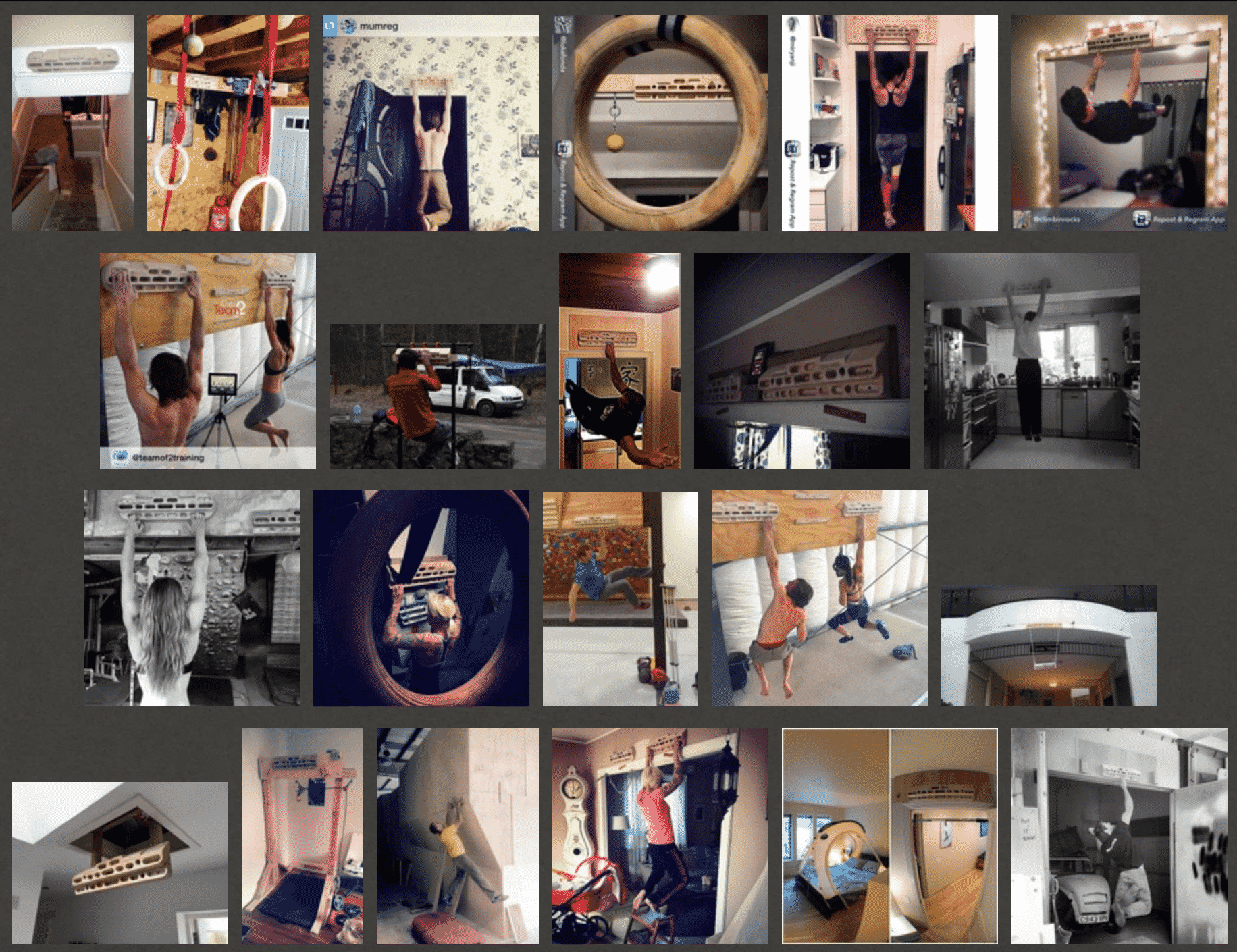
Many of us have heroes we look up to and admire – wish we could be as fit as them, as strong as them, or as good looking.
Wishing we were something other than we are is seen as negative by mindfulness gurus, yet comparison with others has pushed the human race to compete and achieve great things.
In sport we often talk about healthy competition – training with a partner you often feel you perform better. I ran a 10km personal best trying for most of the race to catch up with the guy in front – just out of reach – I never caught up with him, until after the finish line, but as he was running just slightly faster than my usual pace I completed a much better time than usual. Running on your own you have to dig deep for that competition. It comes from within. This can be hard to find!
The negative side of comparison or idolism is mainly avoiding enjoyment of and focus on “the moment” or “the now”. Striving to constantly be different, better, or somewhere else. Setting unattainable standards is both exhausting and makes us miserable. Residing in a virtual concept of what we are not, rather than focussing on and giving thanks for who we are now and what we have in this moment.
Training at home in isolation you can keep a log, but is that enough to spur you on? Doing more reps than last time. Pulling on a thinner edge. Adding another 2.5KG to the dumbells. Another 10 reps of excruciating core exercises, comparing your progress to the last workout and unsure how to measure the improvements. Climbing alongside a friend with similar goals is definitely more fun.
Hanging solo – Tom Randall from Lattice Training
The majority of us have been in lockdown now for just over 2 months – for many of us the schools closing on 13th March was the true start of lockdown, though many businesses had started earlier still.
Although this was an ideal time to train at home, I have had zero motivation for training for climbing. Getting out for a daily walk was easy enough, and a run here and there. In previous years by late March and April I would have been getting psyched for the spring and the return of the trad season, and this is usually a massive motivation to get fit, with the goal of getting back on the rock, and would usually trigger a surge of home finger-boarding and a switch to endurance training at the wall.
A walk in my local woods
With the far-off end of the isolation period and social distancing in sport, bringing the ability to climb with others once more, getting psyched has been and still is a challenge.
I continue some mobility training following the Movement 101 guys who I find brilliant. Lots of free content as well as reasonably priced programmes. I found I had very low desire for any training for climbing for the first two months.
The last couple of weeks I have experienced a clear change in attitude. A friend suggested we do online finger-boarding sessions as a regular meeting. Using webcams and video conferencing we have connected twice a week and trained together. This has given us both a real boost – being able to work out and share feedback as well as to chat in our rest periods has been massively rewarding.
Here are a few more ideas for staying psyched between now and the lift of restrictions:
Local coaching – online
Michael Duffy is offering online coaching and this is proving popular. With a free initial assessment and a reasonable prices for follow-on sessions for some this will be ideal.
Michael is also offering help with design and construction of a home board as well as his tailored training programme and 1:1 coaching.
Ambrose Flynn is offering online coaching for rock climbing skills and also navigation and has a wealth of video instruction prepared to support you. Courses are currently free of charge with a suggested donation to Mountain Rescue.
While the idea of online coaching “feels” strange, one conversation with either of these experienced coaches will give you the boost to advance your training plan with whatever equipment you have at home already, even if it feels like you have nothing!
There are a whole range of these videos, and several are focussed on the isolation theme, training at home and how not to overdo it on the fingerboard. This is the link to the channel to browse all their videos. Of note is their latest returning to climbing after lockdown
I find the Crimpd app from Lattice very helpful as well, and it is a good idea to test your finger strength before you start a period of training then test again at the end to see your improvement. Strength test is on the app and also explained by Tom Randall here
Workouts
For home workouts focussed on climbers, Shauna Coxsey has a few good video’s on youtube:
Dave Keogh recounts a dizzying schedule of famous routes and high mountain encounters
by Harry McGee
When the recession hit construction in Ireland in 2009, Dave Keogh, who was working in architecture, decided it was as good as time as any to see the world.
He had grown up in Tallaght, and outside work, life revolved around playing football and having a few pints with his friends. At 30, he had a vague feeling he wanted to explore, to go hiking and camping.
Over the next few years, new horizons opened up. He spent 11 months in South America, and went hiking in Patagonia, El Halten, Bolivia and Peru. He moved to Australia, where over the next few years he started indoor bouldering.
Keen to do more, he went on a few solo hikes in the wilderness, in some of most remote areas of New Zealand. On one of those, a seven-day expedition, he needed to access the starting point and end point by boat. In a serious turn of events, his appendix burst on the fourth day of a week in which he had seen only two other human beings. He managed to walk out and had surgery a few days later. It didn’t thwart him!
He kept on upping the ante. There were horizons that were beyond him at that stage. “I climbed as far as I could up Mount Aspiring (2,475 metres) before realising I was out of my depth and need more knowledge, skills and equipment,” he said.
“At this point, mountaineering was coming very interesting for me. I rented an ice axe and climbed Mount Taranaki (a dormant volcano at 2,518 metres). There was snow and ice for the final 200 metres or so and in reaching the summit I felt like I had really achieved something.
“Climbing became the way I needed to experience those places.”
He had lost his job in Ireland but had found his vocation.
And so he arrived home in 2013, after doing some sports climbing in Thailand. His next goal was learning how to become a climber and mountaineer.
“The turning point was travelling . Everything flowed from that. The climbing for me, it fitted totally with where I wanted to go.
“I knew If I followed the climbing path it would take me to amazing places and maybe offer an alternative view on the traditional existence of nine to five which I knew I did not want.”
He wondered, though, how he could take the next steps in climbing in a place as wet and relatively flat as Ireland.
Joining the IMC
Soon afterwards he joined the Irish Mountaineering Club. It is astonishing to think the progress that Dave has made since then. Over the course of six years he has become a highly accomplished climber and Alpine mountaineer, with a really impressive array of classic (and difficult) Alps ascents and North faces, big rock climbing routes, as well as ice climbing epics.
In the early days after joining the club, he learned the essential of traditional climbing from Cillian Russell and Noel Caffrey. He then formed what he calls a “solid partnership” with Cearbhall Daly, who he says was equally keen and time flexible.
The following summer, in 2014, he went on his first Trip to the Alps and his first proper Alpine route, the North Ridge of the Piz Badile.
“It was a slow but steady ascent followed by a long abseil descent that lasted well into the night.
“Unable to locate our stashed bivi kit, we bedded down in grass among the boulders and shivered until sunrise. We made plenty of mistakes but learned loads. This felt like alpinism and I loved it.”.
Niall Hedderman climbing (with David) on South Face of the Midi
When Cearbhall returned home, Dave made his own way to Chamonix and teamed up with complete strangers. It made for an impressive tick-list though. There was the Forbes Arête on the Auguille du Chardonnet (a mixed route). He met an Aussie climber, Grant, and they climbed the Contamine Mazeaud and Chere Coulour on the Triangle du Tacul.
“We sensibly backed off he Midi-Plan Traverse in bad conditions when Grant shouted, in a thick Melbourne accent: “There’s no f***ing way I’m going down there mate!
“He was right and we settled for a fund day doing the traverse of Pointes Lachenal.”
He then met “two English chaps” and got invited to do the Frendo Spur, which they did with a bivi. Another adventure followed with a young Scottish climber up his first high alpine rock route, Rebuffat-Baquet, on the south face of the Auguille du Midi. They also did Voie Contamine on Pointes Lachenal.
Scottish Winter Climbing
It was in the Alps that his young Scottish friend explained Scottish winter climbing to him.
“He said ‘It is like alpine climbing without the altitude and glaciers and you go out in shite weather’. Sounded like I need to try that next.
And so that winter he booked into the CIC hut on Ben Nevis for 10 nights. He was joined for the first four days by his Scottish friend Tim Miller; he spend the rest of the time soloing or going out with other parties. It was a valuable experience.
“I learned a little about what makes good and bad conditions to climb in, the importance of navigation and that if you are keen you really can go out in all weather.”
He did Point 5 Gully as only his second Scottish winter route in heavy spindrift. That bears a moment or two of admiration given its reputation. On two other trips with Cearbhall and Tim they knocked off a large number of classic routes including Hadrian’s Wall; Vanishing Gully; Comb Gully: North East Buttress of Ben Nevis; Tower Ridge of Ben Nevis; Crowbery Gully (Buachaillie Etive Mór); The croc (Beinn Udlaidh); White Shark and Left Twin on Aonach Mór.
The following winter saw him return to Scotland for mixed climbing including Lost the Place; Jacknife; Cutlass (Ben Nevis); Savie Slit; The Seam; The Message (Cairngorms); Scabbard Chimney (Stob Coire Nan Lochán).
In really incredible ice-climbing conditions in February he did a number of classic routes on Ben Nevis, Liathach, Coire an t’Sneachda. Those that were brilliant and memorable included The Salmon Leap and Poachers’ Fall as well as Umbrella Falls.
Incorrigible, he returned in April, when the ice was still good, and soloed classic routes over five days including Zero Gully, Sickle, Indicator Wall.
“The highlight was soloing Point 5 Gully, Smiths Route and Observatory Buttress on my last day. I started early and topped out Ben Nevis three times that morning without seeing another person. One of my best days in the mountains.”
Misha looking up at the Red Pillar on our approach to the Eccles bivi hut before the 3 day climb Bonatti Oggioni
2016 and back to the Alps
That summer of 2016, he returned to the Alps. After soloing the Frendo Spur, he did his first ascent of Mount Blanc by the classic Kuffner Ridge.
“I teamed up with a new partner, Misha Nepogodieve, and we went on to have our best Alpine trip to date.”
In an eight day weather window they climbed the Gervasutti Pillar; the Walker Spur over two days; and the Bonatti-Oggionie Route over three days. That route starts from the Italian side and involved a bivi at the Eccles Hut and another on Pic Lois Amedee at 4,469m (amazingly high). They then finished up on to the summit of Mont Blanc.
Dave Keogh and Misha waeke up in their Bivi 150m below summit of Walker Spurt
The winter of 2016-2017 made for a poor season in Scotland. That summer saw another good summer trip to the Alps. With ‘Scottish’ Tim Miller he did the classic North Face rout Comici-Dimai on Tre Cima and then Don Quixote on the south face of Marmolada.
He travelled on to Chamonix to meet up with Anni Huovinen (his partner) and Niall Hederman.
“I climbed Arete du Diable Traverse with Niall who thoroughly loved his one-night stay in the shit shack. Exactly the type of five-star accommodation he’s accustomed to.
“I drove down to the Ecrins with Anni for our first visit. We completed the traverse of La Meije which included a bivi below the Promontoire Refuge at the start and a stay in the Aigle hut at the finish. A beautiful long classic mountaineering route.
Dave and Anni on the La Meje traverse
“Anni wasn’t long in the Alps at this point so it was a strong effort on her part,” he said. “We drove over to Cervinia and climbed Pollux followed by a traverse of the Breithorns. “
Anni flew home to Finland and Dave was joined by Misha for the following three weeks. They climbed teh 32-pitch West Ridge of the Salbitschijen and an ascent of the classic north face Cassin route on the Piz Badile.
“The Cassin was particularly enjoyable as we were fast for once. We also had the most spectacular camp-spot overlooking the North Face. here we waited an extra day for settled weather and had front row seats as a storm hit and turned the face to a waterfall.”
Another memorable, if not enjoyable, climb was the South Pillar of Barre des Ecrins.
“I can’t say we enjoyed it much. It proved to b a 25-hour ordeal of lose rock and lots of time were spent off route. We bailed from 20 pitches up the Cordier Pillar.”
Another amazing Scottish season
And then, finally last winter, he had his best Scottish winter season to date. he teamed up with Tim Oliver who was working towards his British Mountain Guide application and was very keen to see new venues. They were jointed by CIC hut warden Robin Clothier as they headed to the northwest of Scotland.
“We made a couple of second ascents but the highlight was undoubtedly catching the very ephemeral Direct Nose Route on Sgurr an Fhidhleir in reasonable conditions.
“That climb felt like a real team effort and made the four-hour approach and 18-and-a-half hour day well worth the effort. Tim put in a fine lead by head-torch high up on the crux pitch.”
And so the dizzying array of Scottish routes continued: Sgorr Ruadh, Beinn Eighe, Hell’s Lum, Lochnagar, Cúl Mór, Cúl Beag. the standout rout was Taliballan on Stob Coire an Laoigh.
“Gargoyle Wall on Ben Nevis was significant as I remember seeing it on my first trip and thinking how incredible and intimidating it looked.”
The trip was not without incident. He took a 25-metre tumble on the Citadel on the Shetlerstone in the Loch Avon Basin.
“I went off-route on the third pitch and while lowering back to the line my anchor failed and the previous pieces (bulldog and piton) ripped out leaving me back at the belay. Luckily one piece held and I was relatively unscathed. It was a long and lonely walk out.”
He then went to Austria where Anni had recently completed her level one BASI ski certification in a resort called See and was going to work the rest of the season there. Dave started ice climbing and did some amazing routes including his first W16 multi-pitche ice routes.
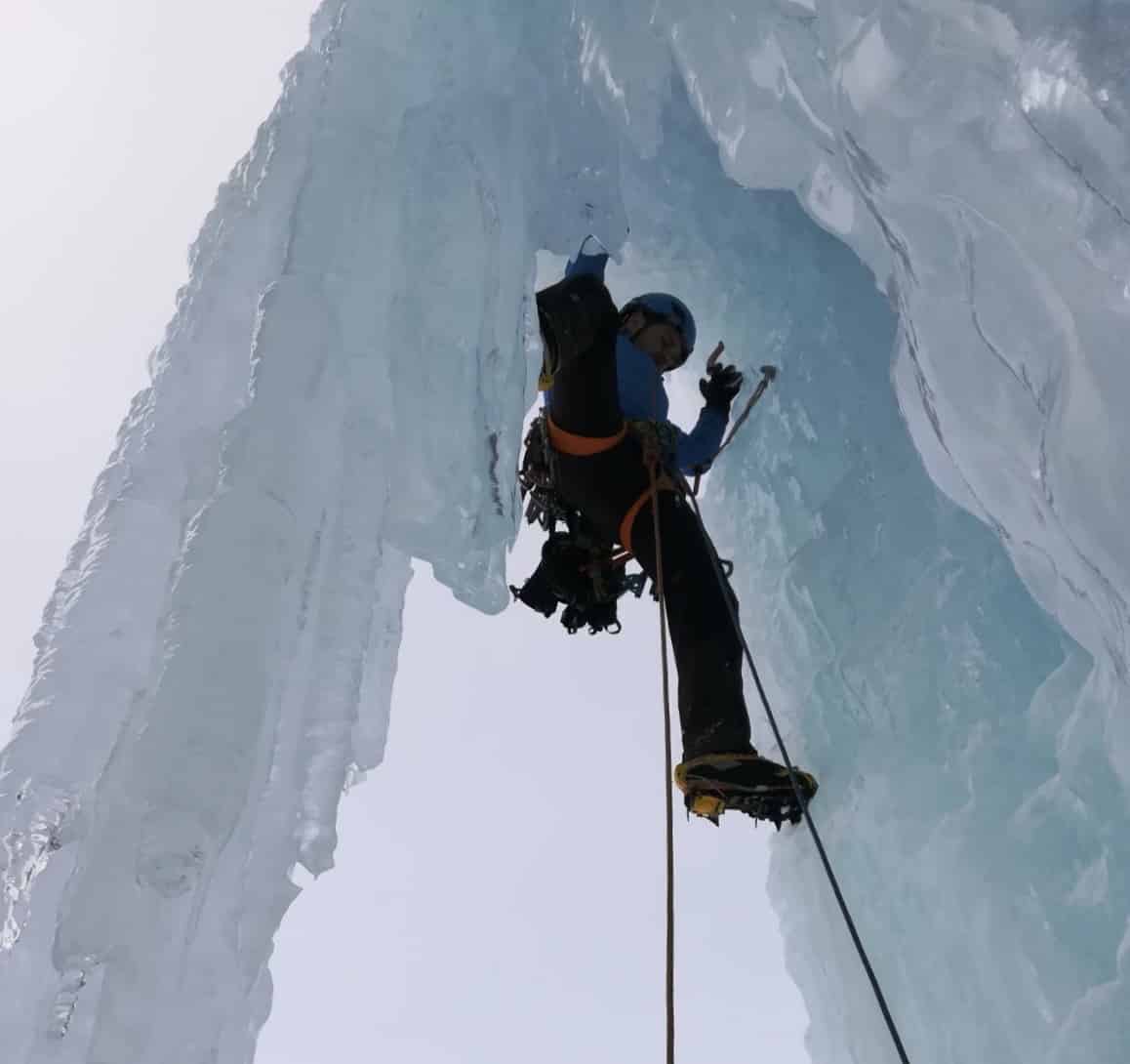
David Keogh climbing on challenging ice pillar in Austria
He himself had improved his skiing and, with Misha, he did the firs ski-in ski-off North Face Route, which was the Terray-Rebuffat route on Auguille des Pelerins.
It almost ended badly after I performed an Olympic style ski jump over a hidden boulder on the descent from the climb by headtorch.”
Misha leading on Terray-Rebuffat route on Auguille des Pelerins
His judgement on his own climbing
And so how does he sum up his own climbing prowess? He gives a characteristically modest assessment.
“Physically I am not gifted. I do not feel talented as a climber. I don’t think I have an edge on people either. But in a away that has allowed me embrace the different aspects.
“I’m not fearless. There are things that intimidate you and all the rest of it. I can probably deal with it and remain calm.”
He spends a lot of time climbing but still manages to work. He did a masters degree in sustainable architecture, encompassing energy and retrofitting. The company he works with gives him a lot of flexibility to arrange trips. He has taken his laptop with him to allow him work remotely when he needs to.
Nowadays, he and Anni climb a lot together. She has only been in the IMC for three years, and climbing for about the same timespan. She has done some incredible climbing in that time and is comfortable on all terrains.
Skiing in the Vallée Blanche above Chamonix
They spent the summer of 2018 on a UK road-trip visiting venues such as the Lake District, Cornwall & Devon before driving to the Alps.
Summer 2019 was spent in Lofoten, having driven there from Helsinki. They had a fantastic trip with highlights being Vestpillaren & Himmlem Kan Vente on Presten and a 24 hour car-to-car adventure climbing Vestveggan (West face) & Vesteggan (West Ridge) on the national mountain, Stetind. They were joined by Imc’ers Dave Craig & Síle Daly on that trip.
Dave Keogh on first pitch at Vestaggan. The picture was taken at midnight during the summer!
Where next in the post Covid-19 world? He loves Scottish climbing and the Alps. He has a plan to go to Alaska at some stage and do some of the bigger hard routes over there.
What’s unmistakable are the incredible peaks and feats. Not bad for a guy who used a nut and a hex for the first time only seven years ago.
More Than Just a Number: Getting into E1
By David Craig
Transitioning from HVS to E1 is often a problem, not just because of the increase in difficulty but because of the mental barrier that comes with that solitary vowel at the beginning of the grade. Derived from extremely severe, it sounds like it should be as hard as it gets. The reality is that you are still firmly in the mid-grades. Nonetheless, it’s a red-letter day in any climber’s progression when that barrier is past.
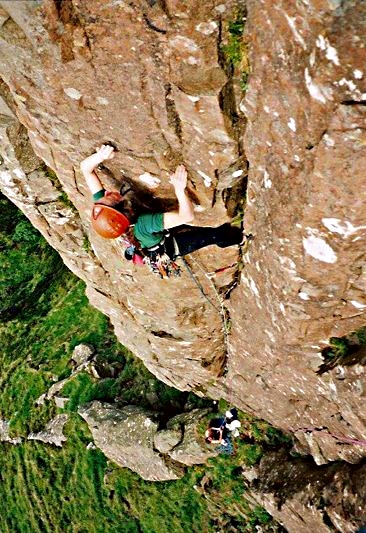
My own first experience with the grade came as a second on the IMC beginners’ course. Out in the quarry one night Tony Groves placed me at the bottom of “Gargoyle Grove” while he walked up the direct version of the route (I didn’t know it at the time but he regularly soloed it!). Following after him, I struggled with the start moves but when I eventually scraped my way through, I dispatched the rest without much issue. I remember the euphoria of swinging across the slab at the top and thinking “sure I could lead that”! Later in the year when the days were starting to get short, I placed myself at the bottom of the grove to try and lead it. The start felt just as hard as the first time but when I scraped through it for the second time, I thought I had the route in the bag. However, standing at the top of the grove and looking at the traverse out left across the slab it felt a very different proposition than it had been with Tony’s rope above me. It was a much more tentative sequence that eventually got me across and when I reached the ledge before the top, I was gripped by the sight of my gear seemingly left far behind. The truth is though, the gear wasn’t that far away and if I fell it would have been fine but convincing myself of either at the time would have been difficult. I didn’t fall and after topping out, even though it wasn’t on-sight, I went away smiling and feeling like an E1 climber. This meant the barrier had been passed and when I would eventually on-sight one it didn’t feel like that big a deal (so much so that I don’t remember what route it was).
I wasn’t aware at the time but a few tricks
you pick up as you go along could have made the process a lot smoother (though
probably less memorable).
1/ It’s a Numbers Game:
I threw myself into my first couple of
climbing seasons and was out in the quarry every Tuesday and Thursday. At the
time Gerry Moss led band of miscreants to whatever crag looked like it would be
dry at the weekend. I tagged along on a lot of these and we visited Donegal,
the Comeraghs, the Mournes as well as the more local crags like Glendalough and
Luggala. Each venue brought experience on different types of rock, providing
new climbing techniques and ways to place gear. This was done in the company of
more proficient climbers, so there was always advice on what routes to go for,
what gear to bring etc. This has defiantly stood to me on many a route since
and hopefully on many more to come. With the number of indoor gyms available at
the moment it has never been easier to get strong for climbing, similarly there
are many providers who will give you some instruction on leading. While this is
a great way to start there is no substitute for being on the sharp end of a
rope and figuring things out for yourself. The more used to placing gear you
are, the quicker you will recognize the best placements, the less pumped you will
get. On the subject of being pumped, it’s the easiest way to fail on a route so
it’s best to not let it happen. If you look at the best climbers, they rarely
hang off of a single hold for very long. Constantly moving your hands and
shaking out (while making sure you have the best body position) will do far
more for your stamina than any number of laps at the climbing wall. If you are
relaxed on the easier parts of a climb you have more for the harder parts.
Simply put its a numbers game, the more HVS (or below) routes you do the easier
an E1 will feel.
2/ Trust the System and Yourself:
Climbing at E1 inevitably brings you away
from your gear. Being aware of the reality of the situation is your biggest
asset, it is easy to get terrified a couple of meters above your gear and it is
often unjustified. To keep on top of this it is good to have a system of mental
checks. For me before launching into a crux sequence or a run-out section this
goes something like the following.
Make sure I am in the best position to pause for a moment. Breathe easily and relax onto the holds (over gripping will get you pumped so again keep those arms moving!).
Look at the gear and verify mentally that I am either confident in it, or confident I won’t fall onto it.
Look for the next placement or rest spot and commit to reaching it. More often than not you will reach it long before you are in any real danger. If things do start to go pear shaped (you will eventually kick out that all important piece of gear) concentrate on your climbing and get to that next rest/placement.
Your own system may differ, but it does need to be habitual, so put in the mileage and practice it on easier terrain.
Terry coming up pitch 2 of Cornish Rhapsody, the ramp is easy but will keep you focused!
3/ Don’t work your weaknesses:
You’re not training, this is what you have
been training for. Choose a route that gives you a good chance. If you are
super strong from indoor climbing go for a steep, easy to protect route. If
you’re not so strong but good on your feet, go for a slab or something more
technical. Ideally, talk to someone who knows the climb and yourself. Don’t be
ashamed to get the inside info on gear, hidden jugs, etc. The next one can be a
pure on-sight if you are fussy about such things.
4/ Go for it:
Finally, if you want to climb E1 (or any grade) just pick a well-protected one and go for it! If you fall off or rest on the gear it really doesn’t matter. Come back next time and try again, you will get a bit stronger/better with each attempt and when you eventually succeed a wealth of new climbs will be opened up to you.
Emulator at the main face in Gogarth. Well protected and a soft touch, perfect ingredients for a first E1.
Some Routes not to be Missed:
If it’s your first E1 it’s probably best to
start close to home. For Dublin/Wicklow based climbers Dalkey Quarry has some
fairly notorious E1 routes, but there are a couple that are good intros for the
grade. I didn’t realise it at the time but “Gargoyle Grove” was a good first
choice for me, the climbing is more technical than strenuous, and you are on
your feet the whole way. You also get a lot of good gear in before the final
section (bring some micros or peanuts for the start). For the strong, the well
protected “Frenzy” is a good choice (small wires and cam). A word of caution, I
once thought ticking off all the Dalkey E1’s would be a good idea, “Shuffle”
changed my mind. There are several similarly sketch E1’s scattered about the
quarry so choose wisely!
In Glendalough, “Setanta” is a nice, well
protected, slab. The start looks a bit vegetated (and I suppose it is) but you
are well rewarded higher up. “Concrete wallflower” will find your weaknesses
with a delicate start followed by a steep, juggy finish. Though it is well
protected throughout (micros for the start). After ticking those two, there is
a nice combination of “Fanfare/Scimitar/Spillikin” on the main face that is
well worth doing.
“Dance of the Tumblers” in Luggala is a good outing and unusually for that crag very amenable for the grade.
Sile enjoying Dance of the Tumblers at Luggala.
The Mournes has too many good routes to
count, but if visiting Lower Cove “The Great Treacle Sponge Robbery” will feel
soft if you are confident on your feet. “Swing Low” is steeper and well
protected but no push over. “Cherub” at Spellack crag is also good fun and soft
if you are tall.
Fair Head is great for the E1 climber, the Prow will not only hone your jamming skills, but also your ability to avoid the pump. “Midnight Cruiser”, “Fireball”, “Railroad” and “Fath Mo Bhuartha” will keep you occupied for some time.
Sile avoiding the jams at the prow, Fair Head!
When you have a few E1’s under your belt make a point of getting to Ailladie and climb “The Ramp”, preferably when there is a low tide in the evening time. E1 is a grade that opens up a wealth of fantastic climbs and every one you do will help you get that first E2 tick!!
Pitch 2 of True Moments at Castle Helen, Gogarth.
Early memories of the Irish Mountaineering Club
by Robert Norton
“The Past is a foreign country: they do things differently there”, L.P. Hartley
Given the rate of social and technological change since then it must be hard for the younger reader to picture Dublin in the 1950s when I was in my teens. A place of economic stagnation and mass emigration. No immigration so black or brown faces or foreign languages were highly unlikely to be encountered.
Nor were there any of the devices now coming under the heading of “tech”, although much of this was already being foreseen in comics and sci-fi writing. An airplane was a fairly rare sight and would attract attention. There was sporadic IRA violence in Northern Ireland about which there were ambivalent views.
When young, idealistic Limerick-man Sean South was killed in the course of a raid on an RUC barracks. 50,000 people turned out for his funeral and songs commemorated the event. It was a place teeming with priests and nuns, where even to cut the grass on Sunday was seen as mildly sinful.
Roman Catholics spending a weekend in the IMC Hut or a youth hostel would regard it as essential to “get” Mass even if this meant walking for some hours. All teachers, male and female were armed with canes or straps to maintain discipline or punish sub-standard performance. The burly Gardai went round on big bicycles and their main job seemed to be to catch boys playing football on the street or directing the sparse traffic on the on the largely traffic-light-less streets.
Entertainment was provided , apart from sport, by the large number of cinemas and dance-halls, where at weekends there would be lengthy queues and you might not actually get in.
Most houses relied for heating on an open fire in a single room where the probably large family would gather to sit in the evening and listen to Radio Éireann or BBC, or read one of the numerous daily newspapers- I seem to recall there were five! The burning of smoky fuels led on occasions to serious smog, when it was difficult to see to the other side of the street and dangerous to cross if you didn’t have sharp hearing. Most adults smoked cigarettes which meant that children were exposed to smoke from infancy
Only the better-off had cars. Bikes, or the bus, were the mode of transport for most people. If you chose to go by bus, your fare would be collected by a chatty “conductor”
Bread or milk would probably arrive at the door in a horse-drawn cart and all refuse was taken to landfill often to reclaim land such as Fairview or Ringsend Parks.
There was nothing comparable to the modern supermarket and household supplies were bought in the small neighbourhood shops. Apart from the fish and chip shops, there were no fast food outlets.
It was possible for quite young children to buy fireworks or indeed, for a few pence, the chemicals need to make your own. Your local pharmacy wouldn’t bat an eye.
Although there was a meagre supply of scholarships, university education was denied to all but the wealthier classes. However, the secondary schools- mostly owned and run by the much-maligned Christian Brothers or other religious orders- supplied a broad and varied curriculum, often for very modest fees.
If this all seems a bit grim there was another side to life. Crime was on nothing like the scale we see nowadays. A murder might happen once a year and would set the whole country talking. Alcohol was the only drug.
GPs would readily make house calls even at unsocial hours and it was not uncommon for them to waive their fee for poorer people. There were no queues of trollies in the hospitals, which, again, were run by the religious, and you might be kept in bed for two weeks after a simple procedure like an appendectomy- I was anyway!
Burnout due to work was unheard of; there was a decent work-life balance and one could, with an easy conscience, go home at 5 pm.
As a child I had always preferred the mountains to the flat boring “sea-side”. We had the use of a cottage – now unfortunately derelict- on the hill behind the An Óige youth hostel at Knockree in Glencree; at that time one of two hostels in the valley.
Even when I was quite young I used to climb Knockree hill on my own “because it was there” and just to see what was to be seen. Down in the valley you could cross the Glencree River by means of a foot-stick bridge and go across to what was commonly called Mount Maulin. It was an enchanted place; no wonder it attracted writers such as John Millington Synge, James Plunkett and Joseph Campbell.
It may have been the first ascent of Everest in 1953, when I was fifteen, that awakened an interest in mountaineering. My first encounter with Irish climbers was in 1956. I was on one of many cycling weekends to Glendalough hostel. It was then I met with certain swaggering and, to me, heroic figures with coils of rope on their shoulders and clanking pitons and karabiners (probably heavy steel ones) hanging on their belts.
Bob Norton 2nd from left with IMC early members Frank Winder, Joss Lynam and visiting famous British Climber Mike Banks at Dalkey mid-1980’s
They were also armed with wicked little hammers for driving in said “pittins”. The use of jammed nuts or even jammed knots does not appear to have spread to Ireland at that time and was probably even in its infancy in the UK. Though some pitons were left in place (some still remain as pathetic relics of the time), the unfortunate second usually had the precarious task of knocking out the pegs (these things cost money, after all!)
These were hard men, dressed in military cast-offs and when not luxuriating on the bare canvas bunks of the hostel would often sleep on the ground in a lean-to structure adjoining the Royal Hotel, or in a hay barn near the round tower.
There was also a shelter under a boulder beside the Camaderry crag, known by the French term ‘gite’ or, more usually, “the gyte”. There used to be a First Aid box maintained there (I don’t suppose it still exists.)
They were the pioneering An Óige climbers and were not affiliated at that time with the only serious mountaineering club in Ireland, the IMC which had been formed (or re-formed) in 1948. The IMC might have been beaten to it by the secretive “Brotherhood of the Lug”.
My first experience of climbing was with the IMC in 1957. Brid Hardiman, the sister of a friend, was a member and invited us to to Dalkey Quarry.
She was there one Saturday to “show us the ropes”, literally. The only other member I can recall was Harold Johnson a genial older man. He was the owner of Irel Coffee, a company making a liquid form of instant coffee. He was a life-long enthusiast for the mountains and climbed in the Alps every Summer with his wife and children. He used to give wonderful slide shows in the club, – then based in 16 Lower Mount Street – of him and his family climbing in the Alps.
This was usually accompanied by a thunderous sound-track of the Tchaikovsky Piano Concerto or such like. Harold was a great encourager of new members and used to run regular “scrambling “outings to The Scalp or Rocky Valley.
It seems strange now, but at that time Dalkey Quarry had almost no trees. The quarrymen left it as a bare rocky bowl and the only vegetation to have begun to establish itself were brambles and other low things. In the Eastern bowl of the quarry there were vestiges of the quarrymen’s cabins.
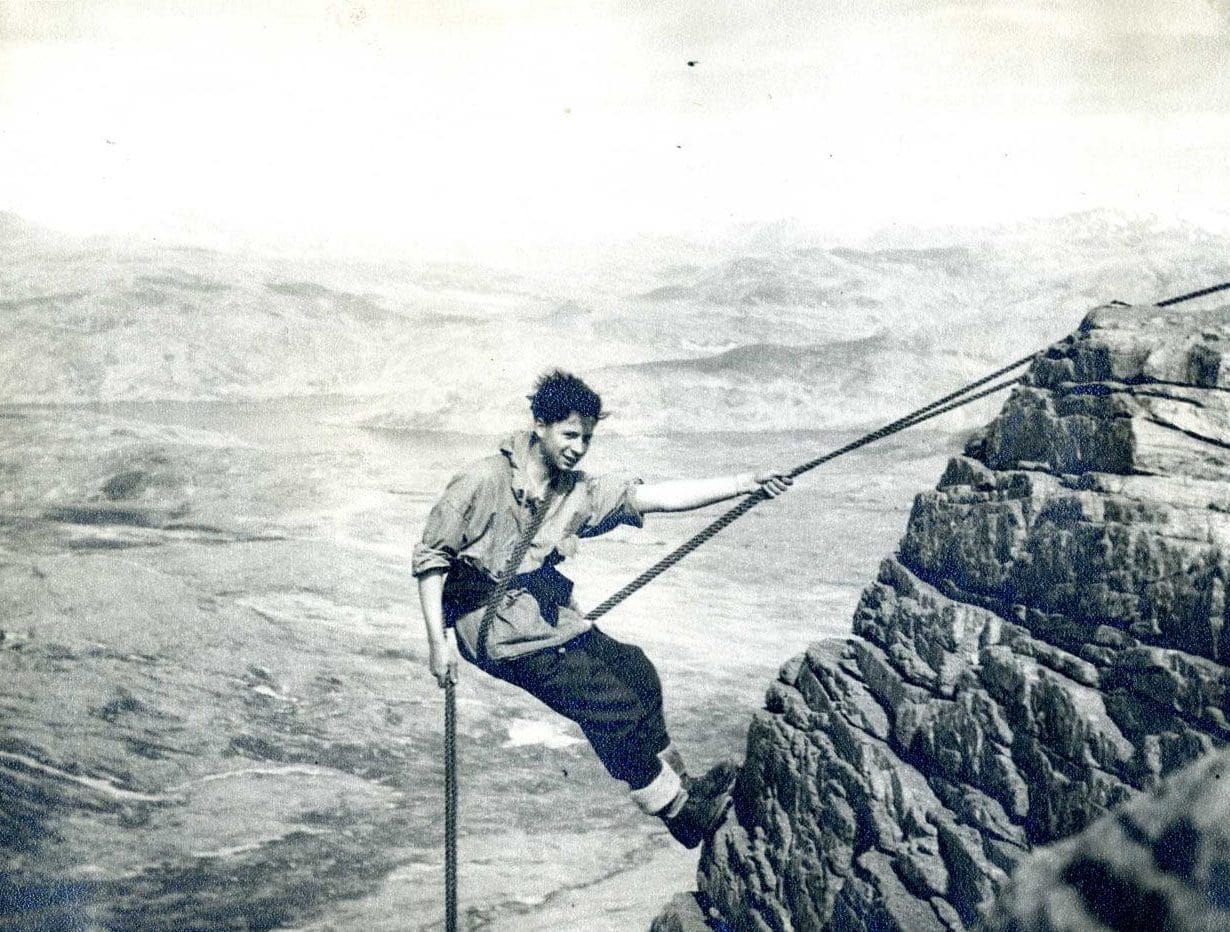
We used Viking nylon cable-laid ropes, which got fuzzy with wear and which had only recently superseded hemp ropes. They had a great safety advantage over hemp because of their greater elasticity. In those pre-harness days, the rope was tied around the waist with a bowline knot. The commonest footwear was bendy hiking boots with Vibram rubber soles or for harder routes black canvas “runners” which had quite good sticky soles.
I never saw nailed boots in use; they had been abandoned by most people from the early 1950’s. The first pair of proper climbing shoes I saw were worn by Englishman Ronnie Wathen a member of the Dublin University Climbing Club, later to become an accomplished performer on the uillean pipes.
They were called PAs after the French climber, Pierre Allain, who had invented them. Helmets had yet to become normal wear. Paddy O’Leary recalls being amused when he first saw them in use in Switzerland.
Standard wear on the head- in Winter, anyway- was a scratchy woollen balaclava, often bright red.
On that first day in Dalkey, we were led up ‘Paradise Lost’, which was climbed in two pitches, and a number of routes on the Eliminates. I think ‘Paradise’ was probably a harder climb then, as its cracks were much thinner than they are now. The crux, then as now, was edging on a tiny hold near the top.
I was thrilled but petrified and was sure I would never be able to lead. The leader belayed with the rope over his shoulder. That was common practice then but was soon given up in favour of putting the rope around the waist. The waist belay was still in use by British climbers Deacon and Stevenson when they made the first ascent of ‘Spearhead’ on Luggala in 1959.
Former member Michael Lunt, using a waist belay, once held a big fall by his leader George Narramore on “Nightmare” in Glendalough, at the expense of burnt hands. The modern friction devices were of course unheard of.
Apart from “pittins”, some slings of light rope (no tapes then!) were carried to use as running belays if you could find suitable rock spikes or flakes.
In October of that year Paddy O’Leary, Liam “Smithy” Smith, Noel Lynch, Bob Lawlor and other An Óige climbers organised a beginners’ weekend in Glendalough. Some An Óige members had themselves been on a beginners’ course organised by the IMC in 1955. I was so exhilarated being part of the climbing scene that the day is engraved in memory.
“Bliss it was in that dawn to be alive, but to be young was very Heaven”
(Apologies to Wordsworth for quoting him out of context)
It was a perfect Summer-like day. There were about a dozen beginners including Patricia Flynn (then McLachlan and her sister Maura, later to be the wife of Noel Lynch. Paddy O’Leary thinks Bríd Arkless, later to be one of the first female mountain guides in the UK, was one of the novices.
After some preliminary training on the enormous boulders along the path, we were introduced to the three V. Diffs.; ‘Expectancy’, ‘Garden of Eden’, with its classic hand-traverse and chimney and ‘Holly Tree Shunt;. My fear quickly turned to sheer euphoria. The most frightening part of the day was having to abseil down ‘Expectancy; by the Dulfer method, i.e. with the ropes running behind one leg and over the opposite shoulder. NO safety top-rope was employed and it was a painful and “white-knuckle” experience!
Another clear memory is of Paddy wearing a pair of stiff-soled black climbing boots which he said he had bought in Courmayeur, which might as well have been have been Shangri La as far the newbies were concerned and, of him recommending “Lets go Climbing”, by Colin Kirkus; still a favourite book.
It may surprise young climbers to hear that there were no shops in Ireland selling mountain equipment. One had to go to the UK or Europe to buy a decent pair of boots or mountain clothing, or import them by mail order. There were, of course, shops in Dublin selling ex-army stuff.
I became a member of the IMC shortly after that memorable day. With a friend Padraig Hardiman, I used to cycle to the hut with our rope, boots etc precariously balanced on the carrier. We would climb on Saturday and Sunday and ride home to Drumcondra.
Being unable to afford a climbing rope we bought 100 ft of hemp rope in McCann and Verdon, “Ships Chandlers” on Burgh Quay. This was used for some top-roping before we invested in a half-weight nylon rope. That may horrify the modern reader, but it was probably adequate for the lower-class routes we felt able to tackle.
We would repeat the routes we had been introduced to and also did routes on Hobnail Buttress. We did a lot of exploring too, on Howth Head, Rocky Valley, and the Scalp.
Apart from cycling or hitching, one could get to the Hut on the St Kevin’s bus route, but most people preferred to catch the bus half-way, either by hiking on Saturday afternoon from Enniskerry to Roundwood, or even by traversing Bray Head and the two Sugarloafs and meeting the bus at the top of the Long Hill.
The IMC in those days did a lot more hill-walking and camping than is common now. Wicklow then, with the small numbers of hikers, was happily devoid of beaten tracks and you were usually trudging through knee-deep heather. This was particularly a Winter activity where the cliffs were wet and cold. There were of course no indoor training walls
I once saw, accompanied by my late friend Tom Fenlon, a fabulous Brocken Spectre, while we were on top of Little Sugarloaf. There was a fog-bank out to sea and the setting sun cast our giant shadows upon it. The image was surrounded by a circular “glory” or halo. The only other incidence of this phenomenon I saw was while on a peak in Zermatt, with Gerry Moss.
I was lucky enough, also, to see the Aurora Borealis from the hill down into Enniskerry past the Anglican Church, at about ten o’clock on a Winter evening, while coming home solo from the hills. It was very clear even though I was looking at it over the city lights. It was like big wavy curtains of pink and green. It most have been close to the peak of its eleven-year cycle.
An Óige, was formed in 1931. Although it was set up by a group of very influential people, its raison d’etre was essentially to provide simple accommodation for people of scant means, especially the young. Serious mountaineering on the other hand had traditionally been practiced by the leisured classes. It was inevitable therefore that the IMC founded in 1948 would attract on the whole, a middle-class educated membership.
There was a high level of education and general “culture” in the club and some people have reported that they found the “posh” atmosphere somewhat intimidating.
It has been reported elsewhere that a class war of sorts developed when the IMC was infiltrated by more down-to-earth An Óige members.
This classification of the memberships is of course something of an over-simplification. I was only a peripheral member for a short number of years, mixing climbing, as I did, with cycle racing and rowing (Neptune Rowing Club), but I found the IMC a welcoming and stimulating place with unfailingly friendly and encouraging people.
Being a bit bookish myself, I enjoyed the conversation around the big iron stove in the hut; lots of talk of books, music (classical of course!) and exploits in the hills.
The names of climbs put up at that time – Helios, Hyperion, Byzantium, etc, reflect the cultural leanings of the pioneers. Frank Winder was an important influence on me at the time, on account of his erudition and his ”necky” climbing ability.
I once succeeded in losing my fiancé and another girl on Djouce on a foggy October evening and they had to spend the night in the open. In the days before organised Mountain Rescue, Frank got up a search party and roped in a few cantankerous and unwilling young Gardai. We succeeded in locating them the next morning.
On marriage and relocation outside Dublin, I lost contact with the IMC and did not rejoin until the 1980’s to re-kindle my enthusiasm in a very changed climbing scene, but that’s another story.
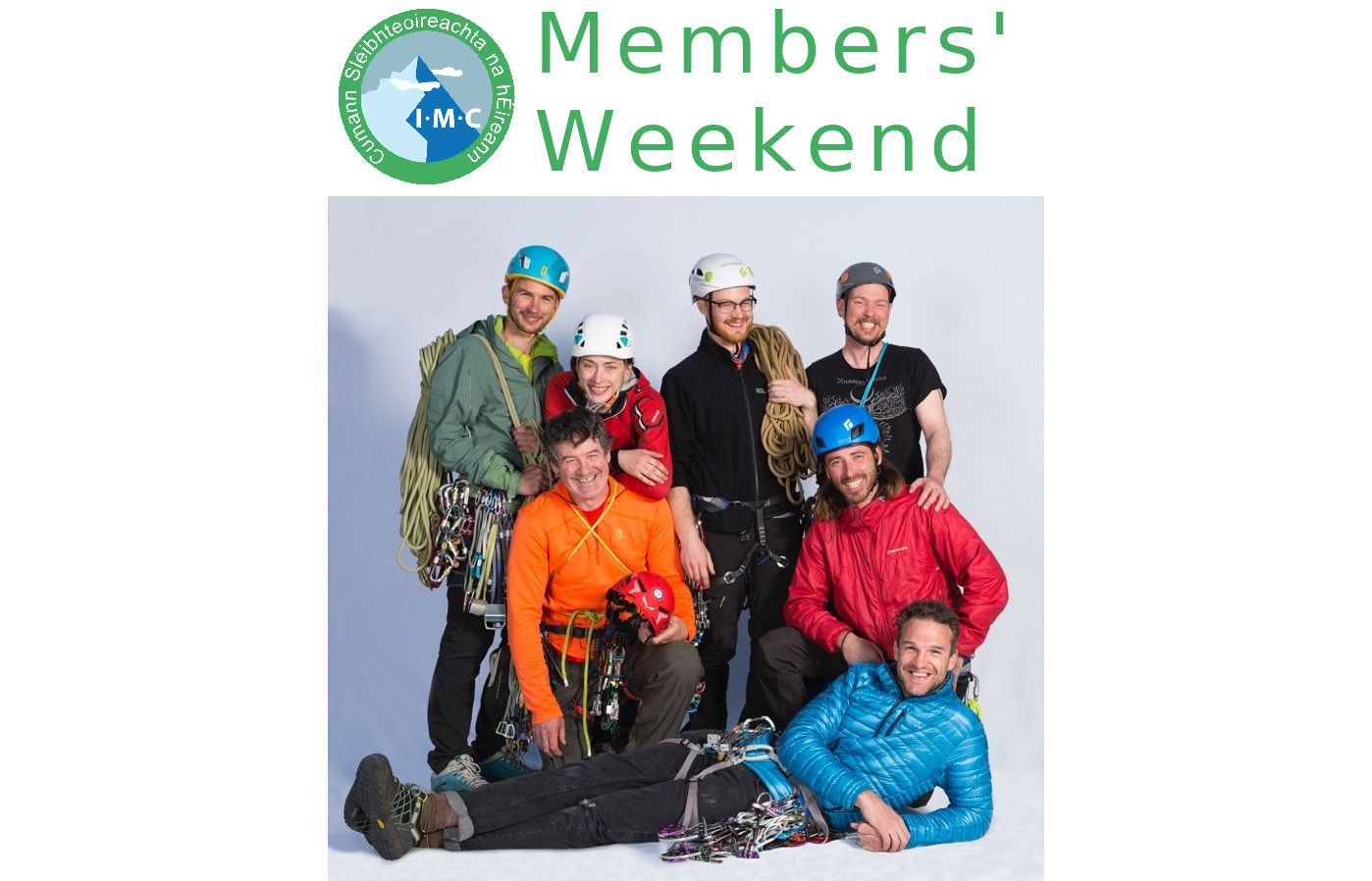
15-17 Nov: Members’ Weekend
We’re trying something new this year: kicking the AGM out of the city and into the mountains as part of a “Members’ Weekend”!
There’ll be outdoor and indoor activities near Glendalough. Summaries for confirmed events and links to their details are below.
Please sign up for events by adding your name to the relevant Forum post (linked from each event, above), so that we can get an idea of numbers of attendees.
Contribute:
If you’d like to help, have an idea to share–or, better still, a new event you’d like to organise and lead–feel free to contact the event organisers or secretary@irishmountaineeringclub.org.
We’re looking for a more compelling name than “Members’ Weekend”: can you suggest one? Please send suggestions to secretary@irishmountaineeringclub.org.
Accommodation:
The IMC Hut’s main building and Cow House are reserved solely for members from Friday to Sunday, so you’re welcome to stay overnight on Friday and/or Saturday.