
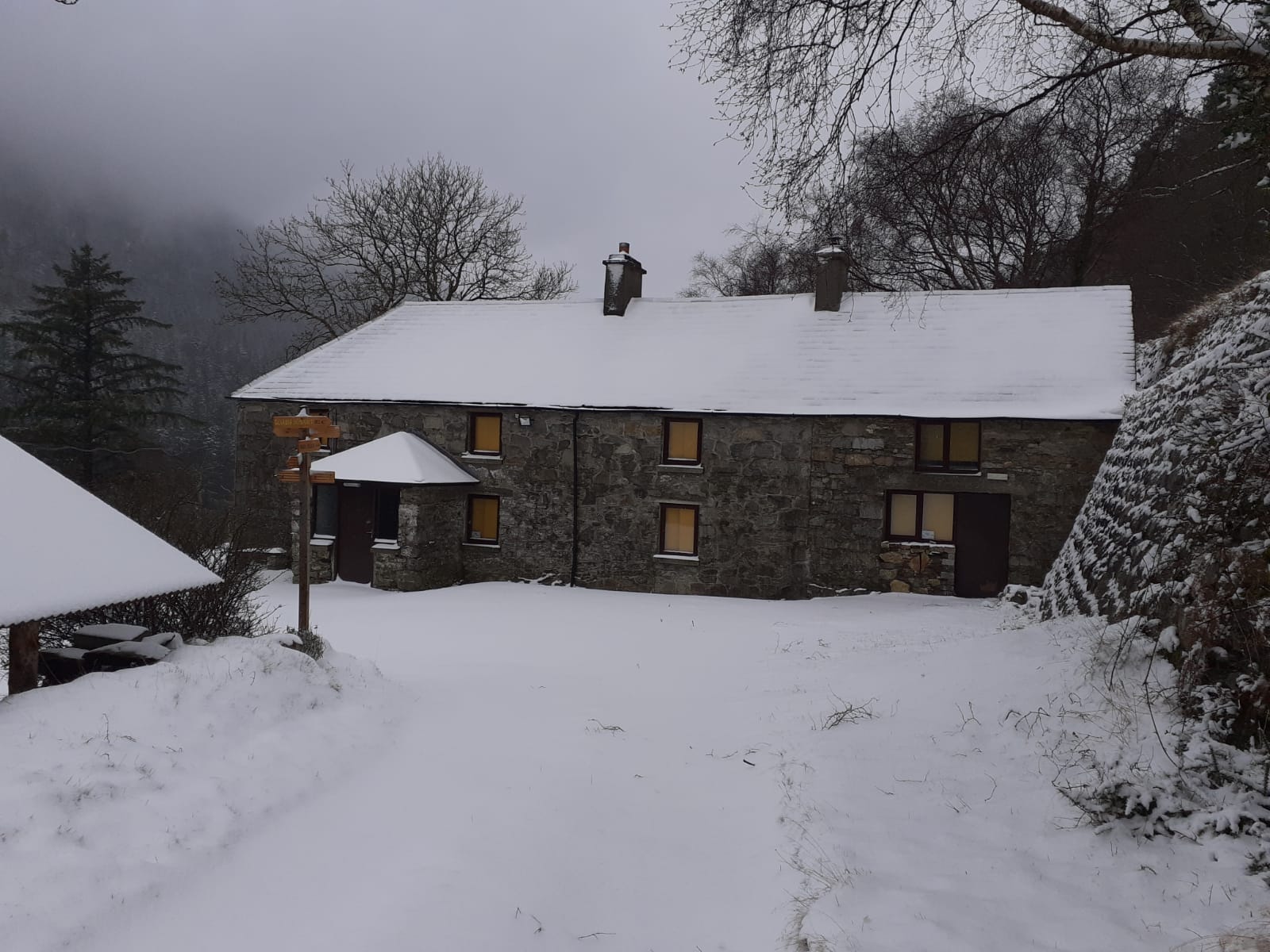
Just a reminder that the Hut is now open for Camping & bookings.
Please click here to visit our hut page for more details
-
Reminder: Hut open for bookings
-
Hut Update
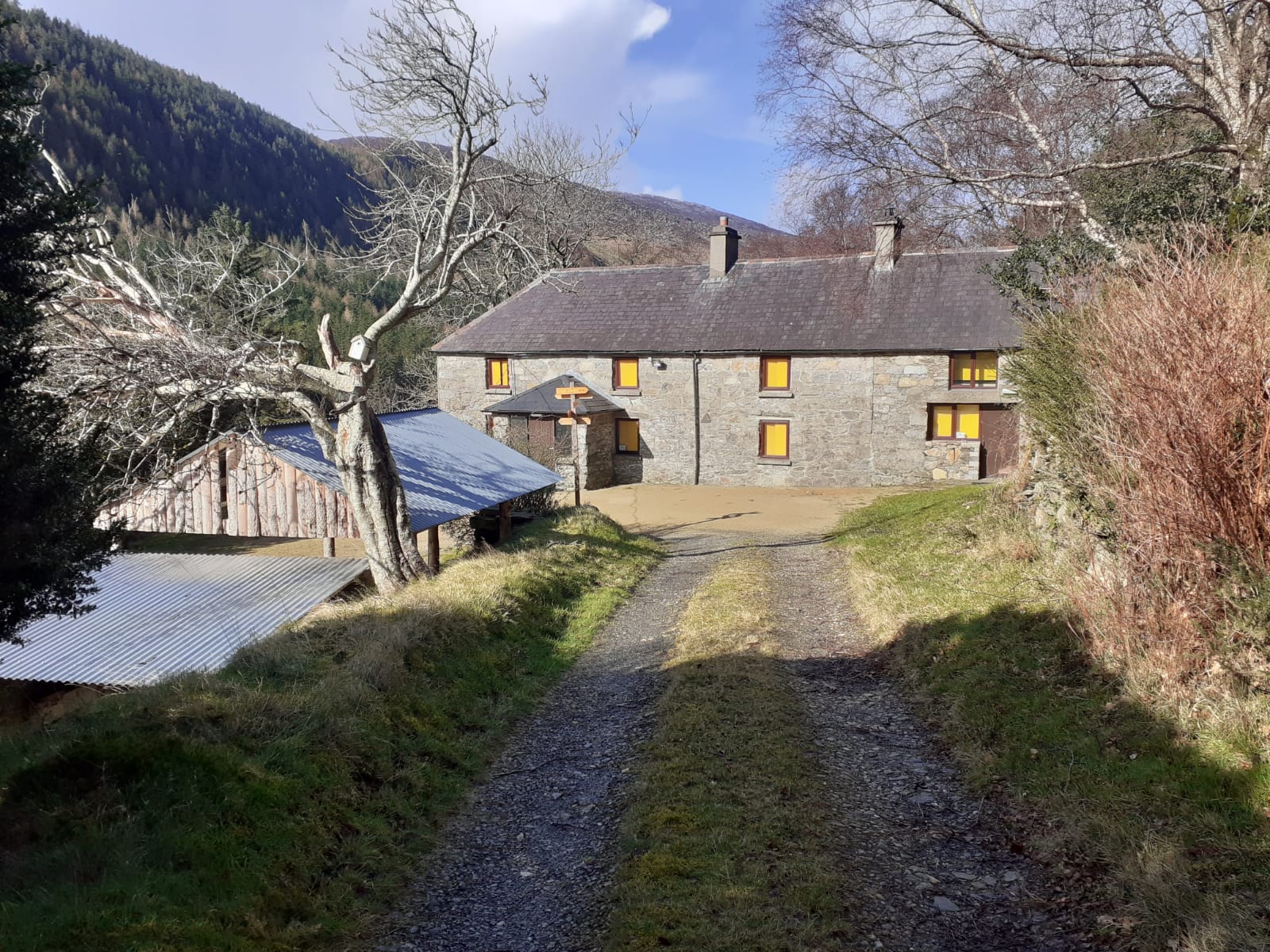
The Hut says “Hi”
IMC Hut Warden Ed Hick (required by insurance to do a regular check-in) tells us that The Hut is well, but a bit lonely… it said to say it misses us all, and hopes we are all keeping safe. Ed has plans to dig more tent pitches in preparation for our ‘Climbfest’ Sep 25-26, and fingers crossed for the club barbeque Aug 7.
Ed replaced broken loo roof tile, put up some new ledges for swallows in shelter, 27th Feb Ed finally got a weather window to clamber up onto loo block roof to replace the broken slate. Hopefully that’s the leak sorted. Put up a few ledges in shelter in case the swallows return this year ( last year there was 1 nest, but it fell). Cowhouse wall seems drier. Our road culvert has been cleared, water supply restored. Ed reckons there’s a day’s hacking in that roadside furze.


13th Feb 
Insect hotel, all critters sleeping zzzz 
Hut water supply exploded during heavy downpours, all sorted now, thanks Ed 
-
Plenty of Bottle needed for this Chardonnet!
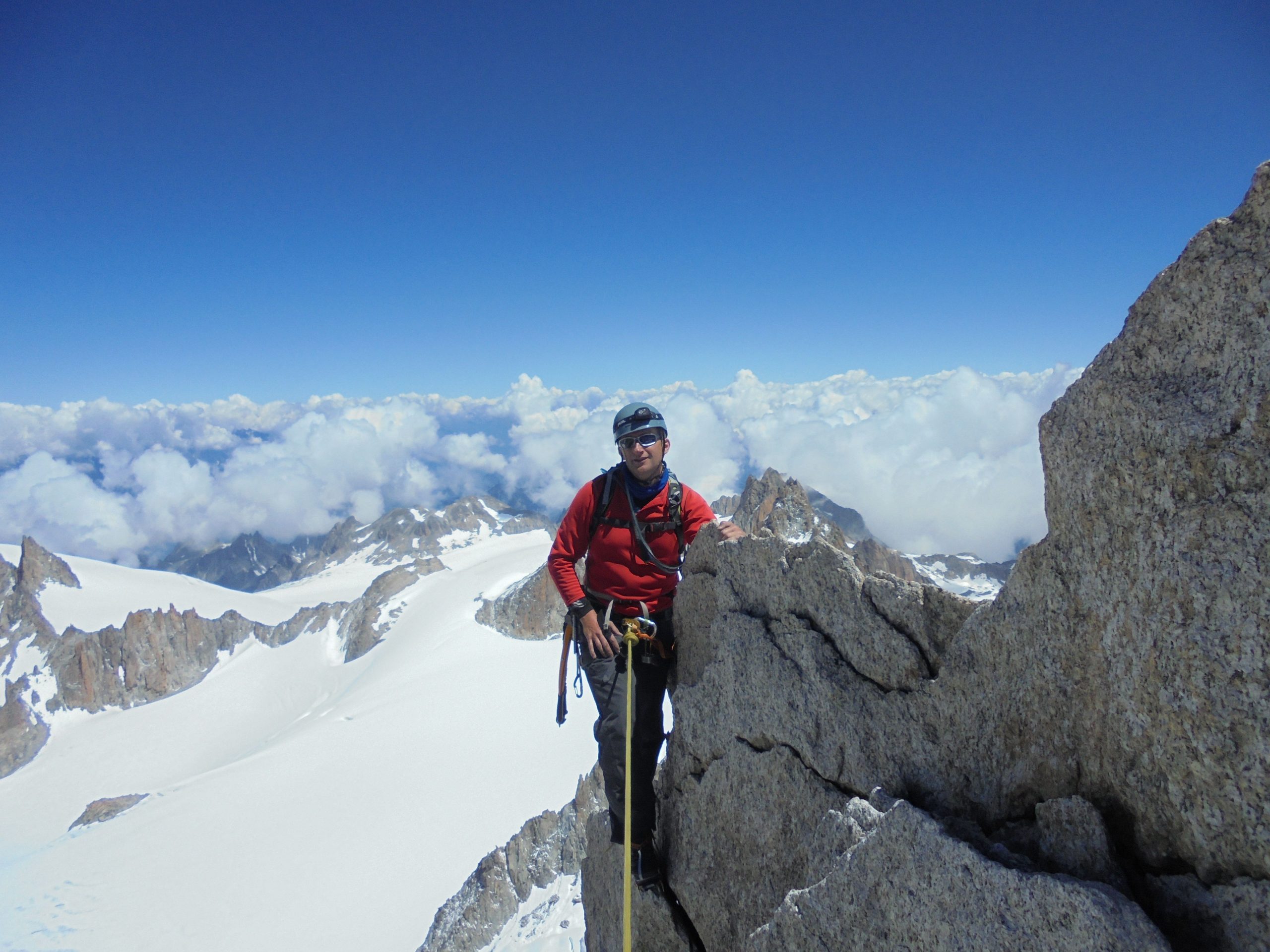
A hair-raising traverse of the Auguille du Chardonnet and Forbes Arête (AD)
by Dermot Shiels
Last summer Declan Murray and I mustered up enough brownie points to get to Chamonix for a cherished ten-day climbing trip.
We have climbed together for over 20 years but funnily enough this was only our second trip to the Alps together. As is the norm before a trip like this we had been training hard, staying fit and researching the routes we planned to climb before we flew out.
With family commitments it is hard to get away for much longer than a week. So, you are faced with a dilemma of having enough time to acclimatise for the higher routes and picking lower routes that are worthwhile to make the trip memorable and worth the effort.
Weighing this up we agreed on the Forbes Arête on Aiguille du Chardonnet (AD) as being one of our main objectives for the trip. The peak is 3,824 metres high and the route is typically done in a day return from the Albert Premier Hut, if you are going well.
With the pair of us a few years either side of 50 we tend to be a bit risk averse these days as an injury can put you out of action for precious weeks or months or could even jeopardise a trip like this altogether. So, we do our best to avoid injuries. An example of this strategy is stopping for tea and biscuits at the climbing wall mid-session while others like Alan and Terry opt to power through the tea break!
Well with bags packed and pre-trip jitters held under control I made my way to the airport full of excitement and enthusiasm. But en route to the airport I received a cryptic text from Declan.
He had an urgent trip to make to the dentist that very morning on his way to the airport. He had unfortunately developed a painful toothache and an abscess in the gum over the previous few days.
For a few scary moments I thought the trip was scuppered. Would he be able to fly? Would he want to? If we did go what condition would he be in? Could he climb? Could he eat biscuits?
The upshot was that he was given penicillin to handle the pain and would have to return to the dentist after the trip to face the music. The side effects of penicillin are plentiful, including the unholy trinity of nausea, vomiting and diarrhoea. And for the most unfortunate you can throw in dizziness and fatigue for good measure. All things considered he’s some man for one man as his prescription would last the length of the trip.
Most mere mortals would take this as a very valid reason to pull out of a trip and look after themselves. Good thing he’s a masochist. As it turns out we had a very successful trip, in our humble opinion. We ended up climbing five enjoyable Alpine routes in mixed weather conditions. Not a bad haul all in all. On some trips you’d be lucky to do two or three routes due to bad weather.
But it also included the type of heart-stopping adventure you don’t really want but almost invariably get on a big mountain trip.
And here is how that adventure happened:

Declan with the Forbes Arête behind him on the skyline A few days into the trip, we stepped out from the Albert Premier Hut into the dark and made our way across scree slopes and glaciers to the foot of the Aiguille du Chardonnet.
Our objective the Forbes Arête was finally on the cards. We weren’t alone. Half a dozen other parties arrived at the same time, heads down plugging towards the steeper ground ahead.
The skies were blue and the wind was a whisper. The scenery is stunning. The stillness making your senses all the more acute, listening to the satisfying crunch of hard snow underfoot.
Declan was suffering in a quiet way as we roped up with the condition he was in and the trepidation of the route ahead. Undeterred, he was resolved to climb the route. Otherwise the conditions were perfect and who knows when we’d be back here again together. He was suffering from fatigue as a result of the meds so he asked me to take the sharp end of the rope for the day and go easy so he could keep up.
As a result, we had to drop our normal pace slightly to ensure we moved smoothly together. We were going to climb simultaneously on either end of the rope Alpine style.
To access the ridge, we meandered up a beautiful snow couloir that progressively got steeper and steeper, like a classic Scottish snow gulley. Occasionally we crossed a deep crevasses on thin snow bridges. One axe each did the job for a while, until we reached a big snow dome below a steep ice section. This was to be the first of the technical climbing. There was plenty of talk about black ice on this pitch the previous night in the hut, so I was expecting it to be difficult.

Crossing the Crevasses – deep and with very narrow snow bridges Still moving together, we started up the ice, both axes out this time. If Declan had been his usual self, we would have flown up this. But not today, our pace was slow. As I reached the crux of this pitch, the ice near vertical, (with no gear between us), Declan was exhausted at the other end of the rope. He was wading in energy sapping softening snow.
He came to a stop at the worst moment for me pulling the rope tight between us. I was only meters away from topping out of the steep ground but I couldn’t move as there was no slack in the rope, every climber’s nightmare.
I didn’t want to stop and place an ice screw as my arms were burning, I just wanted to finish it. Luckily, he soon mustered up a bit of strength and gave me enough slack to be able to mantle shelf up onto an ice ledge and rest my aching arms.

Summit up ahead Next, we climbed a few enjoyable pitches of mixed ground to reach the ridge and we were rewarded with a spectacular view over the other side of the mountain and a rock-solid belay to settle the nerves. Declan soon joined me at the belay, and we sorted out the rock rack and had our first assessment of the ridge.
There are several pitches on mixed ground to reach the summit, my favourite type of climbing, one moment using ice axes, the next using finger locks and front points in a granite crack.
We would have to use all our climbing techniques to reach the summit and abseil back down the far side, as the route is a traverse. I left the belay now and followed the ridge placing slings, ice screws, and a typical rock-climbing rack on enjoyable ground.
The atmosphere was fantastic. The other parties were strung out ahead of us giving us a great idea where the difficulties lay and making us relax as we couldn’t really pass anyone, so the pace was fine.

Dermot on the Forbes Arête. A few hours had passed by now and the weather was beginning to deteriorate. We could see clouds making their way up the valley towards us. Route finding hadn’t been a problem up until now. That said, the descent has a reputation for catching people out, so the potential lack of visibility was a concern.

Cloud building up ahead as Declan pauses during the traverse The team in front of us were moving very slowly now and we were acutely aware of it. We decided to catch up with them to see what was up. They were two young Irish lads, 19 or 20 years-old. They were both exhausted and their motivation had dipped to the floor. Their actions were a bit erratic and we were very concerned about them. The guy in front thought he was on belay, but he wasn’t. It took some persuading, but they finally agreed to let me pass them out and they tied on behind Declan.
So now we were a team of four. It was messy getting to the summit, as everyone was a bit flecked now. And the rope work was slow, adding to the stress. We crossed the summit and hastily set up an abseil down the far side of the mountain.

The descent in deteriorating conditions Two or three abseils down I realised we had taken the wrong bloody line. The weather was deteriorating now, and the light was fading. We were effectively in an avalanche shoot, a bad place to be in a storm. The three guys abseiled down to join me, and the two younger lads were truly exhausted. They wanted to call the mountain rescue, but I was trying to play it down.
As Declan and I looked for options one of the young lads collapsed in a ball and became unresponsive. It was at this moment we discovered the pair of them were on medication too. And they had both run out a few hours previously. So, decision made, we called the mountain rescue.
Not being rugby fans, we didn’t realise that France were playing an international match at the time. So, our pleas for assistance were greeted with tipsy giggles over the phone and reassurances that everything would work out for us. If we still needed help in the morning, they would be happy to assist.
Now that we knew we were on our own, very little light left I immediately started to prussic back up the last 60m abseil to a small cave we had passed on the way down.
Declan followed and we belayed the other pair up. Spirits were low, but we had to accept our lot. We had a cold night ahead. But now we had the security of the cave overhead to shield us from any potential rockfall or avalanche debris if the weather got any worse. It was too late to try to climb back to the summit ridge and the ground was too soft and loose. We would have to wait for morning and a good overnight freeze.
I have spent a few nights like this in semi hanging belays (should I admit this?) so I knew what to expect. Not much sleep, a wet arse and contorted positions for relieving yourself into the darkness. Good character-building stuff. At times through breaks in the cloud we could see the lights in the Albert Premiere below and we knew they were aware of our predicament. We took turns flashing our head torches for a while so they could get a fix on our position and relay this to mountain rescue for the morning.
The night passed without concern and in the morning the weather had improved. With a fewpercent of battery left on one phone we called mountain rescue and they were able to confirm our position. We were about 100m off route.
So I set off horizontally on lovely frozen ground to a huge snow field and dug out a big snow bucket seat and belayed the lads across. We were soon on the correct descent route and several abseils later we arrived back on the glacier, with relief written all over our faces.
We made our way to the hut picked up our belongings and walked down to the valley. Back in Chamonix the warm shower and change of clothes were amazing. Then a leisurely stroll through the town to sample the delights of the Chamonix bakeries.

The two intrepid climbers as they near journey’s end: Declan (left) and Dermot (right). -
The Stuff of Legends
The Stuff of Legends
Selkies, Owey, parting friends and some climbing.
The Selkie
Selkie’s are a mythical creature from Irish folklore similar to mermaids, they are seals in the water, and on land remove their skin and look like we do. There are many versions of the myth, but the one that I am familiar with involves a seal-woman having her skin stolen by a courting king who fancied her for his wife. He hides her skin and professes his love, which she is compelled to return to whoever has her coat. They have seven children together but do not live happily ever after, as she always longs to return to the sea. So, one day when one of the children tell her of a golden cloak Daddy had hidden, she knows exactly what it is. Taking her skin back, she returns to the ocean but can only take two of her children, one under each arm. Naturally, she turns the remaining five to rocks. She and the other two children would return to play off the rocks, tears in their eyes.
That last part always seems a little bit harsh to me, she could have just left the other five with Daddy even if he did steal her coat. Then again, he also held her against her will for several years, so maybe that didn’t feel like an option. Why are fairy-tales always so messed up?
Owey Island
I first visited Owey about 10 years ago for a joint IMC and Columbkille climbers meet. While it was an enjoyable weekend of kayaking and caving my first impressions of the rock were that it was grotty and tended to fall down (see here and here). Since then though, a passel of new amazing looking routes have been put up, so maybe I missed something. Anyway, early in the summer Síle and I decided to give it another chance. We spent a couple of days exploring the cliffs on the hunt for clean, untouched rock. We abseiled into places seeking our quarry and were rewarded with an amazing clean buttress and some fantastic looking cracks rising up from a series of five rocky steps (the Selkies childer’ of course!). Coming home our eyes wide with excitement at the possibilities and we were already planning our next visit.

Selkie Wall and Buttress. The island had changed a lot in our 10 years absence, the once tumbling down little village has been revived with albeit only summertime visitors. The small cottages are refurbished and freshly painted; people chat to you on your way climbing; it’s all very pleasant.
The weather checked our plans somewhat, and we didn’t get back until September when a sunny weekend finally provided our chance . As it happened this coincided with Anni and Dave’s departure to foreign climbs (pun intended). What better way to say good luck than to spend a few days climbing off Donegal’s coast. Artem and Sarah also wanted to wish them bon voyage / go climbing, so the six of us headed out to the island.
Parting Friends
I first met Dave in Dalkey as I was messing around the Ivy Chimney area, I pointed him at a gearless mini-route there that’s given HVS, claiming it is a boulder problem really. He cruised it and at the top called down to a passing mate that he’d just done his first HVS. I thought Jaysus, if I’d know that I’d have sent him up something with gear! I needn’t have worried though, it soon became apparent that he needed little encouragement to push himself when climbing as he rocketed up through the grades.
Anni and Dave have been the clubs most active members the past few years and racked up an impressive tick list between them (see some of Dave’s highlights here). Anni’s exuberant adventuresomeness and Dave’s driven enthusiasm for climbing are infectious and always make you want to climb more and better. They are not bad company around a camp site either, so will be missed.
The Climbing
Anyway, enough sentimentality, onto the climbing. The best crags on the island face west into the Atlantic storms which peel off the coat of loose rock leaving the pristine granite below. The rock architecture is fantastic, almost mythical is stature, the type of place you would certainly expect to find the selkie. The westerly aspect also means the routes can be greasy before the Sun comes onto them. This allows you to spend the mornings drinking coffee and aim to be at the crags for midday, ideally with low tide in the afternoon.
Síle and I first climbed two routes we had worked out on the previous trip and then went looking for more, with Síle adding a third and a fourth route to the list over the next couple of days (details below). The others knocked off some of the established classics of the island and then joined us on the virgin rock. Anni repeated one of Sile’s routes and Dave added a new route of his own. Artem made a strong effort on another difficult looking new line but will have to return for the send.

Artem enjoying some new routing. 
Artem not enjoying some new routing. Route descriptions
Selkie Wall
A steeper than it looks slab with five rocky steps at its base (the Selkie’s Childer’). The first three routes all start off these steps.

Selkie Wall. Flutin’ Around *** E1 5b 30m Síle Daly, David Craig 20/9/2020
Best climbed when low tide is in the evening and in sunshine otherwise the start will be wet. From the lowest barnacle covered ledge, climb the middle crack of the fluted section on huge crystals of perfect, clean granite. Climb the flutes with easy (even when wet) hand and foot jams to a slanting, right trending, black corner. Climb this to 2 thirds of its height. A wild move and hidden hold and crack gains the slab on the left. Climb directly above on steepening rock to the furry top where the pale green, Ramalina lichen hides two wonderful jugs.
Punters Pedestal E2 5c 30 m David Craig, Sile Daly 18/09/2020
Start from the second tallest child beneath twin cracks. Jam the excellent hand cracks until they diverge, follow the right-hand crack to come up the right hand side of a pedestal. Step left and follow a line diagonally left up through an overlap. Keep following a thin crack along the same line to reach blocky ledges and finish up these.
The Selkie’s Childer’ E2 5c 30m Síle Daly, David Craig 18/9/2020
From the highest step, climb the double cracks to the right of ‘Punters Pedestal’. Superb, sustained jamming leads directly to the over hang. The crux requires delicate footwork to the left of the crack as it thins. Resist the temptation to swing over to the pedestal too soon (that steals too much of the other route). Swing into the overhang with spectacular easy moves and climb straight to the top exiting via a shallow niche and right of the big overhanging block.
Selkie Buttress
The buttress to the right of the big corner.
Tir Hudi E3 6a David Keogh, Anni Huovinen 20/09/2020
Start on the tidal ledge beneath a wide crack. Climb this and the flake above to enter a deep groove. Follow this easily to the cracked overhang. Surmount this with difficulty and move up until it is possible to make a step right into the black flakey crack system. Steady climbing leads to another overhang which is passed on the right.
Wild Atlantic Wonderland E1 5c 40m Síle Daly, David Craig 19/9/2020
On the south west side of the buttress, start from a small, round, flat, ledge to the right of a huge black corner. Climb up to a smaller, very black, sharp, steep, rightward leaning corner. Twist, turn and squirm up this (crux) on to easier territory and directly up the deep chimney above. From the top of the chimney an airy step left leads into a gradually steepening groove/corner. Climb this to a large flat ledge with a boulder and directly to the top on easy angled, rounded cracks.

South-West side of Selkie buttress. 
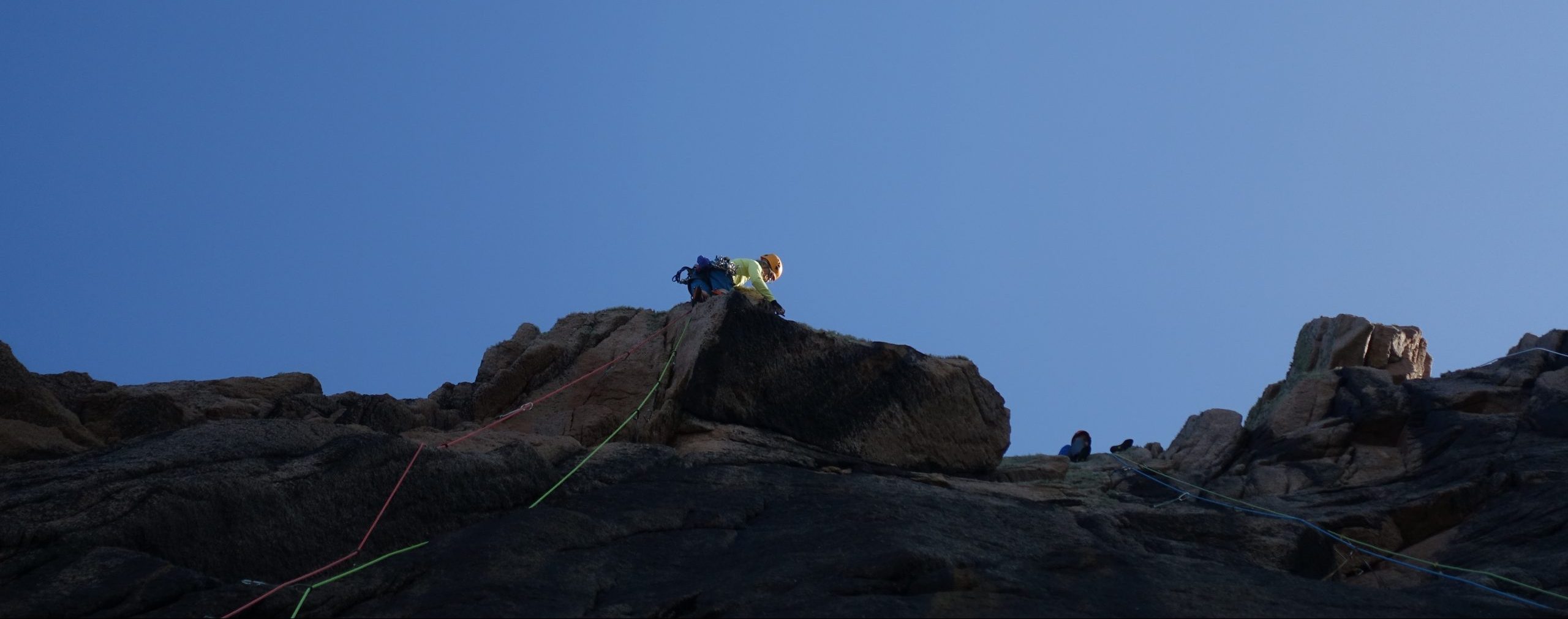
Sile in the first ascent of “The Selkies Childer” E2 5c. -
Patricia Flynn – An Appreciation
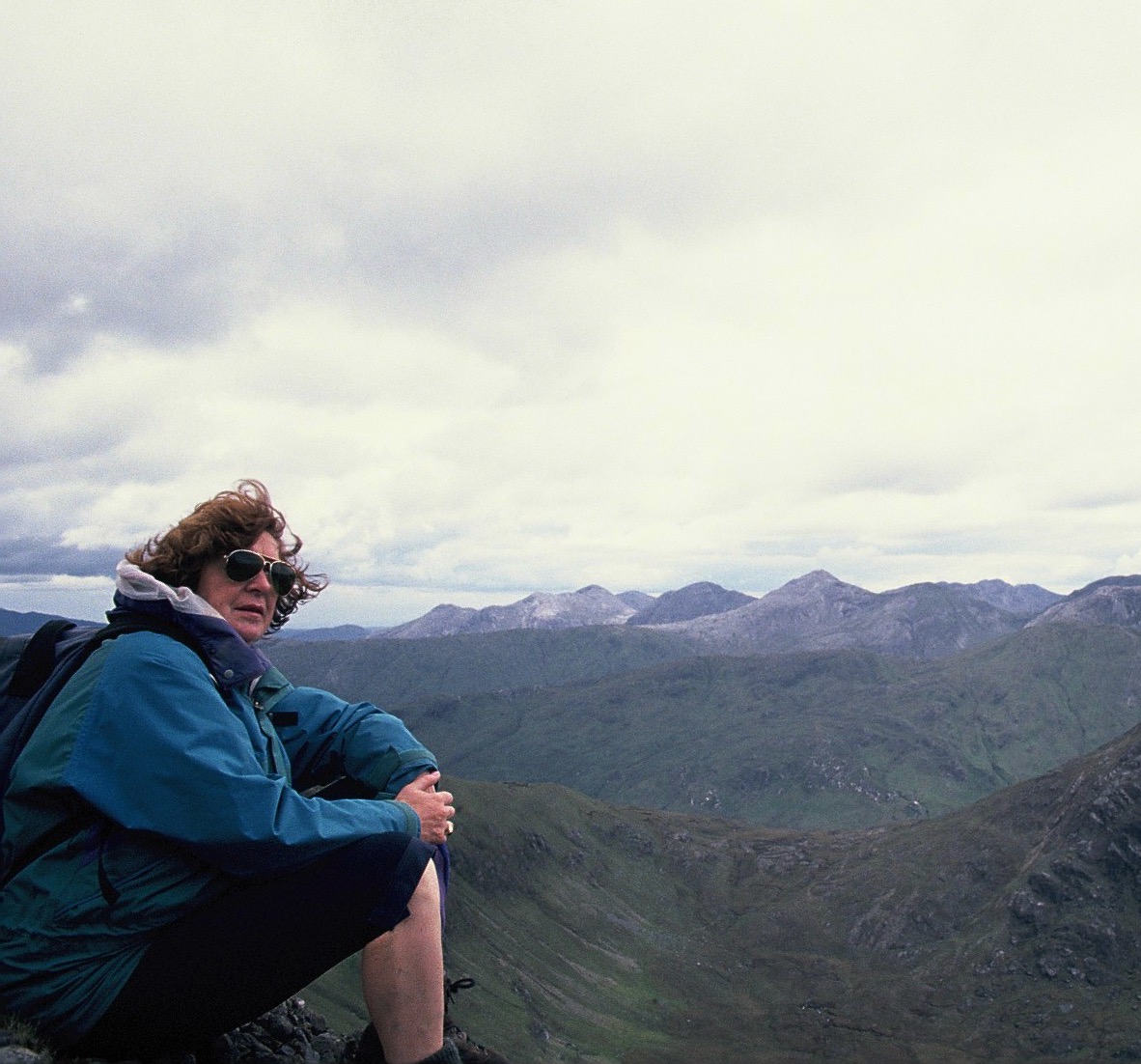
by Jill Rowe
Patricia Flynn, who died suddenly at her Dublin home one August afternoon in 2019, was one of the great Irish mountain women and adventurers of the 20th century.
Through her love of mountains and intrepid sense of adventure she had already climbed Mont Blanc by the age of 20, having hitchhiked from Ireland to get there and back. She went on to break new ground, across Eastern and Western Europe, that others would follow over.
Here in a very personal memoir, lifelong friend and climbing companion Jill Rowe traces some of their trips over more than half a century.
“I met Pat one beautiful summer evening in Dalkey Quarry in 1959. We soon recognised we had the same love of walking and climbing in the hills and mountains.
From then on over a period of many years – between family and work commitments we managed great escapes and adventures.
We covered the ranges from the Mournes to the Kerry mountains, climbed and walked in the Cumbrian Lakes and the Yorkshire Dales, crossed the Cairngorms and the Cuillin Ridge. The weather was not always kind but we prevailed.
Interspersed with these trips we managed holidays in Europe. We tramped the Pyrenees – good huts, great food and lovely mountains.
Encouraged by Paddy Ferron, an early Irish Mountaineering Club (IMC) member we visited the Julien Alps – using his maps and instructions from his trip in 1939.
From there the Balkans called. Difficult to reach in the 1970s as they were part of the Eastern Bloc but we were determined.
We encountered many difficulties and setbacks such as lack of maps and guide books. But these were made up for by the help and directions we received from local mountaineers.
Parts of the Rhodopes mountains in Bulgaria are rugged and wild, the locals we met shared their food, taught us to forage and guided us on our way.
The Tatras in Czechoslovakia (now Czechia) are beautiful, routes well marked and with good huts.
They border Poland so were difficult to negotiate and were guarded at that time. We had a few brushes with the law but good luck prevailed and we managed to leave the country with no more than due admonishment from the authorities.
We went to Corsica and unexpectedly had snow but nevertheless enjoyed our accent of the Islands highest mountain, Monte Cinto and its clear mountain passes and valleys.
Next came the Carpathians. These are softer mountains, easier to traverse and easier to descend into the villages where we would eat and sleep. The people we met were friendly and curious, especially the shepherds. They envied our freedom to travel but were always helpful and kind.
There were other mountain ranges we climbed too – the Alps for example were just beautiful and majestic.
Throughout the years we also had many local days in the Dublin and Wicklow mountains. The week before Pat died, we visited Glendalough – our day filled with reminiscing of the wonderful times we were so privileged to share.
How I wish Pat could help me with this memoir now – if she could what embellishments and detail she would add.
But she will live forever in my heart as that great, loyal and adventurous woman, descending through a mountain mist on a winter’s day – snow on the ground, wearing shorts, her legs bare to the elements. Her love of high wild places was second only to her love for family and friends.”
Patricia died in the arms of her soulmate and husband Joe. In addition to Joe, her son Michael and her grandchildren Alana, Stephen and Cian; she left behind so many friends on whom her mark is indelible and everlasting.

