Skip to content
Irish Mountaineering Club IMC, Cumann Sléibhteoireachta na hÉireann
  • Facebook
  • Instagram
Join Now
Book the Hut
Members Login
  • About
    • Introduction
    • Contact Us
    • Documents
      • Constitution
      • Privacy Policy
    • Expeditions
    • Kindred Clubs, Handy Hostels
    • Library
    • People
  • Join
    • Introduction
    • New Membership
  • Blog
    • Article
    • Obituary
    • Review
    • Route Info
    • Training
    • Trip Report: International
    • Trip Report: Ireland
    • Other: Bottom of Home Page
  • Events
    • Introduction
    • Calendar
  • Hut
  • Publications
    • Introduction
    • Books
    • Newsletters
      • 2010-now
      • 2000-2009
      • 1990-1999
      • 1980-1989
      • 1970-1979
      • 1960-1969
      • 1950-1959
    • IMC Archive
    • Videos
  • Training
    • Overview
    • Introduction to Trad climbing Programme
Irish Mountaineering Club IMC, Cumann Sléibhteoireachta na hÉireann
  • Log In
  • Join the IMC
  • About
    • Introduction
    • Kindred Clubs, Handy Hostels
    • Library
  • Blog
    • Article
    • Obituary
    • Review
    • Training
    • Important Information
  • Events
    • Introduction
    • Calendar
  • Hut
  • Publications
    • Books
    • Newsletters
      • Newsletters 2010-2018
      • Newsletters 2000-2009
      • Newsletters 1990-1999
      • Newsletters 1980-1989
      • Newsletters 1970-1979
      • Newsletters 1960-1969
      • Newsletters 1950-1959
    • IMC Archive
    • Videos
  • Training
    • Overview
    • Introduction to Trad Climbing Programme 2026
Join Now
Book the Hut
Log in
  • First Impressions of Costa Blanca

    First Impressions of Costa Blanca

    First Impressions of Costa Blanca – Sun, Sea & Climbing

    Costa Blanca – Sun, Sea & Climbing

    Having joined the IMC trip to Nice last November, we were keen for some more continental sports climbing in the sun but unable to make the dates of Ian’s trip to Costa Blanca.  Undaunted, within a couple of weeks of returning from Nice, we had booked passage to Alicante flying out the Thursday before Easter and returning the following Friday.

    Being our first visit to the area, we decided to stay at The Orange House in Finestrat.  It is well located, pretty much 30 minutes drive to crags in all directions, and whilst situated in a nice, quiet country area, it is only 5 minutes away from a large retail park with Lidl, Carrefour & more.  As well as that all your fellow guests are climbers, so at breakfast, sitting in the sun by the pool, you can chat away and get their insight into crags & climbs.

    If you’re going to Costa Blanca, you’ll need a hire car to get around.  We used Lara Cars and have no complaints, we were met off the flight and taken straight to the car a few minutes away in the short term car park, 5 minutes for paper work & payment and we were on the road.  Navigating Spanish roads is easy enough, I had a freebie satnav (Navmii) on the phone which we used together with a bit of cop on which got us where we wanted no problem.

    I’d got the Rockfax book well in advance and figured out where I wanted to go, which areas would give us best value for our abilities (at the moment I climb VS tops, which according to Rockfax is equivalent to grade 4/4+, but in reality we found grade 5/5+ to be more equivalent to VS and I even dipped my toe in a couple of 6a’s).

    Good Friday – Sierra de Toix – Far Oeste

    For our first day we opted for simple, easy access single pitch routes of which there are plenty at Sierra de Toix (pronounced Toysh), especially at the Far Oeste crag.  The first few we got to were occupied by families top roping their kids but further along, from Gracias Uwa 4+ onwards were some nice little climbs with stings in their tails, the best being Grand Grill* 5+.

    Sierra de Toix – Far Oeste – Ausgeschissn(4+)

    Encouraged by this we went back to the now emptier main section to do some easy multi-pitch revision, the 2 pitch Bernd* 4.

    Saturday – Sierra de Toix – Este (Left)

    Back to Toix for some multi-pitching.  An educational visit. The Este(Left) crag is more remote & exposed, in comparison to yesterday, we were the only ones there. On impulse I opt for 4 pitch Espolón Arta 4 to get a feel for things.

    Sierra de Toix – Este (left) – Espolon Arta (4) [Pitch 1]

    We haven’t done much multi-pitching, so I fancied something easy that would get us into the rhythm and see how fast & efficiently we moved.  I took the first & third pitches which (not entirely by chance) were the best.  After the first pitches these climbs tend to become a bit scrappy and there are a profusion of bolts leading to a little route confusion.  Due to the more slabby nature of these upper pitches, in places mud & gravel had been washed over the rock which made for an awkward traverse at one point.  We got to the top by a line that was probably right allowing for foreshortening in the topo photo.

    Sierra de Toix – Este (left) – Espolon Arta (4) [Pitch 3]

    There was then a bit of discussion about the way down.  Supposedly a straight line abseil down the line of Horst would bring us to within a few metres of where we started, but from the ab point I felt we were too far over – and the line of Horst was not obvious at all; we could easily end up bashing through thorn bushes and not being able to locate subsequent ab chains.  We ended up abseiling down the line we had climbed.  In retrospect, it would have been better to climb Horst first so that we then knew where it was and where the chains were.

    Back at the bottom we met a friendly self-belaying German who told us he only climbed the first pitches in this crag as it was so scrappy above. So we did the first pitch of Horst* 4+ (a dropped belay presenting a first chance to use an Italian hitch in anger) followed by Spatz* 5, the latter notable for it’s razor sharp holds and for snagging our rope after ab’ing off.

    Easter Sunday – Olta – Sierra de Toix – Placa

    On Sunday we decided to head to Olta which takes a winding road up to a forestry car park & campsite.  Unfortunately, many of the locals had obviously forgone a morning of munching chocolate eggs and got there before us.  The car park was jammed and the road approaching it nearing gridlock.  Having lost time we decided to head back to Sierra de Toix, as it was the nearest crag, and try a different area.

    We wanted more multi-pitching, the popular routes on Oeste were taken but the Placa area was empty. We started on the 3 pitch Lara** 4+ although pretty much ran pitch 1 & 2 together.

    Sierra de Toix – Toix Placa – Lara (4+)

    I took pitch 3 which was quite exposed and slabby with well spaced bolts leading to some focused contemplation at times.  The chain was taken by a party who had started up Ana after us but we had a good chat at the top and enjoyed the view.  At least with 60m half ropes we could (just) get back down to the bags in one go.  After that we went for the 2 pitch Anto* 5, again I took the final pitch which is where the fun was to be had, a great climb.

    Sierra de Toix – Toix Placa – Abseiling off Anto (5)

     Easter Monday – Guadalest – Esther’s Chimney

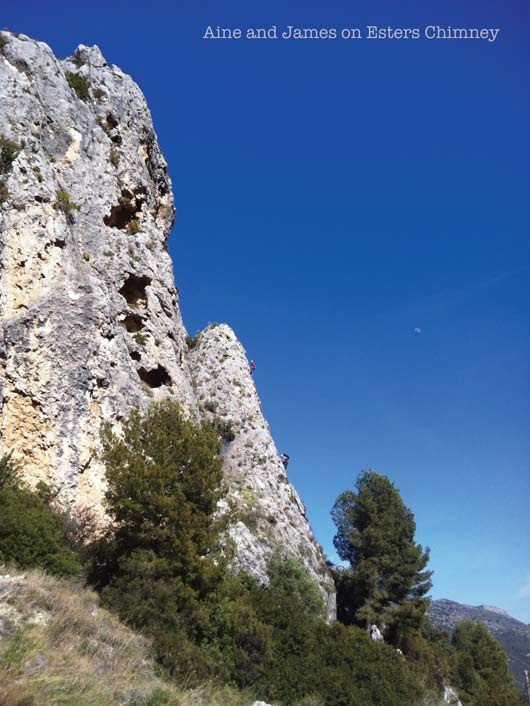
    Guadalest was fairly busy, as you’d expect for an Easter Monday, but the parking for the crag is out of town, down a fairly narrow windy road (I’m glad we had a small hire car).  We wanted to do Esther’s Chimney*** S(4a) having heard about other IMC members visits there.  It’s not a hard climb but has definite novelty value.  It’s not in the Rockfax book but starts around the corner from the Penya Maura area, a topo PDF can be downloaded from the Compass West website.

    Guadalest – Esther’s Chimney S(4a) [Pitch 1]

    The first pitch is now bolted and is a nice climb in itself with a good chain at the top.

    Guadalest – Esther’s Chimney S(4a) [Pitch 2]

    The second pitch is merely a via ferrata style traverse to the foot of the chimney.  The third pitch is where the fun begins, heading up 20m of vertical passageway in the rock.  There’s no bolting here and not much protection but it’s safe enough and has an ab ring at the top.  It’s one of those climbs that’s so enjoyable you find yourself laughing as you make you way up it.

    Guadalest – Esther’s Chimney S(4a) [Pitch 3 – halfway]
    Guadalest – Esther’s Chimney S(4a) [Pitch 3 – stance]

    The fourth pitch is interesting, seemingly committing at first as you step out of a window in the passageway onto the main face again, now some distance above the road.  There is a single bolt to confirm you are headed in the right direction but after that nothing, so you will need a bit of gear to get you to the chain up above.

    From the chain I’m pretty sure you could ab straight down and find the chains at the top of Makarrereta & Inevitable, but not 100% sure.  With two 60m ropes you might even make it down in one, but the chances of the ropes getting snagged on rocks or thorn bushes thereafter are high.  I’d asked Ian before and he said he’d always ab’ed back down the climb, so we went back the way we came.  Tricky swinging back into the window at the top of the chimney but at least you get to go through it again.

    After that we fancied a go at Amber Lights** S(4b) to the right of Esther’s Chimney.   Dorota lead off, taking the line of The Haze 4 to start, again a great climb on it’s own.  But the weather changed, it had clouded over and a cold wind had come up (for those stood around in shorts & T-shirt) so we called it a day and headed for tourism & ice cream in Guadalest town.

    Guadalest – View over castle and Penya l’Alcala (Esther’s Chimney)

    Tuesday – Day Off

    On Tuesday we took a break from climbing and did a spot of tourism including a brief (but not brief enough) visit to Benidorm and further on to the more amenable Altea.

    Wednesday – Echo Valley – Echo 1.5

    Echo Valley is a phenomenal outcrop of crags.  The potential of this area has only been scratched (and in places, subsequently polished).  Echo 1.5 is a popular roadside crag and the lower section was nearly full when we arrived.  The upper section was empty and looked more interesting anyway, so we went up there.  I did Synovial* 5 which certainly got me warmed up, a great climb with, again, some brutally sharp edges for holds.  We took it easy doing the rest of the lower grade climbs and when the party from the lower crag came up, we went down.

    Echo Valley – Echo 1.5(Upper) – Sesamoid (4+)

    I did Phantom* 5+ which has all the work at the start and then took a go at XMAS* 6a which was fine until it became polished slab, so I crossed over onto the upper half of Regalo por Ali** 5 which was much more work than the 5+ I had just done.  A balancy rock over finish with screaming finger tips tensed into the merest of limestone dimples.  It was good but it was time to call it a day.

    I’d wanted to have a look at the El Castellet/Wasp area in Echo valley but it was definitely time for an ice cream. And you have to save something for next time.

    Thursday – Guadalest – Penya l’Alcalà (Right)

    Our final day of climbing and back to Guadalest for single pitches.  Penya l’Alcalà (Right) is a good area on a sunny day as the trees come right up to the crag (hence the confusing topo image in Rockfax).  There’s a series of climbs here that consist of polished bouldering problem starts with easy finishes.  We did a few of these and then dropped further down to Aprendieno a Escalar 4+ an interesting little route up a rib and then stepping across a large chockstone to the main face.

    Guadalest – Penya Maura – Aprendiendo a Escalar (4+)

    Later, sat down at the foot of this eating lunch, a red squirrel appeared, looked up the line and followed the same route we’d just done.  Free solo.  Fumbling with the camera I managed to take a picture of its tail as it leapt onto the chockstone.

    Guadalest – Penya Maura – Aprendiendo a Escalar (Soloing squirrel)

    After lunch we decided to head back to Amber Lights** S(4b) and give it a go.  I started off, again up the line of The Haze 4 traversing left at the end to reach a good chain.  The next pitch looked a bit more challenging closer up, so I got lead again.  It started fine with ample shiny new bolts but then required a bridge into a groove of freshly exposed rock.  It was still a bit loose here and the only hold a wobbling but seemingly sound piece of rock. I started across and up but my second obviously picked up on my uncertainty and revolted.  The bolts at this point had become sparse and as the rock was recently exposed it had a totally different character, much more blocky with far fewer cracks & crevices for fingers.  I decided to move off the line, out to the right and drop some gear in.  Ahead I could see an abseil ring but I was obviously off line and on looser material, favoured only by the birds.  I was barely 15m up the pitch but had reached one of those “it’s probably better to keep going up than down” moments.

    Guadalest – Amber Lights S(4b) (retreat)

    With bloody knuckles I mantled onto the ledge near the ab ring, looked for a fleeting moment at the continuation of the proper line – it looks like a great climb, but not today – I made myself safe and rigged an abseil with shaky fingers whilst my second sunbathed and casually took photos.

    Back down at the bags we decided it would be best to make sure the ice cream shop in Guadalest was still in business.


    NOTES

    Lara Cars (www.laracars.com/rentacar/) – Skoda Fabia 9 days €149 + €61 for a full tank of fuel (which lasted us just about perfectly)

    Navmii Free SatNav (http://navmii.com/#action) – quirky at times but you can download maps and so don’t have to be online to use it.  Also, it helps to predefine the crag parking locations as favourites so you can just hit the button and go.

    The Orange House (http://theorangehouse.co.uk/) – lots of useful info on their website, even if you don’t stay, and some additional topos for newly developed areas.

    The Book (http://www.rockfax.com/climbing-guides/books/costa-blanca-2013/)

    Compass West Topos (http://www.compasswest.co.uk/topos/) – you can find Esther’s Chimney & Amber Lights here:
    Guadalest Lower Amphitheatre
  • Scandinavian Slab Clinic

    Scandinavian Slab Clinic

    Four days climbing in the Setesdal Valley, Norway.
    By Dave Madden


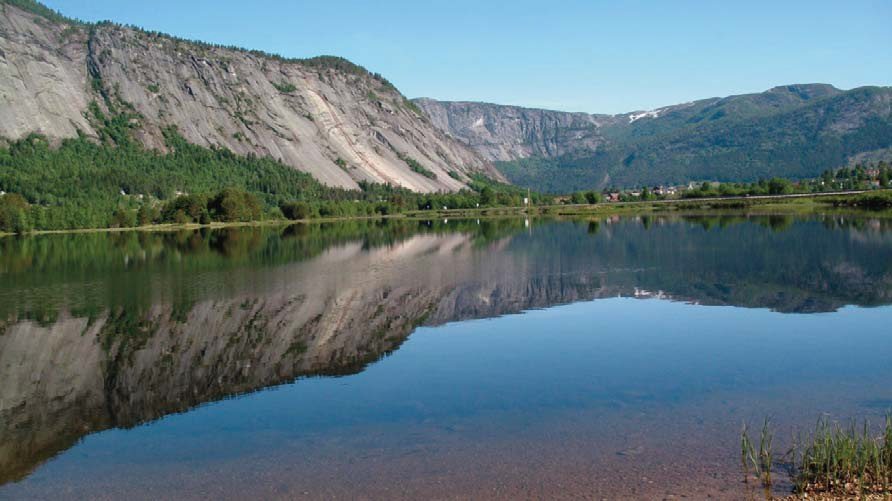
    Welcome to Setesdal. A beautiful valley in Southern Norway flanked on all sides by huge granite domes and peppered with picturesque lakes, rivers and forests. Those granite domes mean one thing….slab climbing!
    So it was with a little nervous anticipation that I arrived in the Setesdal valley eager to polish up my somewhat sketchy slab climbing technique. It was probably just as well that we arrived at 2am, sparing me an initial sight of our main target for the trip, the 850m “Monsterwand” , visible close to the road in Valle. I probably wouldn’t have slept too well.
    Dave had picked out the campsite we were staying in and the location was top notch, right beside the river with great views and it also had a handy kitchen for whipping up our gourmet camping food. To save time , and money, we brought all our food with us in our luggage, something I would recommend for anyone contemplating this type of short trip to Norway.
    Rural Norway has a stripped back appeal, no frothy cappuccinos, no wifi, no pubs and certainly no data roaming if you are wise. But for me this is one of the most appealing aspects of climbing here – it’s a wild and remote climbing experience in a first world country. Having said that you can make this type of trip as adventurous or as relaxed as you want. And Setesdal itself has all the bases covered – from roadside crags through to remote, adventurous mountain routes.

    Sport or trad – take your pick. Or your picks even , if you come back in winter. And yes it does have bolts so you may laugh at my “wild” and “remote” comments!

    Climbing at Loefjell, “Plaisir Picnic”
    Climbing at Loefjell, “Plaisir Picnic”

    Tired and a bit jaded from the previous evening’s long drive, Dave and I were fairly slow out of the traps on day one. We headed for Loefjell, about 15 minutes drive back down the valley. This is the jewel in the crown (according to the guidebook anyway) of Setesdal climbing. And we were blown
    away! A seemingly unending sweep of rock greeted us as we stepped out of the car. You would have travelled far and wide for this – I suppose we had! Was it a mountain or a crag? The 1.5km wall was divided into a number of sectors – we headed for the “Plaisir –Picnic” sector which judging by the name anyway we hoped would ease us into the climbing. The climbing was indeed friendly – superb rock and friction although the bolts were pretty spaced. I guess if you were bolting 150+ routes you would be pretty sparing with your bolts as well!! At the top of one of routes I spotted a superb layback crack running 30m up the crag. No bolts on it and no route in the guide. With a harness full of quickdraws and no trad gear it was a bit frustrating to say the least!!

    Having settled in to the trip we headed on day two for the aforementioned “Monsterwand”. The view from the road was jaw-dropping. A massive slab rising up 850m from the lakeshore. I tried to console myself with the fact that in Setesdal it barely got dark before midnight – although I hoped we wouldn’t be that long! The approach was via the quaint hamlet of “Bo” which could have easily figured on the Norwegian tourist board’s latest campaign.

    Our routes “Trolldans” and “Captain Hook”
    Our routes “Trolldans” and “Captain Hook”

    Our chosen route up the Monsterwand was “Jotun”, a three star 5+ route. At 840m long it is the longest on the wall. However after two pitches it became clear that seepage on the route was going to be a problem. So on Pitch 3 we moved onto “Trolldans”, another three star route graded 6- .
    The climbing was incredible, never particularly hard but massively run out. Some of the easier pitches offered up only 2 bolts for 60m. Usually you got a bolt at the crux but generally a fall would have been a cheese-gratingly bad idea. The odd trad placement was possible, usually a small cam but these were few and far between as the slab was mostly featureless rising up in seemingly never ending waves. Due to the dome shape you could never see the top which only added to the overall atmosphere. My footwork was getting a lot of practice at this point as the route was yielding about one handhold every pitch.

    Dave Trunk high up on Trolldans
    Dave Trunk high up on Trolldans

    On pitch 12 Dave ran into a slight problem. He was forty metres out from the belay when he called back to indicate that the next bolted belay was under water! Unfortunately the huge amount of snow Norway experienced in 2014 was resulting in excessive seepage on the slab from melting snow above. We considered the options including a traverse or pendulum onto another route but it didn’t seem on. We had done the best climbing but with only two pitches to the top it was a bit disappointing not to finish. The next day we opted for another long multi-pitch route, again in Bo, this time on the “Neverland” slab. The curiously named “Captain Hook” was a slightly shorter and supposedly easier route at 5, 575m. It was a peach alright although we both felt it was harder and more sustained than the previous day’s outing. Mind you this time we got about two handholds per pitch. Small mercies. The guidebook had said to watch out for the “Black Mamba” on the seventh pitch. I wasn’t quite sure what to make of that – no more explanation was given. It seemed an unlikely location for an african snake or a lady of ill repute.

    And so it was that I found myself on lead on the seventh pitch. The moves away from the belay immediately felt trickier than anything else the week had produced so far. It got steeper and the rock had a very suspect polished look, closer inspection confirming that it offered next to no friction. I was concentrating very hard at this point not to come off!! Then just to my right I saw it – a four inch wide snake of dark rock twisting its way out of sight up the pitch. The Black Mamba!
    Don’t ask me what the geology was but the sandpaper like surface soon had me tip toeing steeply upwards through the polished wilderness. We topped out on Captain Hook and took a good break to take in the views before the long ab down.

    View from the belay on pitch 5 of Captain Hook
    View from the belay on pitch 5 of Captain Hook

    We awoke on the final day pretty dog tired but a four day pass is a four day pass and that sun was still shining- who knows when we might see that again?? So back we went to Loefjell – a different sector this time “Brokkestoylen”. This is another top location – a really well bolted beginners and intermediates crag with thirty or so routes from 3+ through to 7. At this point our feet were really starting to complain so we took it fairly quietly, climbed a few routes and enjoyed the great views.

    Dave Trunk on Pitch 1 of Captain Hook
    Dave Trunk on Pitch 1 of Captain Hook

    We didn’t even scratch the surface on this trip. The guidebook has over 500 routes in there and if you have more time there is clearly lots of potential for new, adventurous trad climbing. Everywhere you look there are walls and most of them are unclimbed. If you are planning a trip to Norway the best bet is to stay flexible and book at the last minute based on a good weather forecast. Ryanair flights actually go down in price nearer the time – we booked one week in advance. The drive from Oslo Rygge to Setesdal is about 5 hours.

    Loefjell “Skole/Brokkestoylen”
    Loefjell “Skole/Brokkestoylen”

    So if you feel your footwork needs a bit of a tune-up we can highly recommend Setesdal – the Scandinavian Slab clinic.
    I’m still a ropey slab climber but I got a helluva lot of practice!!

    Guidebook: Setesdal – Henniger and Brunnert – Panico Alpinverlag
    Gear: 2x 60m half ropes, 12 extendable draws, some small to medium size cams, half set of nuts, comfortable rock shoes!, small climbing pack
    Recommended camping: Flateland camping, Valle

  • Costa Blanca 2014

    Costa Blanca 2014

    19 of us met up bleary eyed for the 7am flight from Dublin to Alicante on Sat 8 March. Half the flight was made up of Spanish teenagers, who were probably going home after a school trip to Ireland. There was a big cheer out of them when we touched down in Alicante and looking out at the bright sunshine and 20 degrees we could see why. It was a handy 1 hour transfer up to our accommodation at Finepark mountain lodge, a couple of km outside Finestrat and about 10km away from Benidorm. This was a great find by Ian Christie because the lodge was big enough to accommodate all of us, which made for great social evenings, with all the group together each night. 4 who flew in later had to put up with the hardship of staying in a house by the pool a 100m away.
    The pattern from day 1 was drinks after dinner in the big common room until the wee hours (well 1am most nights) and muchos cerveza and rioja was had at bargain prices. Thankfully there was no dancing on tables but ear plugs were recommended for early nighters.

    P

    On the first afternoon, 10 of us trekked up to have a look at the start of ‘Espolon Central’, the 13 pitch monster climb up Puig Campana (at 1400m the 2nd highest mountain on the Costa Blanca). This climb ranged from 3 (VD) to 4+ (VS) but with the serious exposure applying and route finding being critical I decided it was one to aim for next year. However, Kevin Coakley, Ian Christie, Peter Woods and Barry Watts went off satisfied and ready for their assault a few days later. James Aitken cooked a great meal for us all that first night and by 10pm we had our full complement of 23 (asthose coming by the later Ryanair flight were then in).

    spain2

    The first day we all went to Sierra de Toix (well all bar John Duignan and Hugh Reynolds who being the cute ones with a priority car booking had made a dash for Toix straight from the airport the day before and so went elsewhere). Toix is an impressive sea cliff face about 10km north of Benidorm and with a choice of 222 sport routes (ranging from 3 to 8a+) you could spend your week just here alone! There are great views of the coast and the mountains inland from here. Just a short walk from the car park is Toix far Oest, a nice short rock face (single pitch climbing) which had some 3s, and plenty of 4 and 4+s for us to get used to rock again (after a winter indoors). Most of us amused ourselves on this face for the day, as there were 27 routes to choose from. I was climbing with Brian Lawless, as well as Aine O’Reilly and James Aitken, who shared our car.

    spain4

    The second day we went to the crag beside the picturesque village of Guadalest, which is perched on top of an impressive limestone pinnacle and has an imposing castle watch tower and church. We went to the Penya Alcalà area which had a number of 4 and 4+s for us to warm up on. Peter and Barry were climbing beside us and told us that Ian, Kevin, Niall and Tina Ennis had gone off to do an impressive Trad route called Esther’s Chimney (which climbs up through a vertical tunnel hollowed out in the mountain by erosion).

    spain7

    After lunch we moved over to that crag called ‘Penya Maura’ and we met Ian who was just back down and so able to give us details of the climb which was 3 pitches long and took about 3½ hours to do. We decided to give it a go (the first pitch at least) and because it was now mid afternoon Aine lead off up the left side (with James), following Ian’s earlier route, and in order to save time, I lead off up the right side (with Brian) at the same time. Ian had warned us that he had had difficulty getting good protection in and had found this pitch the most committing. This was certainly the case, there was some ‘psychological’ gear put in (that you didn’t really want to fall on), but we both made it up without incident. It was part HS, part VS, but climbing it ‘on-sight’, unsure of protection and unsure what was coming next definitely made it feel VS all the way. The limestone was very sharp compared to the bolted routes and really made us appreciate what the people who developed this area had to deal with in the early days (I imagine an even stronger aversion against falling than usual and a fair investment in rock shoes).
    E
    By stark contrast the 2nd pitch through the chimney inside the mountain was completely smooth and quite straightforward, but because it was so unusual it made the climb particularly memorable. The final pitch was surprisingly short and not too difficult, but exiting out of a small window in the rock onto an exposed face by an airy delicate move this proved equally memorable. On top of the climb a fantastic view of Guadalest on one side and a turquoise coloured reservoir on the other greeted us.

    spain1

    The third day we went to Vall de Guadar (Echo Valley) which per the Rockfax guide “is one of the more impressive mountainous limestone regions in the Costa Blanca. Compared to many of the other crags in the Costa Blanca it is relatively unspoilt and quiet which makes it a great venue for those who are after a bit of solitude far from the madding crowds.” There are 8 climbing areas and we climbed in the Echo 1.5 area (which offered a number of humane grades as well as harder stuff). We warmed up on a number of short single pitch 4s and 4+s, though accidentally did a 5 to start with, and then moved to longer 25m climbs on the upper face. The first of these ‘Romero’s birthday’, graded 4, I found more committing and difficult than the short 5 I did earlier (so certainly one that I would swap the grades around on). Meanwhile Aine and James found an extended climb all the way from the lower crag up onto the upper crag and up to the top on an oddly named route calle ‘Sesamoid’. The imposing face of ‘Aran de Batistot’ and fine views back to the coast made Echo Valley another very scenic place to climb. Meanwhile, today being the last of the very good weather days Kevin, Ian, Peter and Barry had gotten up at 6.30am and gone to Puig Campana to tackle the epic 13 pitch classic ‘Espolon Central’ climb up the east face of it.

    spain6

    That evening we discovered that Eric, Geraldine, Przemek and Karolina, had done the very airy and imposing grade 5 (HVS) Magical Mystery Tour route on Sierra de Toix.
    Three solid days climbing done at this stage we were keen to give the fingers a break from pure climbing and so we hatched plans to have a climbing ‘rest day’ and instead go for the Castellets ridge walk. Per the Rockfax guide “sandwiched between the rock climbing meccas of the Sella valley and the majestic Puig Campana is a serrated ridge of marathon proportions – Castellets. The ridge is composed of a multitude of summits linked by dizzying, and at times difficult knife-edge aretes. There is the magnificent traverse of the first section of the ridge, the El Realet Ridge”. Unfortunately, after escaping for 4 days someone in Met Eireann discovered where we were and sent some Irish weather over our way and so the forecast for Wednesday was suddenly for high winds and rain showers. Knife edge aretes not being the best place to be in high winds and rain we quickly changed plans on Wed morning. As the wind and rain was sweeping in from the north east, we scoured the guide for SW facing crags and found that a low down crag across the road from Echo Valley was just right and so back we went to Echo Valley on day 4. In the end the showers didn’t amount to much and being Spain the rock dried out immediately after so we got a number of good climbs in.

    spain5

    Needing a break from climbing all the time we took the opportunity to set up a top rope from an overhang in order to practice self ascending a rope using harness and foot prussiks (and this was meant to be a rest day!) Ian and a few others were climbing up at the main face of Echo Valley. We had hatched a plan earlier that if the weather held we might walk from Echo Valley back over the mountains, around Puig Campana to Finestrat (a walk of about 10km which Ian had done last year and highly recommended). Luckily the weather held and so Ian, Aine, James and myself, set off from the top of Echo Valley over the mountains to complete this walk late in the afternoon. So much for a ‘rest day’, but I have to say, the views were fantastic (far exceeding my expectations) and ‘Ballymun by the Sea’ (Benidorm) actually looked pretty good from up there (like some futuristic space city). The inland countryside and mountain views are stunning. The view of the knife edged Castellets ridge in the twilight, with mountain ranges behind it continuing to the horizon was particularly good. We even had a full moon rise up over Puig Campana to make it a magical walk back in the last of the daylight.

    S

    On the fifth day, the forecast was for more serious rain, so we decided to use high tech methods to decide where to go i.e. we stuck our heads out the lodge door to see which way the wind was blowing and which way looked least grey. We gambled on a dash back to the coast and Sierra de Toix (as it jutted out of the coast and might escape some of the rain). This turned out to be a good gamble because we spent a full day

    spain3

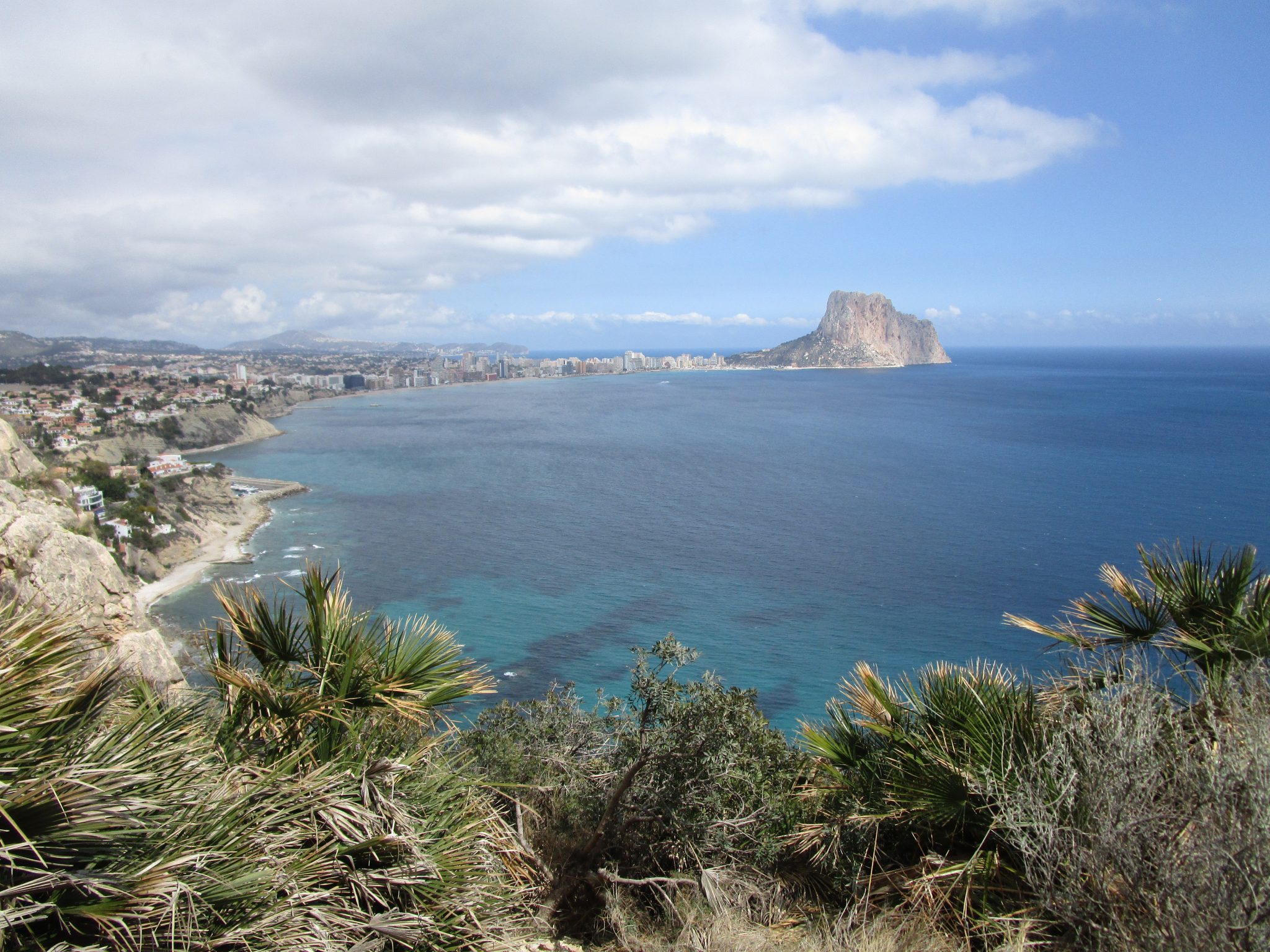
    On our final day, we travelled to Olta (which sits just inland from the massive 300m tower of the Peñon d’Ifach which looms over Calpe). We picked Olta because there were lots of routes to choose from at our grade and because we got to finish off in style with stunning views of the Penon d’Ifach (probably the most famous landmark on the coast). We got in several climbs and finished on a brilliant climb up onto a pinnacle, which gave fine views of the Penon and the coast. That night our hosts at Finepark mountain lodge laid on a huge bbq and we all feasted, told tales, and drank under the stars. Out came the guitar, and Karl, the new voice of Finestrat, gave it socks and led the way in belting out the songs.

    costablanca2

    We climbed for 6 days in a row and had barely scratched the surface of what the Costa Blanca has to offer. We climbed in 4 different locations and in 1 / 2 areas in each. However, to put it in context, the Rockfax guide lists 50 different locations, many with over a dozen different areas in each, a total of 3,500 sport routes, and 21 featured Trad routes (there are many Trad routes, like Esther’s Chimney, which aren’t in the guide, as it focuses on sports routes). We didn’t even make it to the most extensive climbing location in the Costa Blanca, Sella which has 317 routes, albeit, mostly in the higher grades. All the places we climbed were within a 40 minute drive from our accommodation (Echo Valley was only 20 minutes away). Within a 1 to 1½ hour radius from Finestrat dozens of locations are in range and many only have a short walk in to them. The choice of climbing areas and climbs are huge. I reckon you could go to the Costa Blanca every year for over a dozen years and keep climbing new areas every year. Thanks to Ian for a great trip. I can’t wait to get back . . .

    Holiday info: Fly to Alicante (c.€150) Aer Lingus or Ryanair
    Car Hire: (c€50), if you add full ‘crash and bash’ insurance and petrol (c.€200 for the week)
    Finepark Lodge was €17 pp per night (€119 for the week)
    We used the Rockfax Costa Blanca climbing guide.
    Also, lots of info online on Rockfax [Spain, Costa Blanca]
    Also see – Costa Blanca Climbing

  • Climbing In Nice: Le Baou de Saint-Jeannet

    Climbing In Nice: Le Baou de Saint-Jeannet

    (by Peter Wood, December 2013)
    Climbing in Nice November 2013 including an ascent of the thirteen pitch “La Malet ”

    (more…)

  • Climbing around Nice – meet report

    (by Przemek Martyniak, December 2012)
    Winter-time climbing in the sunny south of France.


    A couple of days ago we got back from a great few days of sports-climbing on bolted crags near Nice in southern France.

    (more…)

Previous Page
1 2 3
Next Page

Postal Address

Irish Mountaineering Club
Glendasan
Glendalough
Co. Wicklow
A98 EY91
Ireland

Follow us on Social Media

  • Facebook
  • Instagram

IMC Website

  • Contact Us
  • Introduction
  • Hut