Skip to content
Irish Mountaineering Club IMC, Cumann Sléibhteoireachta na hÉireann
  • Facebook
  • Instagram
Join Now
Book the Hut
Members Login
  • About
    • Introduction
    • Contact Us
    • Documents
      • Constitution
      • Privacy Policy
    • Expeditions
    • Kindred Clubs, Handy Hostels
    • Library
    • People
  • Join
    • Introduction
    • New Membership
  • Blog
    • Article
    • Obituary
    • Review
    • Route Info
    • Training
    • Trip Report: International
    • Trip Report: Ireland
    • Other: Bottom of Home Page
  • Events
    • Introduction
    • Calendar
  • Hut
  • Publications
    • Introduction
    • Books
    • Newsletters
      • 2010-now
      • 2000-2009
      • 1990-1999
      • 1980-1989
      • 1970-1979
      • 1960-1969
      • 1950-1959
    • IMC Archive
    • Videos
  • Training
    • Overview
    • Introduction to Trad climbing Programme
Irish Mountaineering Club IMC, Cumann Sléibhteoireachta na hÉireann
  • Log In
  • Join the IMC
  • About
    • Introduction
    • Kindred Clubs, Handy Hostels
    • Library
  • Blog
    • Article
    • Obituary
    • Review
    • Training
    • Important Information
  • Events
    • Introduction
    • Calendar
  • Hut
  • Publications
    • Books
    • Newsletters
      • Newsletters 2010-2018
      • Newsletters 2000-2009
      • Newsletters 1990-1999
      • Newsletters 1980-1989
      • Newsletters 1970-1979
      • Newsletters 1960-1969
      • Newsletters 1950-1959
    • IMC Archive
    • Videos
  • Training
    • Overview
    • Introduction to Trad Climbing Programme 2026
Join Now
Book the Hut
Log in
  • A Scotsman, an Englishman and an Irishman went on a climbing trip to Wales.

    A Scotsman, an Englishman and an Irishman went on a climbing trip to Wales.

    5am up, bags packed the night before. Breakfast consumed on the drive north to Dublin to meet Irishman and Englishman before catching the ferry to Holyhead. Second breakfast and coffee on the boat, where we met up with another two parties heading over to the IMC Wales meet. Guide books strewn over the table, discussion and anticipation of where to go and what to climb, Gogarth and the Pass being top of the list. We arrived in Wales to overcast skies and showers – not what was forecast. The parties went their separate ways for the day. Irishman was concerned by the wind strength and direction for Gogarth so we headed into the thickening cloud to the Pass, dropping our bags at the hut on the way.

    Englishman was getting excited on the drive round and talk turned to the routes on the Cromlech: Left Wall, Cenotaph Corner, Cemetery Gates and Ivy Sepulchre, we should climb them all he exclaimed not able to choose between the four. Drizzle turned to rain, Englishman’s top lip began to quiver, his excitement drained by the worsening weather. We stopped at the boulders below the Cromlech and fingered the permanently dry but immensely steep routes, too hard for us. Down to Llanberis for tea and to devise another plan. The weather brightening towards the coast and time getting on it was decided that we would not have time to drive back to Gogarth or south to Tremadog. Enda another Irishman turned up making us a four, it had brightened slightly so we headed back to the Pass as time was getting on.

    IMG_1592

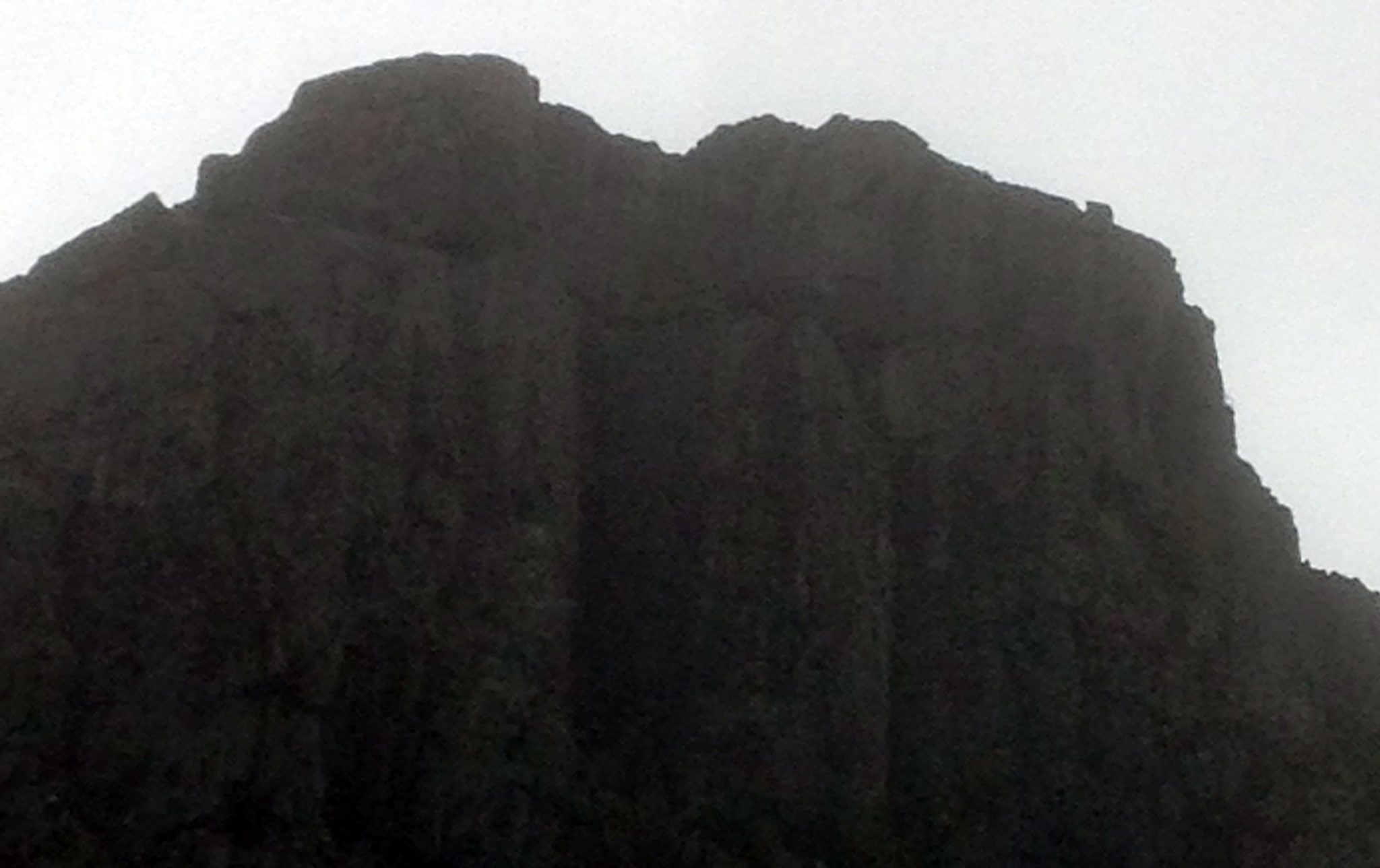
    The rock still wet we geared up anyway. At least it had stopped raining and there were some V Diffs we could do in the wet. The wind picked up on the trudge up the slope, bringing with it some light drizzle. The two corners were soaking wet as was Left Wall, Cemetery Gates too hard to tell from a distance. Englishman made a beeline for the main corner on the Cromlech. With his stiff upper lip he proclaimed that we would climb Cemetery Gates his heart still set on climbing at least one of the four he had earmarked for the day. The two Irishmen opted for the slightly easier Spiral Staircase. We scrambled up the wet slabs to the base of the route, no queues today that was a certainty.

    Englishman made steady progress on the initial ramp proclaiming it to be only hard severe, he reached the steep pull into the sculpted vertical groove “watch me here” the climbing getting notably harder at this point. Up he went gear and holds a plenty, some intestinal explosions helping to propel him upwards into the growing darkness. I looked out across to cars far below driving down the valley, headlights lighting up the road, only 4:30 the day foreshortened by the incoming cloud. Light rain again blowing sideways on to the cliff. Some more grunting and Englishman was on the girdle ledge 2/3 of the way up the route. I only have two extenders left he shouted down. Should I go on or belay? It’s up to you I retorted unable to see beyond the ledge he was stood.

    “Safe”, “Climb when ready”, “Climbing”.

    Up I went the rhyolite providing plenty of unexpected holds by the way of side pulls. Hands cold but thankful for the four layers I was wearing, concentrating hard on my footwork due to the wet rock. I was soon up to the girdle ledge, forearms aching from the effort to grip the rock with numb hands. Englishman was still buzzing, eyeing up the steep final crack he offered me the lead. Personally I would have gone for the arête rather than up the finger crack to the slimy left slanting crack that led to the top. He was determined, this could be interesting I thought to myself. You can go on I said, he had wanted to do the route in one pitch so why deny him the vile looking crack.

    Off he went, fingerlocks followed by hand jams resisting the temptation to cross to the arête he continued up to the slimy left slanting crack, no turning back now. More gear placed he started climbing the crack, body to the right of it with one foot sliding to get traction on the slimy rock. I struggled to see where he was going to go from here, at this stage he had accepted the crack was too wet to climb, presumably he had not appreciated this from the belay ledge. More grunting “watch me here” he was now between the crack and the arête, trying to keep it together just two meters from the top. His lip quivering once more he wobbled upwards letting out a yelp as he lunged for the arête. Somehow he latched something through desperation managing to stay on, whoops of relief as he topped out. He later found out that what he had been attempting in the rain was the Dirty Dick finish and the easy looking arête had been the line of Cemetery Gates.

    I joined him at the top, by this point it was dark our head torches safely stowed in the tops of our rucksacks at the base of the route. We fumbled our way to the tree above Cenotaph Corner and managed to ab down to our bags in a oner. Head torches on scrabbling down the scree to the car, mountains of food at Pete’s Eats then back to the hut. We were joined by ten more IMC members at 2am in the morning having gotten the late night ferry across after work.

    IMG_1587

    Saturday it rained until early afternoon so we opted for a walk up Tryfan and on Sunday we decided to head over to Tremadog as it had proved a better bet weather-wise for other parties who had climbed here the previous two days. I was with Irishman today as Englishman had had his fill and was off fulfilling his Training Officer duties with the new members. First route (One Step in the Clouds) of this wet weather in the mountains crag, it started to rain! I seconded up the first pitch in the rain to the now wet second pitch requiring delicate footwork on small holds, great. Your feet do stick in the wet, it’s all in your head, until you fall off, was what I kept telling myself. Crux pitch dispatched one easier pitch lead to the top. Down to Eric’s Café for tea and cake and to wait for the inclement weather to pass.

    Brightening up and second route selected (Meschach) we wandered back up the hill. Having planted the fact that there was a peg at the crux Irishman was easily convinced to take the first pitch. Some intricate route finding across a slab he was at the belay. I’m pretty sure I would have found myself lost and off route so quite relieved in that respect. Off I went through the bulge and then a long pull up to the ledge with the peg, a delicate traverse from the peg lead to a rising traverse to the top. Irishman followed making friends with the peg ensuring it was seated well on his way past.

    Final route of the day was to be The Plum, time was getting on. We climbed up to a buttress and managed to convince ourselves we were in the right place. I set off aware that I was running out of daylight. It was steep! I pulled through the initial bouldary crux at the start, perched above my gear puffing more than I should have been, doubt crept in, I had been in this position before. I opted to jump off before getting more committed. Transpired I was not even on the right buttress let alone the right route, oh well not the first time my eyes had picked the wrong line.

    Monday turned out to be the best weather day, but we only had till early afternoon as we were on the 5pm ferry. We got sunny weather in the Pass and took some of the new climbers up some multipitch routes. The rite of passage of dropping gear on your first multipitch was achieved by most, all was retrieved so no harm done. It reminded me how much satisfaction you get from taking someone out to experience something new and challenging to them and was enjoyable to all new and old. Back to Pete’s Eats for some more low calorie diet food, then to the ferry. Englishman decided to have one last moment of excitement by flattening his car battery in the queue by having most electrical items on in his car whilst we waited. Some embarrassment later we were up and running again and on the rather choppy ferry home.

    It was a most enjoyable long weekend and my first time climbing in Wales, something would have been wrong if it had not rained once at least every day.
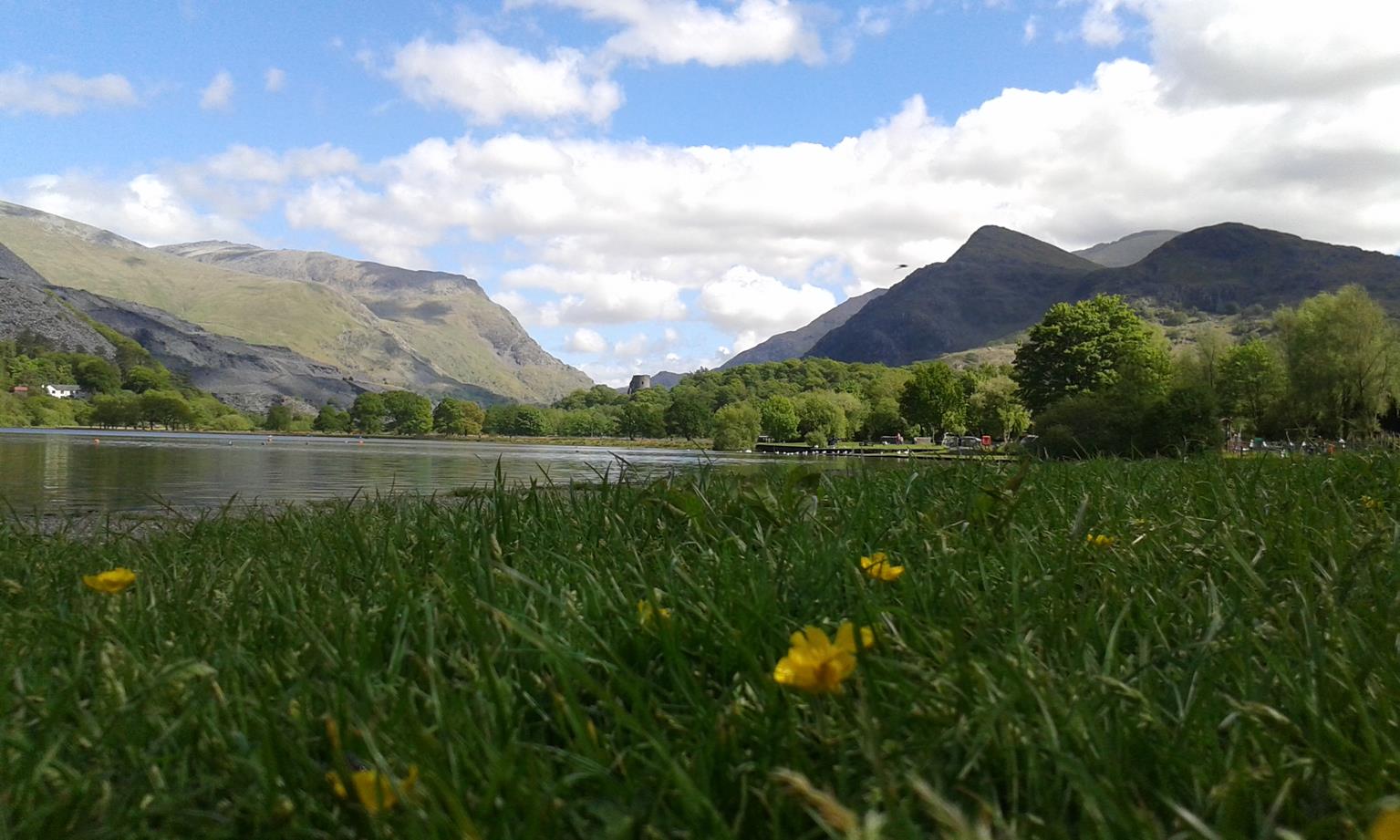
     

  • Wales weaves its old magic on this quick Autumn visit

    Wales weaves its old magic on this quick Autumn visit

    The low sun reminding me how  Summer was fading  – how did Life get in the way of Climbing ?  Ancient bones and lack of training aside  , I needed to scratch that Climbing Itch . Feed the Rat . Thankfully Harry McGee and my niece were free for a few days in Wales.  IMC reciprocal rights to the Climbers Club hut in Llanberis means you  look out in the morning at Cenotaph Corner and all is good in the world.


    1 Idwal Slab Tennis Shoes above crux
    Harry cruising on Tennis Shoes Idwal Slabs

    Tennis Shoes HS 4b*** HS to start : I  always wanted to climb on Idwal slabs – today we had the hills to ourselves :  Knobbly chickenheads that would not  be out of place  in Yosemite  and a fine mountain situation  with the crux at the top .

    2 Harry Magee mantling the crux move on The Cracks Dinas Mot
    Harry Mantles the crux on The Cracks Dinas Mot


    The Cracks , a multipitch  HS  *** on Dinas Mot in  Llanberis Pass next up : Harry did the 5a mantle at the top effortlessly ; Lovely crack and slab climbing ;  We finished the day by crossing over to Flying Buttress  – a multipitch romp on Dinas Cromlech just around from Cemetery Gates  – all the exposure with no  hardship.

    Weather warning on high brought us to the ever reliable Tremadog : Eric was in his café and telling tales of Base Jumping after climbing the Eiger… so gripped was the journalist in Harry that I had to pull him away from a fellow adventurer with many more yarns to tell. Creagh Dhu  wall ***  has got to be one of  the most enjoyable hard severes I have done. It basked in sunshine and had a really fun traverse at the start of second pitch. Both of us got equally interesting pitches. Valerie’s Rib  to follow was  a bit of a letdown – only because Creagh Dhu Wall was outstanding .

    Creagh Dhu Wall Tremadog


    Harry needed some real exercise the next day so went off mountain running Crib Goch and then joined up with a local climber for Nea , a lovely VS in the Llanberis  pass for a great finish to his holiday.

    I join  my niece Anne Marie; 10 years before we were washed off  Grooved Arete *** on one of Gerry’s Meets . Today we had Tryfan to ourselves and the sunshine . The nine pitches flew in – The Knights Move pitch is very memorable and even the polish didn’t seem so bad on the sunshine. This climb alone would make  the trip worthwhile .


    4 Anne Marie on Grooved Arete Tryfan
    Anne Marie on  Grooved Arete Tryfan

    It’s Wales so we had to have some rain  .. and spent it on a slog up Snowdon. It was good to get a backpack off but misty tops meant no views. Definitely  a prompt to go back to Tremadog.   The Upper Tier on Pant Ifan was worth the uphill slog as it had some fine easy grade ( up to VS ) single pitch climbs to enjoy.

    Upper Tier Pant Ifan Tremadog

    Merlin Crag in the afternoon was gave more traditional “in the trees” multipitch  climbing with the toot tooting steam  train in the distance.

    6 Anne Marie climbs in leafy  Merlin Crag
    Leafy Oberon Merlin Crag Tremadog


    A quick dash to Holyhead mountain while waiting for the ferry .  7 New Boots and Panties Holyhead Mountain

    New Boots and Panties provide sticky climbing in the sunshine on Holyhead Mountain

    Gerry Moss’s trip to Snowdonia is a not an option – its a must for new members :  Great crack , brilliant advice from Gerry and a wide range of three star routes at all levels – with a meal in Pete’s Eats to look forward to at Days End … Life doesn’t offer any better


  • A Summer In Mid-Wales by J. P.O’F. Lynam

    A Summer In Mid-Wales by J. P.O’F. Lynam

    In my newly acquired role as IMC Publicity Officer, I was recently in conversation with Peter Cooper, past Colmcille Climbers Club  President and now resident in Mid-Wales, remarking on the fact that he lived within a couple of miles of where I grew up.  In reply he asked if I knew that Joss Lynam had been in the area in the 1950s, working on the Elan Valley dams, 20 miles to the east, and that he’d written about in the IMC Journal.  

    I searched the archives and found the following article.  I initially thought it would merely be an interesting historical item to feature on the blog but since original re-publishing I have been contacted by Dave Williams, a local climber who is currently researching Lynam’s climbs in the area.  They are producing a new climbing guide “Central Wales: A Climbing Guide to Elenydd“, due 2016.  I have included some of Dave’s comments below Joss’s original article.

    [Photo credits go to my father, a keen photographer and frequent visitor to the Elan Valley where, together with my mother they walk & cycle.]


    The Original Article

    When I mentioned one evening last Autumn in the Club Room that I was going to work in Radnorshire, my friends considered that I had managed poorly; they expected me, it seemed, to land a job with a three-day working week on the edge of Lough Coruisk, or at the foot of Great Gable. Soon I began to think they were right; although I was working at 1200 ft. above sea level, and there was plenty of snow, there seemed to be nothing to climb, and though Rhayader is only 100 miles from Snowdon, it takes all day to get there – via Crewe and Chester!

    However, at the beginning of May, when in spite of a jaunt to Ogwen in a friend’s car, we were feeling badly in need of some rock for climbing, we heard rumours of another mountaineer in Radnorshire. A mysterious ‘phone call to the Resident Engineer…A gossiping Sanitary Inspector….Then one Sunday afternoon as we set off on bicycles to explore a cliff I had noticed some time before, we met a cyclist, with a pair of tricouni-nailed boots slung from his handlebars: Lane – Lynam; introductions were made, talk commenced, first in the middle of the road and later, when a thunderstorm blew up, round a teapot in Dolgerddon Hall.  Lane – “E.H.” – was a Crown Forester on Radnor forest, about sixteen miles away, who for several years had been scouring the country for rock-climbs and, mostly climbing solo, had found quite a few short routes.

    Penygarreg reservoir and Craig Dolfaenog

    E. H. was to be our companion on most of our climbs in Radnor, so he deserves a few words. To an English climber I would describe him simply as a Rucksack Club man, but for the Irishman, who may not know this peculiar Mancunian breed, I must be more explicit. The Rucksack Club man has generally learnt his mountaineering in the Pennines, which are responsible for two of his characteristics. Firstly, to his unbelievable capacity for enormously long, dull walks over bog land, which, over the years, have become almost sacred, so that the mention of “Marsden-Edale” will bring an exiled Rucksacker to tears. Secondly, for the filth of his attire, for Pennine gritstone (as I know well, for I learnt to climb on it myself) is the dirtiest rock in these Islands. His third characteristic (and I do not know its cause) is rudeness. Not an abrupt, rather a loquacious rudeness, so that he is never happier than in slagging his friends, and raking up all their misdeeds of twenty years – or more, if his memory lasts.  To these group characteristics must be added E.H.’s personal quirks: a bubbling enthusiasm (liable to turn to black despair at a moment’s notice), an incurable urge to “talk climbing” (which, pent up for weeks, would burst in spate upon us when he came for the weekend) and a fortunate ability to laugh at himself – and everybody else.

    View from the west side of Garreg Ddu reservoir. Creigiau Dolfolau separated by the Lyn Clap tributary.

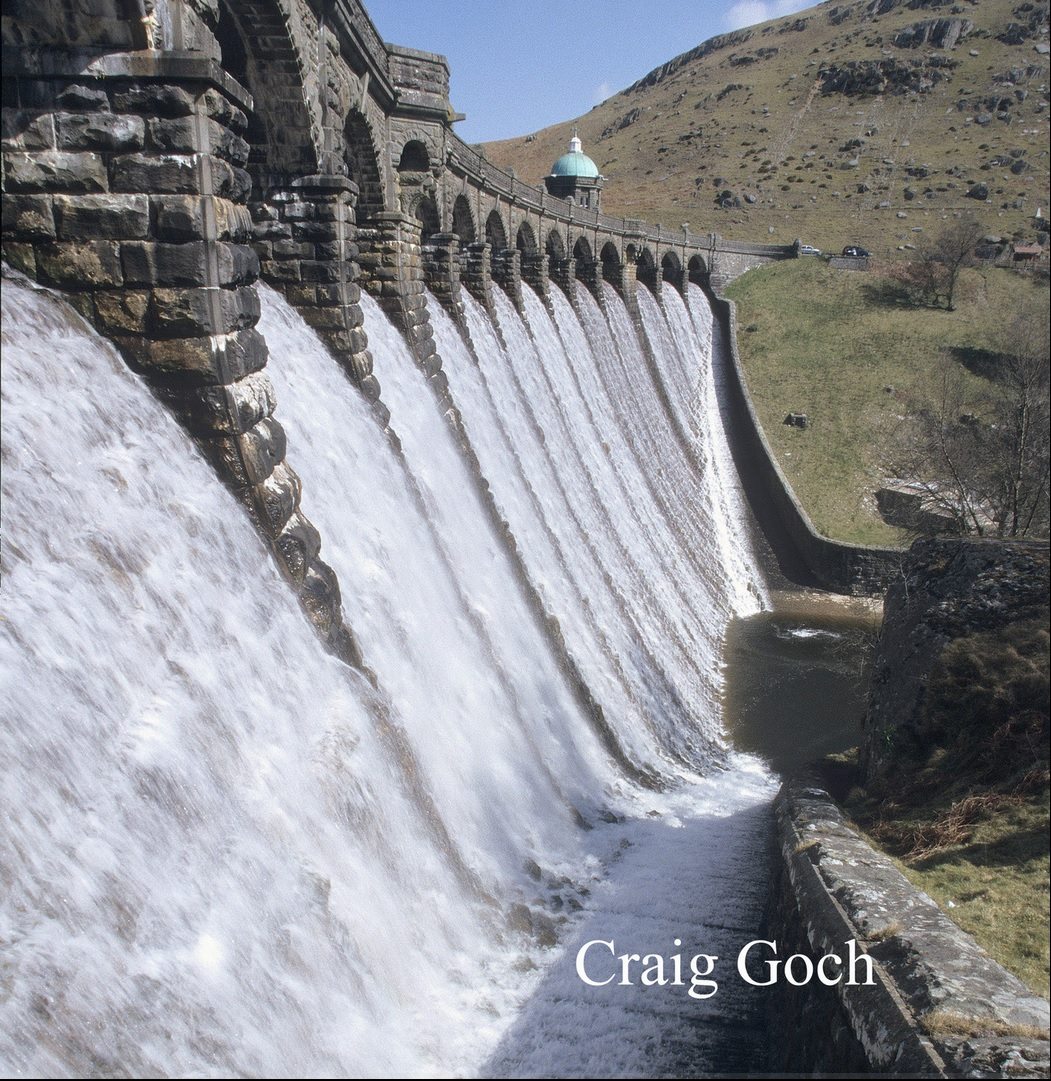
    Enough of the climbers; now for the climbs. Rhayader lies on the east side of an area of flat-topped hills, whose highest domes just pass the 2,000 ft. contour. The valleys are deeply cut and sometimes scarped, the whole forming, in geological language, a dissected peneplain. Two of the largest valleys, the Elan and the Claerwen, are filled by the reservoirs providing the water supply for Birmingham (I was working on the Claerwen Dam – the Elan Valley Dams date from about 1900).  The rock is mainly Silurian slate, often of schisty quality, interspersed with conglomerate and with some volcanic intrusions of similar rock to that found in the Snowdon district.

    The volcanic rock outcrops at Cerrig Gwynion, two miles south of Rhayader, a few hundred feet above the road, perfectly situated for summer evening visits. Here are ten or so short routes, which were mostly worked out by Lane climbing solo. They are steep and quite strenuous, providing routes very similar, though shorter, to those at Dalkey. The cordée Lynam, constitutionally averse to strenuous climbing, only succeeded in putting up one new route, and had difficulty in dealing with some of the other routes without a top rope. The volcanic rock also forms a low north-south ridge of hills east of Rhayader and at the north end of this ridge near Llandegley, there are two outcrops. The angle is generally easier than at Cerrig Gwynion, and so, though there are a few hard routes, Llandegley rocks are primarily a place for a day off, particularly as they are finely situated and command (in spite of their low altitude) excellent views all round, especially of the neighbouring Radnor Forest. The conglomerate rocks have not yielded much climbing, but there are some short routes and scrambles on the rocks at the north end of Caban Coch, the lowest dam (Craig y Foel). Unexpectedly enough, the slate provides the best climbing probably because there is so much more of it. There are many detached buttresses which will repay attention, but one cliff is pre-eminent. It is on the east side of Garreg Ddu reservoir in the Elan Valley (Craig Dolfaenog/Craig Dolfolau), and presents a face of slate of a schistose character, which gives remarkably sound holds. 

    The South Buttress of Creigiau Dolfolau, where many of the Lynam’s multi pitch climbs are located.

    Two weeks after we met him, E.H. cycled over and stayed the weekend, the first ol many visits which formed the pattern of our summer climbing.  We went to Garreg Ddu and on the north buttress of the cliff, a buttress rather distinct from the rest, we climbed a route which he had reconnoitred the day he met us. It was the first climb of more than 200 ft. in the county and we named it Triumvirate as our first joint effort. It is a good climb, though no more than Difficult, and typical of the Garreg Ddu routes. It is predominantly a slab route, reminiscent a little of Bray Head, and though it is a natural line, it is generally possible to traverse off between the pitches.

    Caban Coch dam, looking at the Gigfran Quarry at the `NE` end of Craig y Foel.

     The crag is more than 300 yards long and has a maximum height of about 450 it. It is a “rubber” cliff, for nails would quickly destroy the smaller holds, and clinkers in particular skid badly on the rather soapy surface. The climbing is generally delicate, and require good technique and intelligent use of holds. One of the great joys of the crag is its position, for it overlooks the winding, wooded reservoir and faces into the afternoon sun. It is also no more than a few minutes scramble from a motor road and the slowest of cyclists will reach it in less than an hour from Rhayader.

    Craig Gigfran’s Canopy and Zig-zag Buttresses, north of Caban Coch dam.

     As the summer passed, we visited it more and more frequently, until we were climbing there at least once, and sometimes twice, each weekend. We explored the cliff steadily and found not a few charming climbs. We were most successful on North Buttress, where our route-finding culminated in Climax, a 150 ft. Severe route up a tower on the right side of the buttress. It starts in a recess overhung by trees, and goes up a steep and holdless slab, emerging at the foot of the tower. The lower wall of the tower is climbed by a crack, which is the only break in a smooth face, and the climb finishes with a magnificently exposed (though easier) pitch at the corner of the tower.

    Craig Gigfran and Wide Gully above the Visitor Centre.

     Triptych Buttress, further to the south and lower, is another favourite spot. It is named from the three sharp ribs Adam, Eve and The Serpent, which stand out clearly on it and which each provides a route. Eve and The Serpent are pleasant Difficults, which yielded at the first attempt.  But Adam, which we had admired from our first visit, defied us until October. The rib was formed by the sharp edge of a characteristic slab, but it is a slab steeper, and at its top more holdless, than any we had met. In the end the top pitch was climbed, not on the slab, but round the corner, up a rounded and nearly vertical crack which we were on the point of labelling “V.S.” when Nora came up with great ease, so that we had quickly to demote it to “Severe”.

     There are other good climbs; Hawk’s Nest Chimney, the only route for which an outsider was partly responsible; Concerto, with a grand little tower and a finely exposed slab; Larceny, a “solid DifficuIt”; Diminuendo, which tacked on to any of the Triptych Buttress routes gives over 400 ft. of climbing; Trigonometry, with a delightful final pitch; Osiris, on the right Triptych Buttress; the two traverses, Orion’s Belt and Eve’s Girdle; and the short problems Pizzicato, Pilaster and Fandango.

     There are now sixteen routes on the cliff, ranging from 400 to 50 ft. long, and I think that most of the obvious lines (except the very hard ones) have been climbed. Slate always supports a considerable amount of vegetation and we have hardly touched the parts of the cliff that need gardening. Wholesale removal of heather ledges and of a few trees will certainly uncover some new routes, and on the clean parts of the cliff there should be a few lines to the taste of the leader of Very Severes.

    Zig-zag Buttress, location of the very first climb in the Valley in 1950.

     I have written so far of the climbing immediately around Rhayader but often we took a tent and made more distant expeditions. On our first, at the beginning of May, we got a lift to Devil’s Bridge, on the coast side of our hills, and walked on the Saturday evening to Strata Florida where there are ruins of a Cistercian Monastery whose monks once owned all the Claerwen and Elan Valleys, to Rhayader and beyond. The ruins (mainly of the 13th century) are quite impressive; the arch of the west door is still standing and one can see the massive engraved pillars of the nave and the decorated tiled floors of the side altars. The name, unexpected in Wales, is the latinised form of Ystrad Fflur. We camped for the night a few miles higher up the valley and early next morning, in driving rain, crossed the hills by the old “Monks’ Road” to the Claerwen. We reached the dam at 8.30am, just in time to meet an astonished Sunday shift as they started work. I have no space to describe our other expeditions to Cadair Idris, to Plynlimon and to the Brecon Beacons, save to say that they all demanded intense study of Bradshaw and the Catholic Directory, for Sunday trains and Sunday Mass are the one as rare as the other in this Principality.

     It was an unexpected summer; I had imagined going for weekends to Cadair Idris or to North Wales, but it has never occurred to me that we should find good rock within a few miles. The beauty of the countryside was another surprise; the hilltops are dull, but the valleys, with their trees and heather, gorse and bracken, reflected in the bright waters of the reservoirs, have always some new loveliness of light or colour. The drying shores, left as the water level ebbs through the summer, are a pleasing contrast to the wooded slopes, and oven the grey, stone-faced dams do not obtrude, though, when the lakes are full and the water is cascading whites over the spillweirs, they are a grand sight in themselves. The year taught me something important also; that even when one is working six days a week in the hills, rain, snow or shine (mostly rain), one is still glad to climb on the seventh.

     Original article appears in IMC Journal Vol.3 No.2 Winter 1952.

    Feedback from Dave Williams

    Dave Williams is co-author of the forthcoming guidebook, Central Wales: A Climbing Guide to Elenydd. He is responsible for writing the Elan Valley section of the guide and has undertaken extensive research into Joss and Nora’s huge contribution to Mid Wales climbing, corresponding with one of Joss’s daughters and soon to visit the Joss Lynam Collection in Trinity College Archives.

    Encouragingly, there are no access issues here.  The landowners, Dwr Cymru (Welsh Water), are refreshingly pro-climbing.

    He was alerted to the above article some years ago and, from the information contained within it, Dave says:

    “I’ve subsequently been able to track down the actual route descriptions for every single route climbed by the Lynams and EH Lane in the Elan Valley area between 1950-55. All the climbs have been found and a number of have been repeated – probably second ascents in most (all?) cases, 60+ years after the FAs! The ones that haven’t been climbed are ones we’ve failed on (see below), or ones which are now simply too overgrown to climb. (The passage of time and climate change have not been kind and Elan Estate also prohibits any removal of cliff vegetation on habitat conservation grounds.)

    The climbs were before their time and are a testament to the great skill and nerve of the first ascentionists. Repeating them has been an, er,  ‘experience’. The original grading’s interesting too, and as a rule of thumb:

    • ‘Difficult in rubbers‘ = VS 4b/c
    • ‘Very Difficult in rubbers‘ = HVS 5a/b (Some of these were soloed on the FA!)
    • ‘Severe in rubbers‘ = E1/E2 5b or harder? (We don’t know as we’ve backed off from all the ones we’ve tried – and we are normally okay  climbing up to E4. The difficulties are 3-fold – technical difficulty, unreliable yet often steep rock and an absence of trustworthy gear/ secure belays. A pretty heady mix!)

    The first route that the Lynams climbed with Lane – Triumvirate – is now graded VS 4b. The rather serious top pitch made an E4 leader squawk and I was quite glad it wasn’t my lead!”

    Notes

    •  Cerrig Gwynion
      http://www.ukclimbing.com/logbook/crag.php?id=19613
    • Craig y Foel
      http://www.ukclimbing.com/logbook/crag.php?id=19615
    • Craig Dolfaenog/Craig Dolfolau
      http://www.ukclimbing.com/logbook/crag.php?id=19617
    • Caban Coch/Craig Gigfran
      http://www.ukclimbing.com/logbook/crag.php?id=19614
    •  Elan Valley
      http://en.wikipedia.org/wiki/Elan_Valley_Reservoirs
      http://www.elanvalley.org.uk/


  • A Summer In Mid-Wales by J. P.O'F. Lynam

    A Summer In Mid-Wales by J. P.O'F. Lynam

    In my newly acquired role as IMC Publicity Officer, I was recently in conversation with Peter Cooper, past Colmcille Climbers Club  President and now resident in Mid-Wales, remarking on the fact that he lived within a couple of miles of where I grew up.  In reply he asked if I knew that Joss Lynam had been in the area in the 1950s, working on the Elan Valley dams, 20 miles to the east, and that he’d written about in the IMC Journal.  
    I searched the archives and found the following article.  I initially thought it would merely be an interesting historical item to feature on the blog but since original re-publishing I have been contacted by Dave Williams, a local climber who is currently researching Lynam’s climbs in the area.  They are producing a new climbing guide “Central Wales: A Climbing Guide to Elenydd“, due 2016.  I have included some of Dave’s comments below Joss’s original article.
    [Photo credits go to my father, a keen photographer and frequent visitor to the Elan Valley where, together with my mother they walk & cycle.]


    The Original Article

    When I mentioned one evening last Autumn in the Club Room that I was going to work in Radnorshire, my friends considered that I had managed poorly; they expected me, it seemed, to land a job with a three-day working week on the edge of Lough Coruisk, or at the foot of Great Gable. Soon I began to think they were right; although I was working at 1200 ft. above sea level, and there was plenty of snow, there seemed to be nothing to climb, and though Rhayader is only 100 miles from Snowdon, it takes all day to get there – via Crewe and Chester!
    However, at the beginning of May, when in spite of a jaunt to Ogwen in a friend’s car, we were feeling badly in need of some rock for climbing, we heard rumours of another mountaineer in Radnorshire. A mysterious ‘phone call to the Resident Engineer…A gossiping Sanitary Inspector….Then one Sunday afternoon as we set off on bicycles to explore a cliff I had noticed some time before, we met a cyclist, with a pair of tricouni-nailed boots slung from his handlebars: Lane – Lynam; introductions were made, talk commenced, first in the middle of the road and later, when a thunderstorm blew up, round a teapot in Dolgerddon Hall.  Lane – “E.H.” – was a Crown Forester on Radnor forest, about sixteen miles away, who for several years had been scouring the country for rock-climbs and, mostly climbing solo, had found quite a few short routes.

    Penygarreg reservoir and Craig Dolfaenog
    E. H. was to be our companion on most of our climbs in Radnor, so he deserves a few words. To an English climber I would describe him simply as a Rucksack Club man, but for the Irishman, who may not know this peculiar Mancunian breed, I must be more explicit. The Rucksack Club man has generally learnt his mountaineering in the Pennines, which are responsible for two of his characteristics. Firstly, to his unbelievable capacity for enormously long, dull walks over bog land, which, over the years, have become almost sacred, so that the mention of “Marsden-Edale” will bring an exiled Rucksacker to tears. Secondly, for the filth of his attire, for Pennine gritstone (as I know well, for I learnt to climb on it myself) is the dirtiest rock in these Islands. His third characteristic (and I do not know its cause) is rudeness. Not an abrupt, rather a loquacious rudeness, so that he is never happier than in slagging his friends, and raking up all their misdeeds of twenty years – or more, if his memory lasts.  To these group characteristics must be added E.H.’s personal quirks: a bubbling enthusiasm (liable to turn to black despair at a moment’s notice), an incurable urge to “talk climbing” (which, pent up for weeks, would burst in spate upon us when he came for the weekend) and a fortunate ability to laugh at himself – and everybody else.
    View from the west side of Garreg Ddu reservoir. Creigiau Dolfolau separated by the Lyn Clap tributary.
    Enough of the climbers; now for the climbs. Rhayader lies on the east side of an area of flat-topped hills, whose highest domes just pass the 2,000 ft. contour. The valleys are deeply cut and sometimes scarped, the whole forming, in geological language, a dissected peneplain. Two of the largest valleys, the Elan and the Claerwen, are filled by the reservoirs providing the water supply for Birmingham (I was working on the Claerwen Dam – the Elan Valley Dams date from about 1900).  The rock is mainly Silurian slate, often of schisty quality, interspersed with conglomerate and with some volcanic intrusions of similar rock to that found in the Snowdon district.
    The volcanic rock outcrops at Cerrig Gwynion, two miles south of Rhayader, a few hundred feet above the road, perfectly situated for summer evening visits. Here are ten or so short routes, which were mostly worked out by Lane climbing solo. They are steep and quite strenuous, providing routes very similar, though shorter, to those at Dalkey. The cordée Lynam, constitutionally averse to strenuous climbing, only succeeded in putting up one new route, and had difficulty in dealing with some of the other routes without a top rope. The volcanic rock also forms a low north-south ridge of hills east of Rhayader and at the north end of this ridge near Llandegley, there are two outcrops. The angle is generally easier than at Cerrig Gwynion, and so, though there are a few hard routes, Llandegley rocks are primarily a place for a day off, particularly as they are finely situated and command (in spite of their low altitude) excellent views all round, especially of the neighbouring Radnor Forest. The conglomerate rocks have not yielded much climbing, but there are some short routes and scrambles on the rocks at the north end of Caban Coch, the lowest dam (Craig y Foel). Unexpectedly enough, the slate provides the best climbing probably because there is so much more of it. There are many detached buttresses which will repay attention, but one cliff is pre-eminent. It is on the east side of Garreg Ddu reservoir in the Elan Valley (Craig Dolfaenog/Craig Dolfolau), and presents a face of slate of a schistose character, which gives remarkably sound holds. 
    The South Buttress of Creigiau Dolfolau, where many of the Lynam’s multi pitch climbs are located.
    Two weeks after we met him, E.H. cycled over and stayed the weekend, the first ol many visits which formed the pattern of our summer climbing.  We went to Garreg Ddu and on the north buttress of the cliff, a buttress rather distinct from the rest, we climbed a route which he had reconnoitred the day he met us. It was the first climb of more than 200 ft. in the county and we named it Triumvirate as our first joint effort. It is a good climb, though no more than Difficult, and typical of the Garreg Ddu routes. It is predominantly a slab route, reminiscent a little of Bray Head, and though it is a natural line, it is generally possible to traverse off between the pitches.
    Caban Coch dam, looking at the Gigfran Quarry at the `NE` end of Craig y Foel.
     The crag is more than 300 yards long and has a maximum height of about 450 it. It is a “rubber” cliff, for nails would quickly destroy the smaller holds, and clinkers in particular skid badly on the rather soapy surface. The climbing is generally delicate, and require good technique and intelligent use of holds. One of the great joys of the crag is its position, for it overlooks the winding, wooded reservoir and faces into the afternoon sun. It is also no more than a few minutes scramble from a motor road and the slowest of cyclists will reach it in less than an hour from Rhayader.
    Craig Gigfran’s Canopy and Zig-zag Buttresses, north of Caban Coch dam.
     As the summer passed, we visited it more and more frequently, until we were climbing there at least once, and sometimes twice, each weekend. We explored the cliff steadily and found not a few charming climbs. We were most successful on North Buttress, where our route-finding culminated in Climax, a 150 ft. Severe route up a tower on the right side of the buttress. It starts in a recess overhung by trees, and goes up a steep and holdless slab, emerging at the foot of the tower. The lower wall of the tower is climbed by a crack, which is the only break in a smooth face, and the climb finishes with a magnificently exposed (though easier) pitch at the corner of the tower.
    Craig Gigfran and Wide Gully above the Visitor Centre.
     Triptych Buttress, further to the south and lower, is another favourite spot. It is named from the three sharp ribs Adam, Eve and The Serpent, which stand out clearly on it and which each provides a route. Eve and The Serpent are pleasant Difficults, which yielded at the first attempt.  But Adam, which we had admired from our first visit, defied us until October. The rib was formed by the sharp edge of a characteristic slab, but it is a slab steeper, and at its top more holdless, than any we had met. In the end the top pitch was climbed, not on the slab, but round the corner, up a rounded and nearly vertical crack which we were on the point of labelling “V.S.” when Nora came up with great ease, so that we had quickly to demote it to “Severe”.
     There are other good climbs; Hawk’s Nest Chimney, the only route for which an outsider was partly responsible; Concerto, with a grand little tower and a finely exposed slab; Larceny, a “solid DifficuIt”; Diminuendo, which tacked on to any of the Triptych Buttress routes gives over 400 ft. of climbing; Trigonometry, with a delightful final pitch; Osiris, on the right Triptych Buttress; the two traverses, Orion’s Belt and Eve’s Girdle; and the short problems Pizzicato, Pilaster and Fandango.
     There are now sixteen routes on the cliff, ranging from 400 to 50 ft. long, and I think that most of the obvious lines (except the very hard ones) have been climbed. Slate always supports a considerable amount of vegetation and we have hardly touched the parts of the cliff that need gardening. Wholesale removal of heather ledges and of a few trees will certainly uncover some new routes, and on the clean parts of the cliff there should be a few lines to the taste of the leader of Very Severes.
    Zig-zag Buttress, location of the very first climb in the Valley in 1950.
     I have written so far of the climbing immediately around Rhayader but often we took a tent and made more distant expeditions. On our first, at the beginning of May, we got a lift to Devil’s Bridge, on the coast side of our hills, and walked on the Saturday evening to Strata Florida where there are ruins of a Cistercian Monastery whose monks once owned all the Claerwen and Elan Valleys, to Rhayader and beyond. The ruins (mainly of the 13th century) are quite impressive; the arch of the west door is still standing and one can see the massive engraved pillars of the nave and the decorated tiled floors of the side altars. The name, unexpected in Wales, is the latinised form of Ystrad Fflur. We camped for the night a few miles higher up the valley and early next morning, in driving rain, crossed the hills by the old “Monks’ Road” to the Claerwen. We reached the dam at 8.30am, just in time to meet an astonished Sunday shift as they started work. I have no space to describe our other expeditions to Cadair Idris, to Plynlimon and to the Brecon Beacons, save to say that they all demanded intense study of Bradshaw and the Catholic Directory, for Sunday trains and Sunday Mass are the one as rare as the other in this Principality.
     It was an unexpected summer; I had imagined going for weekends to Cadair Idris or to North Wales, but it has never occurred to me that we should find good rock within a few miles. The beauty of the countryside was another surprise; the hilltops are dull, but the valleys, with their trees and heather, gorse and bracken, reflected in the bright waters of the reservoirs, have always some new loveliness of light or colour. The drying shores, left as the water level ebbs through the summer, are a pleasing contrast to the wooded slopes, and oven the grey, stone-faced dams do not obtrude, though, when the lakes are full and the water is cascading whites over the spillweirs, they are a grand sight in themselves. The year taught me something important also; that even when one is working six days a week in the hills, rain, snow or shine (mostly rain), one is still glad to climb on the seventh.
     Original article appears in IMC Journal Vol.3 No.2 Winter 1952.

    Feedback from Dave Williams

    Dave Williams is co-author of the forthcoming guidebook, Central Wales: A Climbing Guide to Elenydd. He is responsible for writing the Elan Valley section of the guide and has undertaken extensive research into Joss and Nora’s huge contribution to Mid Wales climbing, corresponding with one of Joss’s daughters and soon to visit the Joss Lynam Collection in Trinity College Archives.
    Encouragingly, there are no access issues here.  The landowners, Dwr Cymru (Welsh Water), are refreshingly pro-climbing.
    He was alerted to the above article some years ago and, from the information contained within it, Dave says:

    “I’ve subsequently been able to track down the actual route descriptions for every single route climbed by the Lynams and EH Lane in the Elan Valley area between 1950-55. All the climbs have been found and a number of have been repeated – probably second ascents in most (all?) cases, 60+ years after the FAs! The ones that haven’t been climbed are ones we’ve failed on (see below), or ones which are now simply too overgrown to climb. (The passage of time and climate change have not been kind and Elan Estate also prohibits any removal of cliff vegetation on habitat conservation grounds.)

    The climbs were before their time and are a testament to the great skill and nerve of the first ascentionists. Repeating them has been an, er,  ‘experience’. The original grading’s interesting too, and as a rule of thumb:

    • ‘Difficult in rubbers‘ = VS 4b/c
    • ‘Very Difficult in rubbers‘ = HVS 5a/b (Some of these were soloed on the FA!)
    • ‘Severe in rubbers‘ = E1/E2 5b or harder? (We don’t know as we’ve backed off from all the ones we’ve tried – and we are normally okay  climbing up to E4. The difficulties are 3-fold – technical difficulty, unreliable yet often steep rock and an absence of trustworthy gear/ secure belays. A pretty heady mix!)

    The first route that the Lynams climbed with Lane – Triumvirate – is now graded VS 4b. The rather serious top pitch made an E4 leader squawk and I was quite glad it wasn’t my lead!”

    Notes

    •  Cerrig Gwynion
      http://www.ukclimbing.com/logbook/crag.php?id=19613
    • Craig y Foel
      http://www.ukclimbing.com/logbook/crag.php?id=19615
    • Craig Dolfaenog/Craig Dolfolau
      http://www.ukclimbing.com/logbook/crag.php?id=19617
    • Caban Coch/Craig Gigfran
      http://www.ukclimbing.com/logbook/crag.php?id=19614
    •  Elan Valley
      http://en.wikipedia.org/wiki/Elan_Valley_Reservoirs
      http://www.elanvalley.org.uk/


  • Tales from Wales

    Tales from Wales

    An early start got myself, Niall and Cearbhall on the 8.00 crossing to Holyhead for the start of the October Bank Holiday weekend trip to North Wales. I spent a short while walking around the ship to see if I could spot any of the other participants/victims but had no luck. I assumed they were on another deck. It was a fine morning with calm seas. Enjoying a coffee and a bit of chat I noticed a ship pass on the port side (thanks Cearbhall). I asked the lads what ship that was. ‘It’s probably the fast sailing to Holyhead’ says Cearbhall. ‘Why didn’t we get that?’ I asked. Niall who had booked the ferry was at a loss to explain why he had booked the slow boat. He has some form when it comes to ferry bookings so we let it lie…eventually!
    We were staying in Bethesda, so with a better than expected forecast we continued up past Llyn Ogwen and parked in under Milestone Buttress on Tryfan (still not sure how to pronounce this). We had decided to have a go at Grooved Arête. At an amenable grade, and it being already lunch time, it seemed like a sensible option.

    Llyn Ogwen
    We geared up by the car and set off up the track under Milestone Buttress in the direction of Heather Terrace. It’s a steep pull initially. I passed Cearbhall at one stage and made some comment about the unexpected fine weather. It was meant to be crap. Anyway, Cearbhall growled at me so I left him too it. Niall was ahead and he eventually got to the foot of the climb which isn’t difficult to find. Some helpful soul had scrapped a big G.A. at the bottom of the first pitch. I commented to Niall that Cearbhall was ‘blowing hard’ on the way up. He arrived and we started to gear up. It had taken us about an hour.
    Aidan on GA

    Harness and rack went on and Cearbhall flaked out a rope. I asked were the other rope was. That’s when the fun started. Niall turned to me with a look of disgust. ‘What do you mean, you didn’t bring it?’ ‘No I didn’t. No one asked me too.’ It wasn’t as pleasant as that. I was asked what kind of eejit I was to go climbing without a rope or rack. It was pointed out to me that Cearbhall was ‘blowing hard’ because he had the foresight to bring a rope. It was too late to go back and get the other rope it being already 2.30. We decided to climb on the one 50m half rope. The leader could tie-in in the middle, and the other two at each end. It would mean taking intermediate belays but at least we could all climb.

    Niall on GA
    Niall led off up first pitch. No sooner had he started than we had to let him know he was down to 5m. It was going to be like that all the way up. He made himself safe and told us to follow up. Cearbhall set off and I followed closely behind. Grooved Arête is a Welsh classic. With that, everything is extremely polished, and with all the recent rain most of the cracks and corners were like bars of soap. Cearbhall had not made it to the first belay and he was already on his ear. He didn’t get much sympathy. There was plenty of sniggering.
    Attentive Belayer

    Niall decided he’d keep leading for a while and we left him too it because we had only the one rope, and myself and Cearbhall were too busy taking selfies to send to Dave Keogh, who had to pull out of the trip because of exams. We moved up without any difficulty, being carful of the polish and wet and eventually got to the crux. Initially Niall said that one of us should do this pitch but as we got up to it he changed his mind. He wanted to do it now because he had taken a fall on it on his first year climbing. The Knight’s Move pitch is great. Easy climbing with a great feeling of exposure. He brought us over and decided to hand over. His chublets were cold. He’d a hole in his shoe and his feet were wet. He suggested I do the next pitch.
    Niall & Cearbhall on GA
    The next pitch is up a steep easy corner. All the footholds were wet so I was trying to be careful. From below I could hear the two lads laughing as they tried to get a photo of themselves and me climbing above.
    Belay Selfie
    Talk of moons, arses etc. drifted up. Fantastic belaying. I got up to next to last belay and handed gear over to Cearbhall. He finished the last couple of pitches and we topped out just shy of the top. We shared out our chocolate Santa.
    Santa on Tryfan
    I had bought one in Bethesda where they are already gearing up for Christmas. It was close to 5.00pm as we packed our gear away. I only turned my back for a second and the two lads were gone. They had made sure I was at least bringing the rope down. I followed them down a gully which would bring us back down to Heather Terrace. I randomly rubbed some chalk on bits of rock and we wondered what Ambrose would make of this. His crusade against chalk was a hot topic on the way down. I was falling behind the two lads enjoying the colours of the late autumn evening when I realised I was alone and surrounded by a large swarm of goats. In the fading light I had walked into the middle of them and I gave them a fright. I ran off to catch up with the lads but I was too late they had pushed on and were back at the car. It was fully dark by the time I made it to the car and it started to rain. I hoped we beat the IMC after-dark curfew. We retired to the pub in Bethesda for beer and buns. All agreed it had been an excellent afternoon on the hill and Grooved Arête is definitely worthy of it’s 3 star status.
    The October Bank Holiday was off to a good start.

1 2 3
Next Page

Postal Address

Irish Mountaineering Club
Glendasan
Glendalough
Co. Wicklow
A98 EY91
Ireland

Follow us on Social Media

  • Facebook
  • Instagram

IMC Website

  • Contact Us
  • Introduction
  • Hut