Skip to content
Irish Mountaineering Club IMC, Cumann Sléibhteoireachta na hÉireann
  • Facebook
  • Instagram
Join Now
Book the Hut
Members Login
  • About
    • Introduction
    • Contact Us
    • Documents
      • Constitution
      • Privacy Policy
    • Expeditions
    • Kindred Clubs, Handy Hostels
    • Library
    • People
  • Join
    • Introduction
    • New Membership
  • Blog
    • Article
    • Obituary
    • Review
    • Route Info
    • Training
    • Trip Report: International
    • Trip Report: Ireland
    • Other: Bottom of Home Page
  • Events
    • Introduction
    • Calendar
  • Hut
  • Publications
    • Introduction
    • Books
    • Newsletters
      • 2010-now
      • 2000-2009
      • 1990-1999
      • 1980-1989
      • 1970-1979
      • 1960-1969
      • 1950-1959
    • IMC Archive
    • Videos
  • Training
    • Overview
    • Introduction to Trad climbing Programme
Irish Mountaineering Club IMC, Cumann Sléibhteoireachta na hÉireann
  • Log In
  • Join the IMC
  • About
    • Introduction
    • Kindred Clubs, Handy Hostels
    • Library
  • Blog
    • Article
    • Obituary
    • Review
    • Training
    • Important Information
  • Events
    • Introduction
    • Calendar
  • Hut
  • Publications
    • Books
    • Newsletters
      • Newsletters 2010-2018
      • Newsletters 2000-2009
      • Newsletters 1990-1999
      • Newsletters 1980-1989
      • Newsletters 1970-1979
      • Newsletters 1960-1969
      • Newsletters 1950-1959
    • IMC Archive
    • Videos
  • Training
    • Overview
    • Introduction to Trad Climbing Programme 2026
Join Now
Book the Hut
Log in
  • SPA(RCI) Skills Refresh and MPA Preparation, Night hike, Food and Talk

    First event for the 2020 Calendar
    SPA(RCI) Skills Refresh and MPA Preparation, Night hike, Food and Talk?
    Skills Sat Feb 29, 2020 9.30am – 5pm IMC Hut Training wall if wet and cold Acorn Buttress if dry
    Walk: The usual Spink traverse of Glendo, starting and leaving from Hut (headtorch required)
    Evening Food: Goulash, made to a recipe “similar” to what a Hungarian would call authentic
    Talk: Jon’s early years of climbing 1989-1995), introducing you to crags for the up and coming Yorkshire climbing meet. (AKA best meet ever)

    Greetings:
    Over the Last few years we ran a skills refresher, usually in October, in Dalkey, never compulsory. A just if you want kind of meet.
    This year I have a special impetus to review and refresh as I am being dragged into March with a MPA assessment with another IMC member (he is shy)
    I have booked the IMC hut with the intention to:-
    Cover a morning session for this, reviewing, demonstrating and practicing what I would call core competencies that form of a typical day out on the crag. Those that are documented in the IMC training syllabus .
    (We can also use the hut screen to show best practice videos)
    Building a belay for an abseil (3 points), abseil safely down to route using a prusik
    Interpreting the guidebook description of a given (easy)route. Lead the route placing leader protection. Build an intermediate belay 2 or 3 anchors (be able to explain the quality of the anchors), and belay partner up to the belay safely.
    It will be similar to the learn-to-lead sessions….
    Second part of the day we will cover the rescue skills covered at the formal SPA and MPA Level. These are not just for those that have been through formal SPA, all are welcome. Will supply tea/coffee and sausage sandwiches during the day
    —–
    Second Climbs Past His Runner (single rope)
    Equip: 2 HMS
    Lock of Belay, take rope closest to the Anchor, feed loop down with a HMS crab, have 2nd attach to belay loop, belay back down with 2nd HMS on italian Hitch, until tight again on lead rope.
    Assisted Hoist
    Equip: Prusik + HMS
    Lock of Belay, Fix Prusik to live rope (infront of belay device), take dead rope closest to belay, feed loop down with a HMS crab, have 2nd attach to belay loop. Unlock belay and take up slack; Victim pulls on rope coming from belayer,leader pulls on rope coming from victim
    Unassisted Hoist
    Equip: 2 Prusiks + HMS
    Lock of Belay, Fix 1st Prusik live rope before belay, Fix 2nd Prusik live rope further down with attached crab, dead rope attach to 2nd Prusik, pull and keep moving 2nd Prusik down the rope (as far possible)
    Escaping the System (from belay built out of reach rope (no powerpoint))
    Equip: Prusik , 2 Slings , 4 HMS
    Lock of Belay, fix Prusik to live rope to anchors with sling (Klemheist rather than French) using 2 HMS, sling has an overhand for potential tieoff,powerpoint; release belay to weight prusik; back up prusik withItalianHitch-tied off(releasable knot)or fig8 if going to ab down on tail); personal saftey – girth hitch 2nd sling into belay loop into anchors; untie from system;
    Abseil Past a Knot
    Equip: Short Sling , 2 Prusiks
    Setup sling girth hitched to belay loop attached to Prusik in reach (half or shortened sling) on live rope; lower by releasing top prusik until 60cm before knot,let pusik take ; tie backup knot 2meters (beyond knot) ; release belay device and attach just after/below knot with prusik on leg loop (3rd hand); release top prusik to belay device and 3rd hand
    Abseil Y-hang pickup
    Equip: Y-Hang-rig is a standard sling overhand near middle , leaving a small loop and belay device connect into , Crab needed for victim
    Lowering Past a Knot
    See https://people.bath.ac.uk/dac33/high/13SelfRescueSenarios2.pdf
    Equip: ShortSling attached to belay, Prisik attached to deadrope, 2 HMS for direct lower off
    If interested in attending , let me know or join the WhatsApp group for the meet

    https://chat.whatsapp.com/FBomyZQIp5rKVaj3FttKC7
  • Moonlight Challenges

    Moonlight Challenges

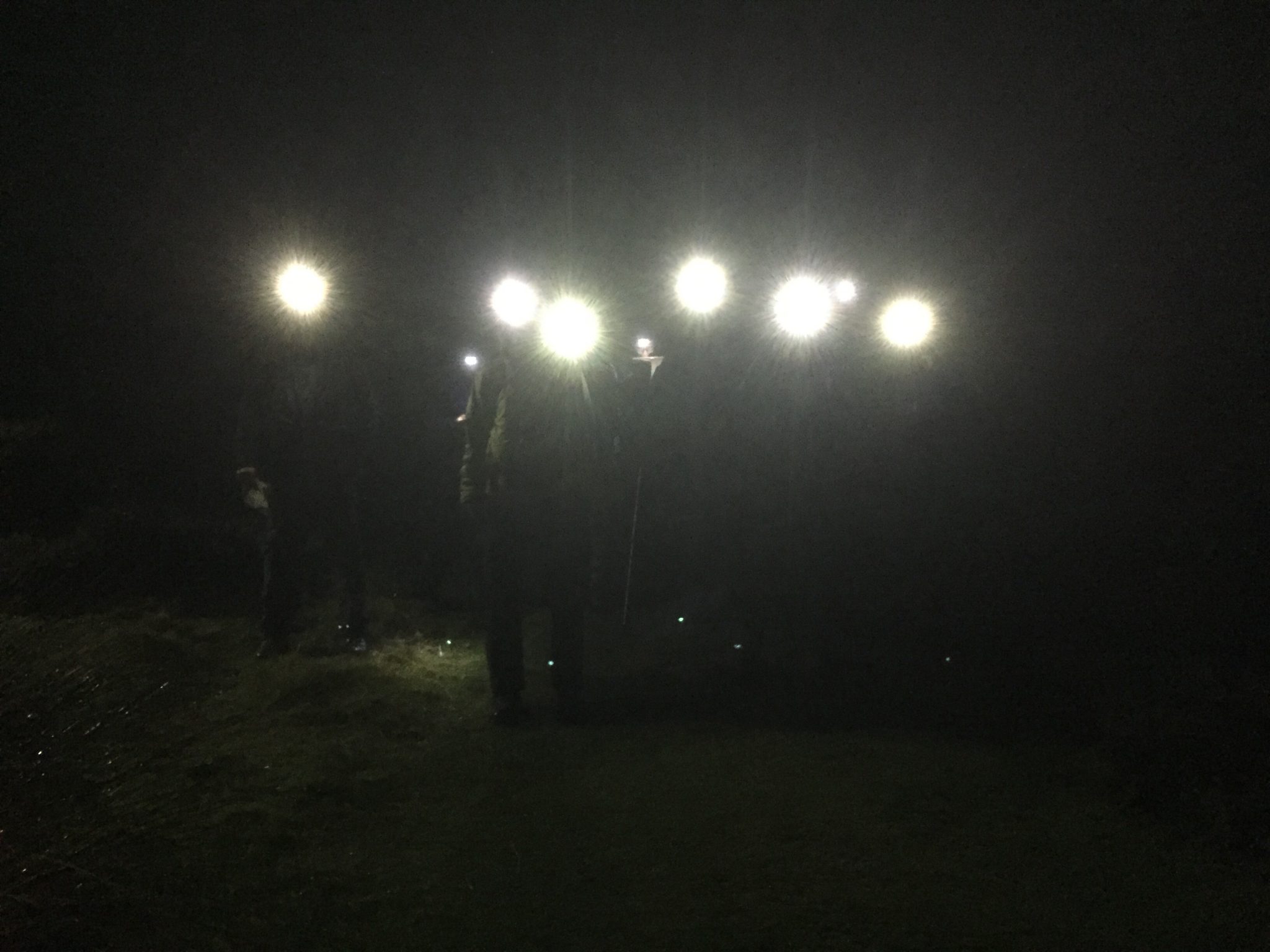
    Recent interest in the organised Moonlight Challenge and all this talk about a super moon reminded me of a time when we used to hold night hikes once a month from November to February, on the Friday night nearest to the full moon.

    These were all night affairs and on each of these trips we would have a nominal leader, plus half-a-dozen rival candidates for the post, which often led to some good humoured banter.  Sometimes we had moonlight, sometimes we had cloud and rain and, sometimes, we had snow.

    The shortest of these walks was the Glenealo Horseshoe, starting from the hut.  We tackled Lug from several different points.  Starting from Glenmalure we climbed Lug via Art’s Lough and a scramble up Bendoo, returning via Cannow and Table Track.  From Aughvannagh we approached via the Ow Valley and the main gully in the South Prison, continuing on via the Three Lakes and Camaderry, and down to Laragh in time to catch the St. Kevin’s early morning bus back to town.

    If the weather was wintry enough we would head up from Fenton’s pub at Seskin, bringing the tents with us for our winter camp on the summit.  From Knockree we crossed Maulin and Djouce, down to Lough Dan, on up to the Military Road and up and over Tonelagee and down for the bus.  From Blessington we went via Sorrel Hill, Black Hill and Billy Byrne’s Gap to Mullaghcleevaun and on to Tonelagee and Laragh.

    On one of these excursions we had deep snow drifts and dense mist all the way from Billy Byrne’s Gap, making for tough going and difficult navigation, but Joan Flanagan, our leader on the night, coped admirably.  We had our reward as we descended towards Glendalough.  The skies cleared just before dawn and, as the sun peeped up over the horizon, it painted the snowy summit of Tonelagee a delicate, blushing pink, which ripened to a deep red, then orange and, finally a cheerful yellow.

    The most testing of these night hikes was the Lug Walk, which at one time was considered to be a must prior to any Alpine trip.  On one of our Lug Walks, with Des Doyle as leader, we had starry skies, a full moon and a sharp frost.  Visibility was excellent, there was no call for map or compass and we skipped along over frost-hardened ground.  Well, some of us did.  Sean Barrett was breaking in a new pair of boots (plastic Koflachs, if I remember rightly) and by the time we got to Mullaghcleevaun, his feet were in rag order.  But he finished with the rest of us.

    There was a time when our club fostered interest and competence in walking by organising fortnightly Sunday walks during the winter months, details of the routes being published in the monthly newsletter, or revealed on the previous Thursday night, so that those who wished could plot the bearings beforehand and put them to the test on the day.  These walks started from a wide variety of locations in Wicklow and we also made day trips to the Cooleys, Mournes, Galtees and Comeraghs, areas which can be reached much more quickly and easier now, with the proliferation of motorways.  The walks took place regardless of weather conditions, on the basis that foul weather provided the best test of navigational skills.  The result of all of this was that the club always had a core group of experienced walkers, with a wide knowledge of our mountain ranges which they were always happy to pass on to newer members.

    Learn by Doing was the tried and trusted concept back then and it worked admirably well.  Nowadays the emphasis is on doing courses, but it never ceases to surprise me that anyone, least of all the members of a mountaineering club, should feel it necessary to take formal instruction in something as basic as hill-walking.  The thing is, for donkey’s years Dubliners, as children and as adults, have enjoyed walking in the Dublin/Wicklow mountains, without fuss or palaver.  When An Oige was in its heyday, back in the fifties and sixties, their Wicklow hostels would be packed to capacity every Saturday night as young people explored the nearby mountains.  As chisellers in Harold’s Cross, gangs of us would regularly throw a couple of hard-boiled egg sambos into our schoolbags and head off for a day in the hills and no-one would look up or down at us.  It was as common and everyday as using your jumpers for goalposts when playing street football.  In those days the schoolbags would have been the only bit of kit we took with us but, nowadays, we are urged us to tog ourselves out in expensive gear and equip ourselves with all kinds of gadgets before setting out for the hills.  It wasn’t always thus.

    In his book, The Neighbourhood of Dublin, published back in 1912, Weston Joyce extolled the virtues of walking the Six Hills (the area between Stone Cross and Kippure) at a time when Dublin hardly extended beyond the canals and Glenasmole was so remote from the city that the Irish language had survived there until the nineteenth century.  And the gear Joyce recommended for these outings?  A pair of stout boots and a walking stick.  At that time I’m sure some would have regarded the use of a walking stick as smacking of ostentation.

    J.B. Malone, the doyen of Dublin hill-walkers, in his book, The Open Road, published in 1950, was frugal in his choice of gear, too. He recommended what was known as The Russian Roll.  This was a raincoat, rolled width-ways and worn like a bandoleer, draped over one shoulder and fastened beneath the other with the coat belt, with the lunch stowed in one of the pockets.  Many of us, in those frugal times, would have regarded owning a coat with a belt as being a blatant example of conspicuous consumption.

    Bill Murray, in his book, Undiscovered Scotland, recommended going out, alone, at night, in the depths of winter and trekking the snow-clad summits by moonlight, advice that would probably be frowned upon nowadays.  It is increasingly rare for us to be blessed with decent snow cover on our hills but, if the opportunity arises, you should try it.  The silence, the serenity and the soft, subdued light reflecting off the glittering snow slopes all adds up to a magical experience.

    Our mountains are small by international standards, but they can provide much enjoyment and, sometimes, challenges, too and learning to cope with these challenges may serve well elsewhere, on more distant hills.  So, go on, spread your wings, get your boots wet and test yourself.  After all, we are members of a mountaineering club.  Shouldn’t we be doing what it says on the tin.

  • Luggala, Revised Topo, Selected Climbs, Sept 2014

    Hi all,
    I have revised some of the topos for Luggala.
    I have asked people more familiar with the crag than I am, compared notes and examined the topos in the Wicklow Guidebook and also the photos on line on the IMC site.
    The IMC site seems to have more current lines.
    I have added some photos and info to help people unfamiliar with the crag to get about. Not all routes have been updated, just a selection, that might be useful for the meet on Saturday 20 September.
    I have also added belay points.
    If anyone see anything that is inaccurate please let me know.
    Also, if you are climbing at the crag try and take photos of the routes and belay positions, putting them in context of the rest of the crag. I can add the photos to the topos if they are helpful.

    For ‘Low Res’ web version please see below.

    Let me know if you have any problems.

    Regards

    Ken

    kdo@eircom.net

    086 8340932

    Luggala Main Face
    Luggala Main Face
    Luggala Main Face, South Buttress right
    Luggala Main Face, South Buttress right
    Luggala, South Buttress left
    Luggala Main Face, South Buttress right and left
    Luggala Topo South Buttress Right
    Luggala Topo South Buttress Right


  • Prelude Nightmare

    PN is a special climb. When I first started climbing, my second day out on a two day course was a “taste of multipitch” climbing. With a lot of effort I made it to Nightmare Ledge. What a name. I spent the next twenty minutes/ half an hour trying to get off NL but I’d blown a gasket and the instructor abbed down to me and lowered me off on an Italian hitch. I went home in a right strop. Moving forward a few years, I decided at the start of this Summer that PN was going to be my short term goal. I was going to lead it before the weather changed. Having had a good run of things over the past few weeks in the quarry I decided last Saturday was going to be the day.
    Myself and Niall arrived at the foot of the crag on a perfect Saturday morning. Unusually quiet, I geared up at the bottom of climb. I’ve been up it once or twice since as a second (do you pay attention when seconding?), but this morning after traversing the ramp I realised how poorly protected the first 5/6 metres are. I stalled at the step-up but got it together quickly and moved through to get my first bit of gear in. It felt good. I relaxed.
    In a short time I was up and across to the in-situ peg where the real fun started. I clipped the peg, backed it up and worked my way out onto the ledge and stalled. I had made up my mind that the next move involved a side pull or pocket to my left. I began to search. I found nothing. I persisted. Still nothing. I could hear Niall below shouting up “encouragement”. My mouth had gone dry. I had decided I was going to come off but I should at least try some upward movement before I did. I’d been holding on for that long my hands were going. I eventually heard Niall. He mentioned a pocket above. I could just about reach it. I managed to pull through the difficulty and was able to shake out on the ledge above. I was trashed. I got my head together and with Niall reminding me from below that he had work on Monday, I made it up to the belay and got set up. Niall followed up quickly and climbed thru the second pitch.
    While belaying the doubts crept in. The first pitch is a grade easier in guide book than the final pitch. I knew I could get Niall to finish out. An easy option, but I knew I may not get back there again this year. Conditions were perfect. I need not have worried. Niall had set up the belay in such a way as I had no choice. “Up you go” he said and started handing me the gear immediately. As a technique lay-backing defeats me. I never seem to be able to move my limbs correctly. I hate seconding Scavenger or Blood-cracks in the quarry. Anyway with a solid belay and a solid first piece of gear I was up and over before I knew it. The short step across the slab is fantastic and with a solid nut in the quartz crack I was able to relax. The position is fantastic. I milked the crack for ever hold. It’s amazing. No stress. Holds and gear on demand. Too soon I was on top. A dynamite pitch. I set up a belay and brought Niall up. Elated. As Niall came into view a head popped over the edge. He rambled up past Niall and stepped over the top. He’d just soloed up. It put everything in perspective for me.
    We abbed back down Expectancy and Niall led Cracks in the Garden of Eden where my short-lived lay-backing skill deserted me in double quick time. Another super route. It was a great day out in perfect weather in a perfect location. Long may this Indian Summer continue.

    Aidan

    PS. I wrote this to try and stop Ambrose monopolising the forum.

  • St. Kevin’s Traverse

    St. Kevin’s Traverse

    “In Glendalough there lived and old saint, renowned for his learning and piety.
    His manners were curious and quaint and he looked upon girls with disparity.”

    17 souls gathered in the Glendalough Upper Car Park on Sunday February 15’th for a pilgrimage in the footsteps of one of the earliest locals, the infamous misogynist St Kevin. Led by our own Kevin (Coakley) who indeed must have the patience of a saint, he shepherded his flock on a circuit of the Upper Lake. As we left the tourist trail we noticed a lakeside bench well submerged in lakewater, perhaps a sign of what was ahead that we…maybe should have paid more heed to it.

    1601383_10152259171567718_1085310368_n

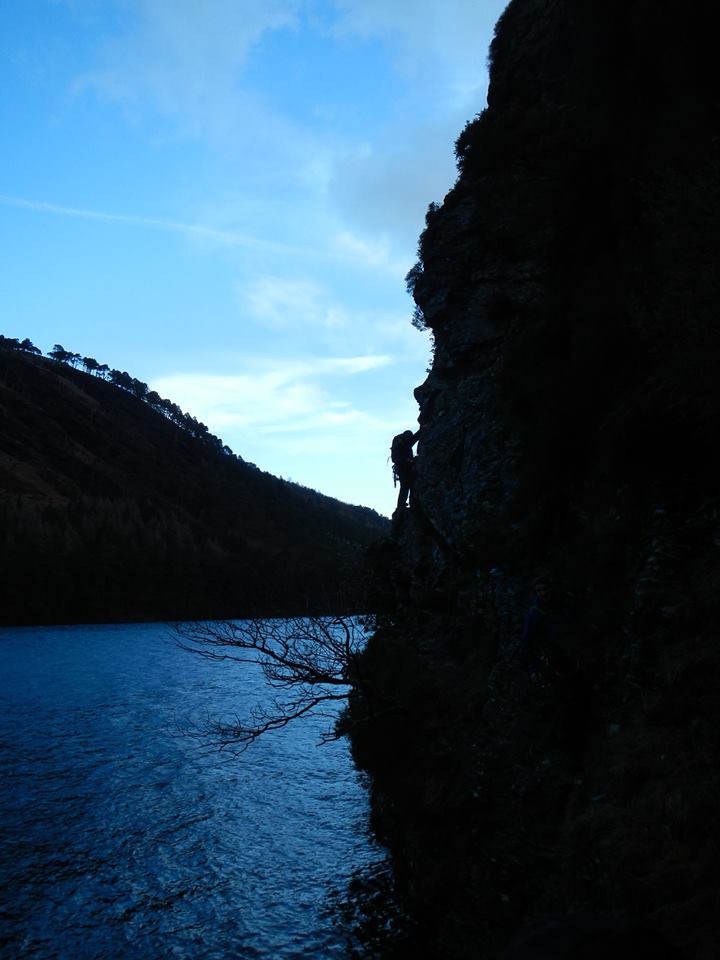
    Our trail continued under the Spinc, conditions being rather soft underfoot. The first obstacle is traditionally negotiated ‘Tarzan’ style with a swing from the trees but on the day an abseil was the chosen method for most.

    Tarzan

    We then came to Kevin’s Bed itself, a section of rock with many old pegs insitu. A rope handrail was put in place and one by one the lost sheep crossed, each stopping to peer into St Kevin’s Bed, a small cave in the rock face. The cave is man-made and probably pre-dates St Kevin (c 500-600CE)

    lake

    traverse

    This refuge was also apparently used by others such as St. Laurence O’Toole and Michael Dwyer in their time. As we continued on another rock traverse was roped and that brought us to what should have been a walk along the shore except that for us it was a delicate rock and turf traverse, a sort of shallow water solo, the path below being under half a metre of water. Indeed some of our party just stepped into the cleansing waters of the lake hoping to wash away their sins if not the muck on their boots. We then reached the ruins of an old church which must be one of the most inaccessible historical sites in Ireland.

    church

    Continuing on what we now thought would be easy ground we came to another impasse as our path again disappeared in to the lake waters. After some debate in the now fading light, we decided to take the high road. Our advance party climbed a greasy chimney to reach a tree that could be used as an abseil anchor. Kevin then descended into the murky vegetated gloom and after some time we were relieved to hear a shout that he was now on safe ground. One by one the pilgrims then followed on, and then we could finally put away our ropes and gear.

    It was a beautiful mild spring evening and although sun had long ago set, a full moon now rose over the Spinc to light our way home. Crossing the river was our final hurdle but Niall, Tina & Barry went ahead and found it was easily forded at the Miner’s village. With the moonlight shimmering on the lake, a short walk soon had us back at the car-park, just a little later than planned but all in good spirits.

    moonlight

    We retired to the hut to regroup where we found Christy had a roaring fire in place to welcome us. The finest selection of confectionery and cakes was then produced for what was a grand birthday feast (Vanessa’s) for which we certainly now had an appetite to do it justice. Serenaded by Kris & Colm the party then continued long into the night.

    cake

1 2 3 … 11
Next Page

Postal Address

Irish Mountaineering Club
Glendasan
Glendalough
Co. Wicklow
A98 EY91
Ireland

Follow us on Social Media

  • Facebook
  • Instagram

IMC Website

  • Contact Us
  • Introduction
  • Hut